
To really build your intuition, the first job is learning to tell its quiet, subtle signal apart from the much louder voices of fear or wishful thinking. It’s less about waiting for a lightning bolt of insight and more like tuning an old radio to find a clear station amidst the static. It’s a skill, and like any skill, it gets stronger with consistent, mindful practice.
What Is Intuition and How Does It Work

Before you can start strengthening your intuition, it helps to know what it actually is. Forget the idea of it being some mystical, unknowable power. In reality, intuition is a deeply practical cognitive function. It’s your brain’s incredible ability to spot patterns and connect the dots using a lifetime of stored experiences, memories, and sensory information.
This all happens so fast that it completely bypasses your conscious, analytical mind. That’s why a “gut feeling” can feel so immediate and certain. Your brain is a powerful processing machine, always scanning your environment for familiar cues and matching them against things that have happened before. When it finds a strong match, it sends up a flare—a nudge, a feeling, a sudden flash of knowing—and we call that intuition. It’s not about fortune-telling; it’s about making incredibly well-informed judgments in the now.
Tuning Into the Right Frequency
The single biggest challenge in learning to trust your intuition is separating its signal from all the other mental noise. Your inner world has a few different “voices” vying for your attention, and learning to tell them apart is the most important first step.
Here are the key players you need to get familiar with:
- True Intuition: This signal is almost always calm, neutral, and emotionally quiet. It delivers information without a dramatic story attached—just a simple knowing, a clear “yes,” or a firm “no.” It feels grounded and matter-of-fact.
- Fear and Anxiety: These voices are loud, urgent, and dripping with emotion. They spin “what-if” scenarios and worst-case outcomes, usually rooted in past hurts or worries about the future. Fear feels constricting; it makes your body physically tighten up.
- Wishful Thinking (Ego): This voice is fueled by what you want to be true. It’s attached to a specific outcome. It can feel exciting or hopeful, but there’s often a current of neediness or desperation underneath. It’s the voice that will happily help you rationalize away any red flags.
The heart of this practice is learning to pause and ask yourself, “What is the quality of this feeling?” Is it calm and clear, or is it loud and emotionally messy? That one simple question is your most powerful filter.
To help you get better at this, here’s a quick guide to telling these inner signals apart.
Distinguishing Intuition from Other Inner Voices
| Signal Type | Feeling & Quality | Message Focus | Action It Inspires |
|---|---|---|---|
| Intuition | Calm, quiet, neutral, detached. Feels like a simple “knowing.” | Objective information, observation, a clear “yes/no.” | Pausing, observing, taking aligned and thoughtful action. |
| Fear/Anxiety | Loud, urgent, chaotic, emotional. Physically constricting. | Worst-case scenarios, “what if,” and potential threats. | Avoidance, paralysis, or reactive, panicked decisions. |
| Ego/Wishful Thinking | Hopeful but needy, desperate, or pleading. Rationalizes. | What you want to happen, ignores inconvenient facts. | Impulsive action, ignoring red flags, seeking validation. |
Learning to spot these differences in the moment is a game-changer. It helps you stop getting swept away by fear or desire and instead listen for that quieter, more reliable guidance.
Your Brain Is Built for This
Here’s the good news: this ability to sense patterns isn’t something you have to build from scratch. Your brain is already wired for it. Our brains are essentially natural statistical machines. From the time we’re infants, we learn by observing how often things happen and what the results are.
This innate capacity for what some call “intuitive statistics” is the bedrock of a reliable gut feeling. To sharpen this skill as an adult, you just need to consciously start paying attention to the feedback loops in your own life. You can learn more about this incredible cognitive function by exploring some of the research into intuitive statistics.
Lay the Groundwork: Getting Your Mind Ready for Intuition

Before you can even begin to hear your intuition, you’ve got to turn down the volume on everything else. Our analytical minds are loud. They’re constantly running—making to-do lists, solving problems, and demanding solid proof for everything. Intuitive hits, on the other hand, are quiet. They’re more like a gentle nudge or a soft whisper than a blaring alarm.
In a mind crowded with constant chatter, those subtle signals just don’t stand a chance.
Think of it like trying to see the bottom of a pond. If the water is choppy and stirred up with the winds of stress and overthinking, everything is murky. You can’t see a thing. The first step is to let the water become still. Only then can you gain any clarity.
This doesn’t mean you need to lock yourself away for a two-hour meditation session. It’s about intentionally creating small pockets of stillness in your day. Just a few moments can make a world of difference.
First, Quiet the Analytical Brain
Your logical brain is a brilliant and necessary tool, but when it comes to intuition, it can be a bit of a control freak. It wants to question, analyze, and categorize every thought that doesn’t follow a straight line. To really tune into your intuition, you need to gently ask that part of your brain to take a back seat for a little while.
One of the simplest and most powerful ways to do this is with your breath.
When you consciously slow your breathing, you’re sending a physical signal to your nervous system that it’s safe to relax. You shift out of “fight or flight” and into a calmer, more receptive state. This naturally quiets a lot of that internal noise.
Here’s a simple reset I use all the time:
- Breathe in slowly for a count of four.
- Gently hold that breath for a count of four.
- Breathe out completely for a count of four.
- Hold the breath out for another count of four.
- Repeat the cycle for a minute or two.
This technique, often called Box Breathing, physically interrupts the hamster wheel of anxious thoughts. It creates a small, quiet space—and it’s in that silence that intuitive signals can finally make themselves heard. This is a foundational practice you’ll come back to again and again.
Adopt a “Beginner’s Mind”
One of the biggest obstacles to intuition is thinking we already have everything figured out. That need to be the expert, to be right, makes us unconsciously filter out anything that doesn’t fit into our existing beliefs. To break this habit, we can borrow a concept from Zen Buddhism called Shoshin, or “beginner’s mind.”
A beginner’s mind is all about approaching something with openness and curiosity, as if for the first time. It means putting your expertise on the shelf for a moment and just being willing to see things in a new light.
When you approach a situation with this attitude, you’re not rushing to judge. You stop trying to immediately label things as right or wrong, good or bad. You just observe. This open, receptive state is where those unexpected “aha!” moments happen.
Think about pulling a tarot card. The typical reaction is to grab the guidebook and look up the “correct” meaning. With a beginner’s mind, you’d instead just sit with the card. What jumps out at you in the image? What feelings, memories, or words pop into your head? This approach prioritizes your unique, intuitive response over a pre-written answer.
Let Go of the Need for Certainty
Our world loves certainty. We’re taught to value concrete facts and provable data. But intuition rarely speaks in absolutes. It’s more comfortable with shades of gray, offering possibilities, feelings, and potential paths rather than a single, verifiable truth.
If you demand that every gut feeling be 100% accurate right out of the gate, you’ll choke the life out of your intuitive practice before it even starts.
Instead, try to cultivate a spirit of playful curiosity. Treat your intuitive hits less like final verdicts and more like interesting hypotheses to be explored.
- Instead of asking: “Is this feeling right or wrong?”
- Try asking: “Okay, that’s interesting. What might this feeling be trying to show me?”
This small shift in language changes everything. It turns intuition from a high-pressure performance into a gentle, ongoing conversation with yourself. By creating this calm, curious, and open inner space, you’re not just waiting for intuition to show up—you’re actively building the perfect environment for it to flourish.
Weaving Intuition Into Your Daily Life
Once you’ve set the stage mentally, the real work—or rather, the real play—begins. Building intuition isn’t about waiting for a lightning bolt of insight. It’s about the small, consistent things you do every single day to train yourself to listen.
Think of it like building a muscle. You don’t get strong from one massive workout; you get strong by showing up consistently. The goal here is to create little pockets in your day where your intuition can speak up, and you’re actually there to hear it. You can start with just five or ten minutes. Weave these practices into your morning coffee routine, your walk to the train, or the quiet moments before you drift off to sleep. Consistency will always beat intensity.
Start With Your Body
Long before your conscious mind has a chance to analyze a situation, your body already knows the score. It’s your primary antenna for intuitive information. That sudden knot in your stomach when something feels off? That’s intuition. That wave of warmth and expansion when an idea just clicks? That’s intuition, too. A body scan is a simple mindfulness trick to get you back in tune with this built-in guidance system.
Here’s how to do it:
- Find a quiet spot where you won’t be interrupted for a few minutes. Sit or lie down, close your eyes, and take a couple of deep, grounding breaths.
- Bring your focus all the way down to the tips of your toes. Just notice what’s there without trying to change it. Is there warmth? Tingling? Numbness? No judgment, just observation.
- Slowly sweep your attention upward through your body—feet, ankles, calves, knees, all the way to the top of your head. Pause at each part and just listen.
You’re not trying to fix anything, just get acquainted with your body’s language. Doing this regularly makes you incredibly sensitive to the subtle physical cues that scream “pay attention!”
The body never lies. Learning its language—the tightness in your chest that signals caution, the warmth that says “yes”—gives you a reliable, real-time compass for navigating decisions.
Keep an Intuition Journal
Your intuitive journal is a personal logbook for tracking hunches, odd synchronicities, and weird dreams. This isn’t a “dear diary” of your day; it’s a dedicated space to capture those fleeting whispers you might otherwise ignore. Writing them down proves you’re taking them seriously and helps you spot patterns over time, which is a huge confidence booster.
You don’t have to write a novel every day. The trick is to jot things down before your logical brain has a chance to swoop in and explain them away.
A few powerful ways to use your journal:
- Automatic Writing: This is a classic. Set a timer for five minutes, ask a question like, “What do I need to know about X right now?” and just write. Don’t stop, don’t edit, don’t censor. Let the words flow, even if they seem like nonsense at first.
- Dream Log: Keep your journal right by your bed. The very first thing you do when you wake up—before you even check your phone—is write down any images, feelings, or story fragments from your dreams.
- The Bedtime Question: As you’re getting ready for sleep, write down one single question you’re wrestling with. In the morning, grab your journal and immediately write down the first thoughts that pop into your head. Your subconscious does some heavy lifting while you sleep.
Take a Sensory Walk
So much of modern life is lived inside our own heads. We’re constantly thinking, planning, and worrying, completely disconnected from the world around us. A sensory walk is your antidote. It’s a simple exercise to pull you out of the mental chatter and drop you right into the present moment, which is where intuition lives. Sharpening your powers of observation is fundamental to building intuition.
Go outside for 10-15 minutes with just one mission: to observe without labeling. Instead of seeing a “tree,” notice the specific shade of green on a single leaf. Instead of hearing a “bird,” tune into the specific pitch and rhythm of its call. See the texture of the bark, the hum of a distant engine.
This practice quiets the analytical part of your brain that’s always trying to categorize everything. It allows you to simply receive information. You’ll be amazed at what you start to notice. By training your awareness on the world outside, you paradoxically become far more attuned to the world within.
Ultimately, nothing builds intuition faster than engaging with real-world feedback loops. Studying historical data, like the shocking drop in fertility rates in South Korea, can give you an intuitive feel for how quickly societies can change. The key is to connect that data to your own experiences by making small predictions, reviewing your decisions, and seeing how they play out. You can learn more about how historical data shapes our understanding by exploring these insights on economic and social trends.
Use Tarot Cards as an Intuition Training Tool
Think of a tarot deck less like a fortune-telling device and more like a gym for your intuition. Those 78 cards are packed with rich, archetypal imagery that creates the perfect playground for practicing intuitive hits. It’s how we move this work from abstract theory into something tangible you can actually feel and get feedback on.
The point isn’t to predict the future. It’s about learning the language of symbols, trusting that first gut reaction, and building confidence in the quiet pings you get before your logical brain jumps in to second-guess everything. When you reframe tarot as a series of practical drills, you create a consistent, low-stakes way to strengthen that intuitive muscle.
Start with a Simple Daily Pull
The single most effective way to start is with a one-card daily pull. This little ritual takes maybe five minutes but pays off big time. It trains you to tune into the energy of your day and see how it reflects back in the card’s symbolism.
Shuffle your deck and ask something simple like, “What’s the main energy for today?” or “Where should my focus be?” Pull a single card. Now, before you even think about grabbing the guidebook, just sit with the image for a moment.
What do you notice first? Is it a color? The look on a figure’s face? Some tiny detail in the background? Don’t filter it. That first flash is usually your intuition talking, pure and simple. Only after you’ve explored your own gut feelings should you look up the traditional meaning to see how it resonates.
Your personal connection to a card’s imagery is just as valid as any definition written in a book. The point of this exercise is to build trust in your own internal dictionary of symbols.
Go Deeper with Symbolism Dives
Once you’re in the groove with daily pulls, try a more meditative practice I call a symbolism deep dive. This is all about uncovering the personal meaning hidden in a single card, going way beyond its textbook definition. It’s a fantastic way to see how these big, universal archetypes are actually playing out in your own life.
Here’s how to do it:
- Pick a Card: Choose one that you’re either really drawn to or completely baffled by. Strong reactions are good—they mean there’s energy there to explore.
- Set a Timer: Give yourself a solid 10-15 minutes of quiet, uninterrupted time.
- Just Look: For the first few minutes, simply gaze at the card. Let your eyes wander over it without any pressure to analyze or figure anything out.
- Ask Questions: Start to gently probe the scene. What’s the mood here? What might have happened right before this moment? What is the figure thinking or feeling?
- Journal Everything: Write it all down. Every thought, feeling, or random memory that pops into your head. That strange connection you made between the sun in the card and a warm memory from your childhood? That’s an intuitive hit.
These kinds of exercises are foundational. They help you get out of your head and into a more receptive state, which is essential for tarot and all other intuitive work.
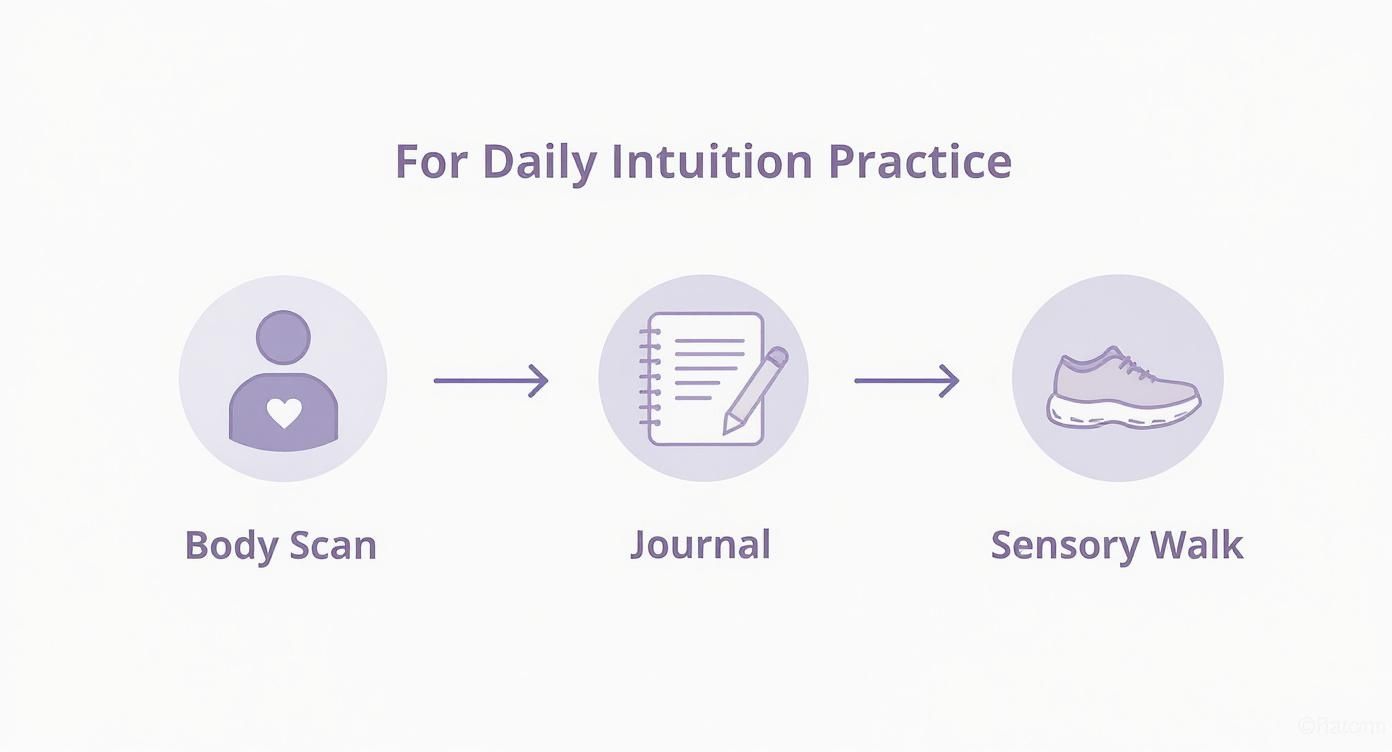
As this flow shows, checking in with your body, journaling your insights, and engaging your senses are the core practices that make more structured work with tools like tarot possible.
Build Narratives with the Intuitive Story Drill
Okay, this is where you really start to see your skills in action. The intuitive story drill forces you to build connections between what seem like totally random concepts—a core function of intuition. It’s not about getting the “right” answer. It’s about flexing your ability to create a coherent story from symbolic breadcrumbs.
Pull three cards at random and lay them out. Your job is to weave them into a short story, focusing only on the visual cues.
- Card 1: The beginning. It sets the scene or introduces the main character.
- Card 2: The middle. This is the central challenge, the conflict, or the turning point.
- Card 3: The end. It shows the resolution or the final lesson learned.
Let’s say you pull The Tower, the Four of Cups, and The Star. Your story might be about a sudden, shocking event (The Tower) that leads to a period of apathy and feeling stuck (Four of Cups), but ultimately results in a renewed sense of hope and healing (The Star).
This simple drill trains your brain to find patterns and make meaning. The more you do it, the faster and more natural these connections become, not just with cards, but in every area of your life. For a deeper look at the tarot archetypes, platforms like Tarot Studies have some great resources.
To help you put this all together, here’s a simple, progressive plan for using tarot cards to build your intuitive skills.
Progressive Intuition Drills with Tarot Cards
This table outlines a structured approach to move from basic card familiarity to more complex intuitive interpretation. Start at the beginning and only move to the next level when you feel confident.
| Skill Level | Drill Name | Objective | Frequency |
|---|---|---|---|
| Beginner | One-Card Daily Pull | To build a daily habit and trust initial impressions. | Daily |
| Beginner | Symbolism Deep Dive | To connect card imagery with personal experiences. | 1-2 times a week |
| Intermediate | Two-Card “Relationship” | To practice finding connections between two concepts. | 3-4 times a week |
| Intermediate | Three-Card Story Drill | To weave a narrative and practice intuitive flow. | 2-3 times a week |
Remember, consistency beats intensity every time. A few minutes each day will build a much stronger intuitive faculty than a long, sporadic session once a month.
Track Your Progress and Navigate Common Pitfalls
Developing your intuition isn’t a straight line from A to B. It’s more of a spiral—a practice full of breakthroughs, quiet plateaus, and moments where you seriously question if you’re just making it all up.
The secret is learning to spot your own growth, even when it’s subtle. You also need a game plan for the hurdles that trip up everyone on this path.
It’s so easy to get discouraged when you’re waiting for some huge, cinematic moment of clairvoyance. The truth? Progress usually shows up in small, quiet ways that build on each other over time. Learning to notice these little shifts is the key to staying motivated and building real trust in yourself.
Recognizing the Signs of Intuitive Growth
So, how do you know it’s actually working? The feedback isn’t always a lightning bolt, but there are definitely signs that your intuitive muscles are getting stronger. You might find yourself feeling more in sync with life, making choices with less agonizing, or just noticing more “weird” coincidences.
Here are a few concrete things to look for:
- Synchronicities Amp Up: You’ll start noticing more meaningful coincidences. You think of an old friend, and they text you an hour later. You pull The Tower card and then see a news story about a local landmark being torn down.
- Snap Judgments Get Sharper: Your first gut feeling about a person or a situation starts proving to be right more and more often. That initial “ping” becomes a reliable first draft.
- A Feeling of “Knowing”: Instead of being stuck in a loop of pros and cons, you start to feel a calm, grounded certainty in your body when a decision is right. It’s less of a thought and more of a feeling.
Keep a “validation journal.” Seriously. Jot down any intuitive hit, weird coincidence, or gut feeling that turns out to be right. When you’re having a day full of doubt, flipping through that journal is concrete proof that you’re not just imagining things.
Navigating Common Intuitive Pitfalls
Everyone who walks this path stumbles. Knowing the most common traps ahead of time helps you recognize them when they show up so you can navigate them without losing your nerve. Think of them as part of the curriculum, not signs of failure.
Here are the three big ones I see all the time.
1. Intuitive Burnout
This is what happens when you try to force it. You’re pushing for answers, straining to “get” a message, and trying to be intuitive on demand. The result is mental fog, frustration, and, ironically, a total shutdown of the very channels you’re trying to open.
- How to Handle It: The second you feel that strain, stop. Just stop. Let go of all expectations and do something grounding. Go for a walk, put on some music, or even just do the dishes. Grounding exercises are non-negotiable here—feeling your feet on the floor and taking three deep breaths can work wonders to reset your energy.
2. The Ego Hijack
Oh, the ego. It loves to be special, important, and right. It can snatch a pure intuitive signal and twist it to fit a story driven by fear or wishful thinking. A neutral hit like, “I have a feeling this project might be delayed,” gets warped by the ego into, “This project is going to fail, and it’s going to be a disaster!”
- How to Handle It: Check the emotional flavor of the message. True intuition is almost always calm, neutral, and matter-of-fact. If the message feels loud, anxious, dramatic, or self-important, hit the pause button. Ask yourself: “Does this feel like quiet information, or does it feel like a loud fear?”
3. The Frustration of Being “Wrong”
This one is the biggest confidence-killer. You followed a gut feeling, you took a leap… and it didn’t pan out. You feel foolish and want to write off this whole intuition thing as nonsense.
- How to Handle It: Reframe what “wrong” means. Sometimes an intuitive nudge isn’t about getting you to a specific outcome. Sometimes, it’s about getting you onto a path where you learn a lesson you desperately needed. Maybe that “failed” business venture taught you exactly what you needed to know for your next, successful one. Treat every outcome as feedback, not a final grade.
Building this skill is also about grounding it in reality. The more you understand real-world patterns, the better your intuition becomes at sorting signal from noise. For example, knowing that global child mortality has dropped from an unbelievable 43% in 1800 to below 4% today gives you a grounded sense of human progress. This kind of factual anchor helps your intuition make better long-term judgments instead of getting swept up in short-term panic. You can explore more of these fascinating macro-trends to train your perspective by checking out this history of global living conditions.
Have Questions? Let’s Untangle Them
As you start this work, you’re bound to hit some snags or have questions pop up. That’s a good sign—it means you’re engaged in the process. It’s all about unlearning the habit of constant self-doubt and building a new, trusting relationship with your inner knowing.
Let’s walk through some of the most common questions that arise on this path. Think of these less as rigid rules and more as friendly signposts to guide you. Everyone’s journey looks a little different, but the core challenges are often surprisingly similar.
How Can I Tell the Difference Between Intuition and Fear?
This is the big one, maybe the most important distinction you’ll learn to make. True intuition usually feels calm, neutral, and strangely matter-of-fact. It’s like a quiet “ping” of knowing that lands without a lot of emotional fanfare.
Fear, on the other hand, is loud. It’s frantic, emotionally charged, and loves to spin worst-case “what if” scenarios. Your ego can also masquerade as intuition, but it’s usually pushy, driven by desire, and desperate for a specific outcome.
The best way to tell them apart? Check in with your body. Intuition tends to feel expansive—your shoulders might relax, or your chest might feel open. Fear is contractive. It’s the tight knot in your stomach, the shallow breath, the clenched jaw.
Your body is the ultimate truth-teller. A simple rule of thumb is that intuition informs, while fear alarms. One offers a clear signal; the other creates chaotic noise.
Try journaling about the feeling behind a message. Over time, you’ll start to recognize the unique signature of each.
What Should I Do If My Intuition Feels Blocked?
First off, don’t panic. Feeling blocked is completely normal. It’s usually a sign of stress, mental burnout, or just trying way too hard. The best thing you can do is step back and release the pressure. Seriously. Stop forcing it.
Instead, shift your focus to grounding yourself. Go for a walk in nature, get lost in a creative hobby just for the fun of it, or even just put on some music and dance around your living room. Physical activity is fantastic for clearing out mental cobwebs and getting you back into your body.
An intuitive block is often just your system’s way of saying it needs a break. Once you feel more rested and centered, you can gently return to your practices. Start small, maybe with a simple one-card pull, and let go of any expectation for a mind-blowing revelation.
How Long Does It Take to Develop Strong Intuition?
There’s no universal timeline here. This isn’t a race to a finish line; it’s a deeply personal process of getting to know yourself better. Some people notice big shifts within a few weeks of consistent practice. For others, it’s a more gradual unfolding over months or even years.
The real key is consistency, not intensity. Just a few minutes of mindful attention each day will build the muscle far more effectively than one long, intense session once a month.
And remember to celebrate the small wins! Did you notice a cool synchronicity? Did you follow a small gut feeling that paid off? Progress is measured in that growing sense of self-trust, not in achieving some state of psychic perfection.
Can Everyone Truly Develop Their Intuition?
Yes. Absolutely. Intuition is a natural human ability, not some rare gift reserved for a chosen few.
Think of it like a muscle. Some people might start out with more natural strength, but anyone—and I mean anyone—can make it stronger with dedicated practice. The exercises in this guide are designed to help you do just that, no matter where you’re starting from.
All it really takes is a willingness to listen, patience with yourself, and the commitment to create a little quiet space for that inner voice to finally be heard. It’s already there. Your job is just to clear away the noise.