
The real secret to learning how to ask tarot questions is pretty simple: shift from passive, fortune-telling inquiries to open-ended, empowering ones. Instead of asking what will happen, you start asking how you can create the outcome you want. This one small tweak can turn a simple reading into a powerful tool for self-discovery and genuine guidance.
Why Your Question Shapes Your Tarot Reading

The magic of a truly insightful tarot reading isn’t just in the shuffle or the spread—it starts the moment you decide what you need to know. The question you bring to the cards is like a rudder, steering the entire session and defining the kind of wisdom you’ll receive.
Think of it like this: a vague or disempowering question is like asking your GPS for “directions to somewhere nice.” Sure, you’ll get a result, but it probably won’t be where you actually need to go. A clear, intentional question, on the other hand, gives a precise destination, letting the cards map out the best possible route to get you there.
Moving From Fortune-Telling to Introspection
When people first start with tarot, they often fall into the trap of asking passive, predictive questions. “Will I get the job?” “Does he love me?” “Am I going to move this year?” We’ve all been there. These yes/no questions put you in the passenger seat of your own life, waiting for fate to happen to you.
While that’s a totally normal starting point, these kinds of questions hand over all your power and seriously limit the conversation you can have with the cards. The real goal is to frame your questions around introspection and your own ability to act. It’s a mindset shift that moves you from being a spectator to becoming an active co-creator of your future.
This approach is becoming more common as tarot sheds its old stereotypes. Roughly 30% of American adults now consult tools like tarot cards at least once a year, and the focus is increasingly on personal growth. You can see more about how people are using tarot for guidance in a full report from MysticMag.
A powerful tarot question doesn’t ask the cards to predict your future; it asks for guidance on how to build it. It’s the difference between asking for a weather report and asking for a map.
To really drive this home, let’s look at how to reframe those common passive questions into ones that give you your power back.
Shift Your Mindset from Passive to Empowered Questions
| Disempowering Question (Avoid) | Empowering Question (Use Instead) |
|---|---|
| “Will I find a new job soon?” | “What can I focus on to attract the right career opportunity?” |
| “Does my partner still love me?” | “How can I nurture more connection and intimacy in my relationship?” |
| “Will I ever be successful?” | “What blockages are standing in the way of my success, and how can I overcome them?” |
| “Is moving to a new city the right decision?” | “What do I need to understand about the potential of moving to a new city?” |
See the difference? The questions on the right open up the conversation, inviting the cards to offer advice, reveal hidden dynamics, and show you where you have the power to make a change.
The Foundation of an Empowering Practice
Learning to ask better tarot questions is the foundation of a meaningful and empowering practice. It ensures that every time you sit down with your deck, you’re creating an opportunity for real clarity and self-discovery.
Here’s why it’s so important:
- It puts you in the driver’s seat. You’re no longer just waiting for answers. You’re actively seeking guidance to make choices that are right for you.
- It gives you actionable advice. Instead of a flat “yes” or “no,” you get insights into the steps you can take, the mindsets you should adopt, and the challenges you need to navigate.
- It builds deep self-awareness. Open-ended questions force you to look inward and understand your own motivations, fears, and strengths on a much deeper level.
At the end of the day, the quality of your tarot reading is a direct reflection of the quality of your question. When you learn to ask better questions, you don’t just get better answers—you get the wisdom you need to build a more intentional life.
Crafting Open-Ended Tarot Questions That Actually Work
The real art of asking the tarot good questions is about moving from a place of passive worry to one of active curiosity. It’s about taking that vague, anxious feeling in your gut and turning it into a specific question that invites real guidance. This is where we stop talking theory and start getting practical.
Honestly, the mechanics are simpler than you might think. It really just boils down to choosing the right way to start your sentence. Instead of asking about a future you can’t control, you kick things off with a phrase that puts you squarely in the driver’s seat.
The Best Ways to Start a Powerful Question
Certain phrases just naturally open up a conversation with the cards, inviting advice instead of a flat prediction. I lean on these all the time in my own practice because they immediately change the entire energy of the reading to one of empowerment.
Try starting your next question with one of these:
- “What do I need to understand about…” This one is my go-to for cutting through the fog when a situation feels confusing.
- “How can I best approach…” Perfect for when you need a game plan or a clear next step.
- “What’s the hidden dynamic affecting…” This helps you peek behind the curtain to see subconscious patterns or outside influences you might be missing.
- “What can I learn from…” A fantastic way to reframe a challenge as a genuine opportunity for growth.
These openings make it impossible for the cards to give you a simple “yes” or “no.” Instead, they have to tell you a story, offer a piece of advice, or show you a new perspective—which is so much more useful for navigating the beautiful mess of real life.
The goal is to ask questions that open doors, not close them. A closed question begs for a final answer, while an open question asks for a path forward.
This shift toward self-exploration isn’t just a tarot thing; it’s part of a much bigger cultural conversation. The global tarot card market has exploded into a massive industry, valued at an estimated $2.24 billion USD in a single year, with North America leading the charge. This incredible growth points to a collective hunger for tools that help us look inward. You can dig deeper into these market trends and insights if you’re curious.
Turning Your Worries into Actionable Questions
Let’s walk through a real-world example. Job security is a huge source of anxiety for so many people. The first question that pops into your head when you’re scared is probably, “Will I lose my job?” It’s a totally valid fear, but as a tarot question, it’s disempowering. It frames you as a victim of circumstance and gives the cards nowhere to go.
So, let’s reframe it using those starter phrases.
The Original Worry: “Will I lose my job?”
Some Empowering Alternatives:
- For Clarity: “What do I need to understand about the current energy at my workplace?”
- For Guidance: “How can I best demonstrate my value and secure my position right now?”
- For Growth: “What can this professional challenge teach me that will support my long-term career?”
See the difference? Each of those reframed questions yanks the focus away from a scary outcome and puts it right back on what you can actually do. You’re asking for a roadmap, not a verdict. This empowers you to take meaningful action, no matter what’s happening around you.
Matching Your Question to Your Need
The kind of question you ask should line up with what you genuinely need from the reading. Are you just confused? Do you need a solid plan? Or are you trying to understand your own patterns better?
Think about what kind of insight you’re after:
- Questions for Clarity: Pull these out when you feel overwhelmed. For example, “What’s the most important thing for me to focus on with my finances right now?”
- Questions for Decision-Making: These are your best friend at a crossroads. Try something like, “What is the potential outcome if I pursue Path A, and what’s the potential if I go down Path B?”
- Questions for Understanding Dynamics: When you’re trying to figure out a relationship—be it romantic, professional, or with family—these questions get to what’s going on under the surface. A great one is, “What is the energetic pattern between me and this person?”
When you consciously choose the type of insight you’re looking for, you can craft a question that gets straight to the heart of the matter. This makes your readings not just interesting, but genuinely useful.
Sample Tarot Questions for Career, Love, and Personal Growth
Knowing the theory behind asking a great tarot question is one thing. Seeing it in action is something else entirely. To really get a feel for it, let’s walk through some proven, effective questions you can use or adapt for your own readings.
Most of the time, people come to the cards for guidance on three big areas: their career, their relationships, and their own personal growth. The goal here isn’t just to hand you a list to memorize. It’s to show you how a tiny shift in your wording can completely unlock a deeper, more useful reading. Think of this as your practical toolkit for turning vague worries into clear, actionable inquiries.
This simple visual breaks down the core of a powerful question into three key ideas: Clarity, Action, and Growth.
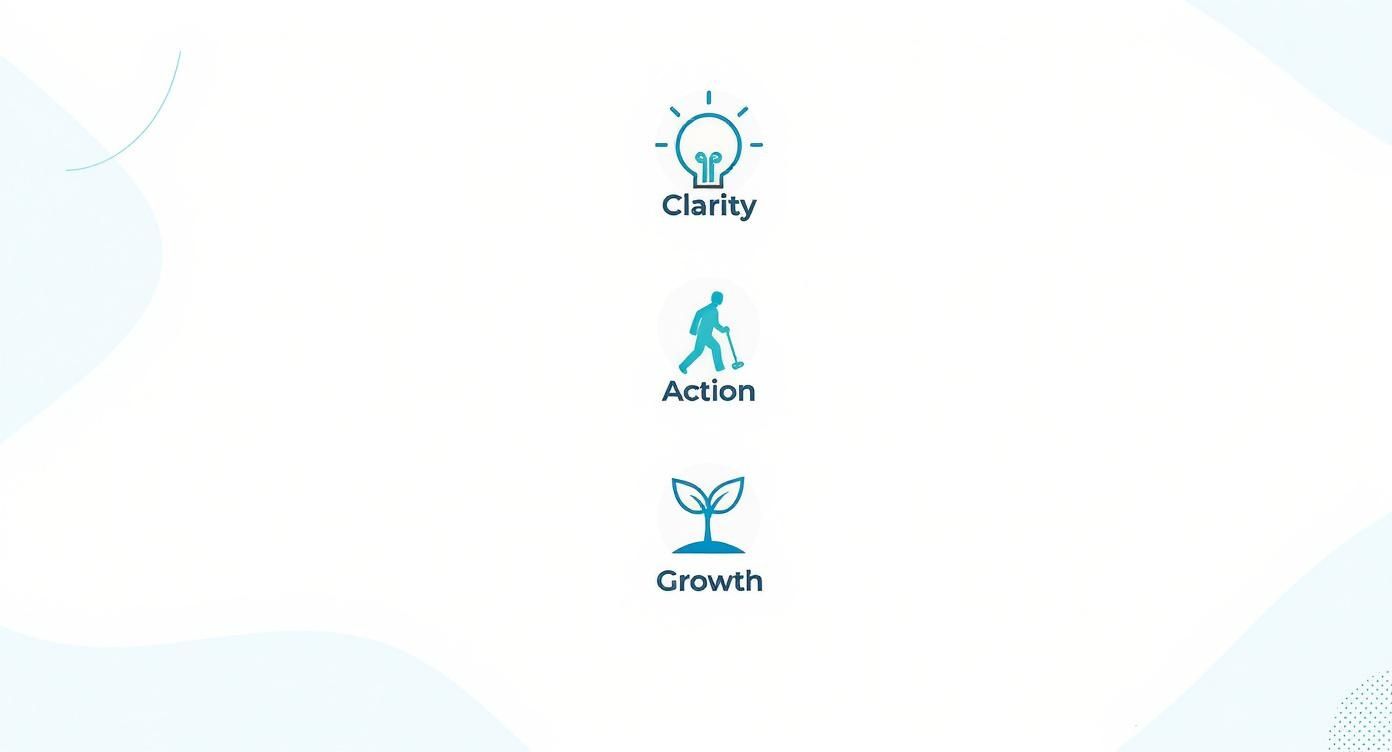
Keep these three elements in mind as you frame your questions. You’re looking for understanding (Clarity), your next steps (Action), and ways to evolve (Growth).
Crafting Tarot Questions for Your Career
Career questions almost always spring from anxiety about the future—promotions, job security, or finding the right path. But instead of focusing on what might happen to you, the best questions focus on how you can actively shape your professional life. This proactive approach turns the cards into your personal strategic advisor.
Your career is a journey you build, not a destination you’re handed. Frame your questions to reflect your role as the architect, not just an employee waiting for instructions.
The trick is to move from passive prediction to active participation. For example:
Instead of asking: “Will I get the promotion?”
Try asking: “What strengths should I focus on to advance my career right now?”
Instead of asking: “Should I quit my job?”
Try asking: “What do I need to understand about my current role versus the potential of a new opportunity?”
These reframed questions don’t just ask for a weather report; they ask for a map. They invite the tarot to highlight your skills, illuminate unseen factors, and point you toward your next productive move.
Exploring Love and Relationships with Tarot
Relationships are messy, beautiful, and complicated. That’s why simple “yes/no” questions rarely get you anywhere useful. Asking something like “Does he love me?” reduces a rich, emotional landscape to a single, unhelpful data point.
A much better approach is to ask questions that explore the energy, the patterns, and the potential within the connection. This allows the cards to offer nuanced insights you can actually use to improve your relationships, whether they’re romantic, platonic, or with family.
Instead of: “Is this person my soulmate?”
Ask: “What is the energetic dynamic between me and this person right now?”
Instead of: “Will we get back together?”
Ask: “What is the lesson this connection is meant to teach me at this time?”
Instead of: “Is my partner cheating on me?”
Ask: “How can I foster more trust and open communication in my relationship?”
See the shift? These questions move the focus from trying to control the other person to understanding your own role and power within the dynamic. They help you see the relationship as a space for growth, not just a problem to be solved.
Asking Powerful Questions for Personal Growth
This is where the tarot really shines—as a mirror for the self. Questions about personal growth help you uncover subconscious blocks, identify your true purpose, and align with your highest potential. This is how you have a deep, meaningful conversation with your own inner wisdom.
The key here is to ask questions that encourage self-reflection and reveal the path forward.
Examples of Growth-Oriented Questions:
- What hidden belief is currently holding me back the most?
- How can I better align my daily actions with my soul’s purpose?
- What is the most important message my higher self has for me today?
- What aspect of myself do I need to embrace more fully?
- How can I cultivate more joy and peace in my everyday life?
These inquiries open the door to genuine self-discovery. They don’t just fix a temporary problem; they help you evolve into the person you’re meant to be. This is the heart of a truly empowering tarot practice—one that goes far beyond simple fortune-telling and becomes a dedicated tool for living an intentional life.
Question Reframing for Specific Scenarios
To bring this all together, let’s look at a few more side-by-side examples. This table shows how to transform common, often disempowering questions into queries that will yield much richer, more actionable guidance from the cards.
| Common Concern | Ineffective Question | Effective Reframed Question |
|---|---|---|
| Feeling Stuck in a Job | “Will I ever find a new job?” | “What internal block is preventing me from pursuing a new career?” |
| Starting a New Business | “Will my new business be successful?” | “What is the most important action I can take this month to support my business’s growth?” |
| Relationship Uncertainty | “Is this relationship going to last?” | “What can I do to nurture the health of this relationship?” |
| Conflict with a Friend | “Is my friend mad at me?” | “What is my role in this conflict, and what can I learn from it?” |
| General Life Direction | “What’s going to happen to me?” | “What path will lead to my highest good right now?” |
Notice how each reframed question puts the power back in your hands. It assumes you are an active participant in your life, not just a passive observer waiting for fate to unfold. This small but critical shift is what turns a tarot reading from a curiosity into a powerful tool for personal transformation.
Common Tarot Questioning Mistakes to Avoid
Getting clear, insightful answers from your tarot deck isn’t just about learning what to ask—it’s also about unlearning a few bad habits. We all pick them up, especially when we’re starting out. Think of this as fine-tuning your approach.
Knowing these common pitfalls is just as important as mastering the art of framing a good question. By steering clear of these easy-to-make mistakes, you’ll find your readings become so much clearer and more reliable. Let’s walk through some of the most frequent missteps and, more importantly, how to sidestep them.
Asking About Others Without Consent
This is a big one, and it’s an easy trap to fall into. It’s so tempting to ask about what an ex is thinking, whether a friend is trustworthy, or what your boss’s next move will be. But here’s the thing: tarot is an intimate conversation, and pulling cards on someone else without their permission is like reading their diary.
This is often called “psychic spying,” and it’s a major ethical boundary to respect. The cards can’t give you an accurate or ethical report on someone else’s inner world. Plus, it pulls your focus away from the only person whose life you can actually change: you.
The Fix: Always pivot the question back to yourself.
- Instead of: “What does my ex think about me now?”
- Try: “What do I need to understand about this connection to help me move forward with peace?”
Card-Stalking Your Questions
Oh, we’ve all been there. You pull a few cards, and the answer feels… off. Or maybe it’s just not the answer you were hoping for. So, you scoop them up, shuffle furiously, and ask the exact same question again. This is what I call “card-stalking.”
Asking the same question over and over is the fastest way to get a confusing, chaotic mess of conflicting messages. It doesn’t bring you clarity; it just mirrors your own anxiety back at you and shows a lack of trust in the process.
When you repeatedly ask the same question, you’re no longer seeking guidance—you’re demanding a specific answer. This closes you off to the wisdom the cards are trying to offer.
The Fix: Let the reading breathe. If the message is murky, don’t re-ask the original question. Instead, pull a clarifier. For example, if you pulled the Tower and felt lost, you could ask, “What is the most constructive way for me to navigate this Tower energy?”
Posing Questions with a Hidden Agenda
This is the classic trap of confirmation bias. It’s when you approach the cards already convinced you know the “right” answer and you’re just looking for them to pat you on the back. A question like, “Why is my new business idea guaranteed to be a huge success?” isn’t a real question. It’s a demand for validation.
This mindset completely shuts down any potential for real insight. You’re not open to hearing about potential challenges, warnings, or alternative paths. The tarot is a mirror; if you come to it with a closed mind, that’s exactly what it will reflect.
The Fix: Approach the cards with genuine, open-minded curiosity.
- Instead of: “Show me why quitting my job is the best decision I’ll ever make.”
- Try: “What perspectives should I consider as I weigh the pros and cons of leaving my job?”
Being Overly Vague
While open-ended questions are the gold standard, there’s a fine line between “open” and “so broad it’s meaningless.” Flinging a question like, “What about my life?” or “Tell me my future” at the deck gives the cards absolutely nothing to grab onto. The reading you get back will likely be a jumble of symbols that are impossible to piece together into a coherent story.
A great tarot question provides just enough context. It points the cards toward a specific area of your life, which allows them to deliver a focused, relevant, and detailed message. It’s like using a GPS—”Take me somewhere” won’t work, but “Give me directions to the nearest library” will get you exactly where you need to go.
The Fix: Ground your question in a specific situation or timeframe.
- Instead of: “What do I need to know?”
- Try: “What is the primary energy or lesson I should focus on for my personal growth over the next 30 days?”
Using Spreads to Deepen Your Inquiry

A great question is the perfect start, but it’s rarely the end of the conversation. The real magic happens when you move past a single-card answer and allow a true dialogue with your deck to unfold. This is exactly where tarot spreads and smart follow-up questions come into play.
Using a spread takes your reading from a simple Q&A to a rich storytelling session. Each card’s position in the spread is like a built-in question, letting you explore your main inquiry from several different angles at once. It’s how you get the full picture.
How Spreads Frame the Narrative
Think about a classic like the Past-Present-Future spread. You’re not just getting one answer; you’re pulling three cards that create a story arc. You’re basically asking three interconnected questions all at once.
- Position 1 (Past): “What past energy or event is really shaping this?”
- Position 2 (Present): “What’s the core of the situation right now?”
- Position 3 (Future): “Where is this heading if things stay on the current path?”
See how each position adds another layer? The spread itself does the heavy lifting, asking nuanced, sequential questions for you and weaving a narrative that a single card just can’t.
This kind of in-depth, personal exploration is a big reason why tarot has become so popular. One survey found that a surprising 51% of people aged 13 to 25 use tarot, often to explore personal identity and emotional landscapes. Spreads are perfectly suited for that deep-dive work. You can read more about these cultural shifts in tarot practice to see how the community is evolving.
Asking Follow-Up Questions for Clarity
Even in a great spread, you’ll sometimes pull a card that just leaves you scratching your head. Maybe you get the enigmatic High Priestess in the “Obstacle” position of a Celtic Cross. What does that even mean? This isn’t a dead end—it’s an invitation to ask for more detail.
Don’t ever hesitate to pull a “clarifier” card. It’s a simple but powerful technique: leave the confusing card where it is, focus on a specific new question about it, and pull another card to lay right on top.
A follow-up question turns a static reading into a living dialogue. It’s your chance to say, “Okay, I hear you, but can you tell me more about this specific part?”
This keeps the energy moving and shows you’re actively engaging with the cards’ message. The goal isn’t just to get an answer, but to truly understand what the cards are trying to tell you.
Examples of Effective Clarifying Questions
The trick to a good follow-up is to be precise. You’re drilling down into one specific point. Let’s say a card in your reading just feels a little fuzzy.
Here are a few ways you might ask for more detail in a real reading:
- The Hermit appears as your “Action” card: You could ask, “What specific area of my life needs this quiet introspection right now?”
- The Ten of Swords shows up as a “Future Outcome”: A helpful follow-up might be, “What is the most important lesson I’m meant to take from this ending?”
- An “Obstacle” card feels vague: Try asking, “Can you show me the nature of this obstacle in more practical, everyday terms?”
This back-and-forth keeps the conversation flowing, letting you peel back the layers of meaning until you get to the heart of the matter. Learning to combine structured spreads with these kinds of intuitive follow-ups is one of the best ways to get clear, actionable guidance from your deck.
Your Top Tarot Questions, Answered
Even seasoned readers run into the same old head-scratchers now and then. This is where we tackle those common stumbling blocks you might encounter when figuring out what to ask your cards. Think of this as a quick reference guide to get you unstuck and reading with confidence.
Can I Just Ask a Yes or No Question?
Look, sometimes you just want a straight answer, right? While you can pull a single card—maybe upright for “yes” and reversed for “no”—you’re really selling the tarot short. That approach strips away all the beautiful, nuanced stories the cards are trying to tell you.
It’s a missed opportunity for real insight.
Instead of asking, “Will I get the job?” try reframing it. Ask something like, “What is the potential outcome if I pursue this job?” See the difference? One leaves you waiting for fate to decide, while the other gives you actionable wisdom you can actually use.
What if I Have No Idea What to Ask?
It happens to everyone. You sit down with your deck, mind completely blank, maybe because you’re just too overwhelmed by a situation to even form a coherent thought. Don’t sweat it, and definitely don’t force it.
This is the perfect time for a general check-in reading. Just get the conversation with your cards started with a simple, open-ended prompt.
- “What does my higher self need me to focus on right now?”
- “What message is most important for my well-being today?”
- “Which area of my life is calling for my attention?”
More often than not, the cards you pull in a general spread will light a spark. They’ll point you toward the real issue, giving you the clarity you need to ask a more specific, focused question in a follow-up reading.
How Specific Should My Questions Be?
This is all about finding that Goldilocks zone—not too broad, not too narrow. A question like, “What about my life?” is so vague that the cards will likely give you a muddled, confusing answer. There’s no clear direction.
On the flip side, getting hyper-specific can be just as unhelpful. Asking, “Will I meet a tall, dark-haired stranger at the coffee shop on Tuesday?” isn’t really asking for guidance; it’s trying to force a fortune-telling prediction and robs the cards of their power.
Your goal is to be specific about the situation but open about the outcome. Give the cards enough context to work with, but don’t try to dictate the answer you want to hear.
A much stronger question would be, “What energetic patterns are currently blocking me from forming a healthy romantic partnership?” It’s focused, insightful, and leaves room for genuine wisdom to emerge.
How Often Can I Ask About the Same Thing?
It’s tempting, especially when you’re anxious about a situation, to ask the same question over and over, hoping for a different answer. This is a fast track to confusion and frustration. The cards will just start reflecting your own chaotic energy back at you.
Once you’ve done a reading on something, give it space to breathe. Let the energy shift and unfold in the real world.
A good rule to follow is to only ask again after a significant development has occurred. If nothing has changed in your situation, the cards’ advice probably hasn’t either. Instead of asking the exact same question, try a follow-up like, “Based on my last reading, what is the next practical step I should take?” This keeps the conversation moving forward.