
Welcome to the world of tarot! You have your deck, you’ve connected with its energy, and now you’re ready for the most exciting part: asking questions and receiving guidance. But where do you start? The key to unlocking meaningful answers lies in learning a few foundational layouts, and this guide is designed to be your definitive starting point.
This comprehensive listicle introduces seven essential tarot spreads for beginners, each chosen to build your confidence and intuitive skills from the ground up. We move beyond simple card definitions to provide a complete toolkit for each layout. You won’t just learn what a spread is; you’ll understand how to use it effectively.
Inside, you will find a structured breakdown for each of the seven foundational spreads, including:
- Purpose: The ideal situations and questions for each layout.
- Card Positions: Clear diagrams showing you exactly where to place each card.
- Step-by-Step Instructions: A simple, actionable process for conducting your reading.
- Example Questions: Specific prompts to get you started immediately.
- Interpretation Guidance: Tips on how to connect the cards and form a cohesive narrative.
Forget the feeling of overwhelm that often comes with learning a new skill. These carefully selected tarot spreads for beginners provide a clear, actionable path forward. Think of each spread as a unique framework for conversation with your intuition. This guide will equip you with the practical knowledge to not only perform a reading but to truly understand the story your cards are telling you. Let’s begin.
1. The One-Card Draw
The One-Card Draw is the foundational building block of tarot reading and one of the most essential tarot spreads for beginners. Don’t let its simplicity fool you; this single-card pull is a powerful tool for daily guidance, focused meditation, and developing a deep, intuitive connection with your deck. It strips away the complexity of larger spreads, allowing you to build a personal relationship with each of the 78 cards.
Its primary purpose is to provide a single, potent piece of advice or a theme to contemplate. This minimalist approach is perfect for daily check-ins, quick answers to specific questions, or as a focal point for journaling and self-reflection.
Card Position and Layout
The layout is the simplest possible: one card, placed face up in front of you.
┌─────────
│ │
│ │
│ Card 1 │
│ │
│ │
└─────────
- Card 1: The core message, answer, or theme for the day.
How to Read the Spread
Reading a single card is an exercise in focused interpretation.
- Set Your Intention: Quiet your mind. Hold the deck and focus on your question or your intention to receive a “Card of the Day.”
- Shuffle and Draw: Shuffle the cards in a way that feels comfortable. When you feel ready, draw a single card from the top or cut the deck and select one.
- Initial Reaction: Before consulting any books, take 30 seconds to observe the card. What colors, symbols, or actions stand out? What is your immediate emotional or gut reaction?
- Analyze the Meaning: Now, consider the card’s traditional meaning. How does it apply to your question or the day ahead? If you use reversals, what nuance does its orientation add?
- Synthesize and Journal: Combine your intuitive hit with the card’s known meaning. Journal a few sentences about how this message could guide you.
Beginner’s Insight: The goal isn’t to know every card’s meaning by heart immediately. It’s about learning to have a conversation with the card. Ask it, “What do you have to teach me today?”
Example Questions
This spread works best with open-ended, focused questions:
- “What energy should I embrace today?”
- “What do I need to be aware of in this situation?”
- “What is the single most important thing I need to know right now?”
- “What is the lesson behind this challenge?”
Tips for a Deeper One-Card Reading
To get the most out of this practice, integrate these techniques:
- Morning Ritual: Make it a daily habit. Pulling a “Card of the Day” each morning sets a powerful intention and helps you learn the deck organically.
- Use Clarifying Cards: If a card feels confusing or its message seems unclear, ask, “Can you clarify this?” and pull a second card. Place it next to the first to add context.
- Sync with a Guidebook: After your initial interpretation, open a trusted tarot guidebook to a random page. See how the universe provides additional, sometimes surprising, insight that connects to your card.
- Journal Your Journey: Keep a simple tarot journal. Note the date, the card pulled, your question, and a brief interpretation. Over time, you’ll see patterns emerge and witness your intuitive skills grow significantly. This practice is a cornerstone for mastering more complex tarot spreads for beginners.
2. The Past, Present, Future Spread
The Past, Present, Future spread is a classic for a reason. As one of the most fundamental tarot spreads for beginners, it expands upon the single card draw by introducing the concept of a narrative arc. This three-card layout tells a simple yet profound story about a situation, helping you understand its origins, its current state, and the potential trajectory it’s on.
Its primary purpose is to provide context and clarity. By examining the flow of energy from what was, to what is, to what could be, you gain valuable perspective. This spread is perfect for analyzing a specific problem, understanding the evolution of a relationship, or getting a quick overview of your personal journey.
Card Position and Layout
The spread is laid out in a simple horizontal line, representing the linear progression of time from left to right.
┌─────────┐ ┌─────────┐ ┌─────────┐
│ │ │ │ │ │
│ │ │ │ │ │
│ Card 1 │ │ Card 2 │ │ Card 3 │
│ (Past) │ │ (Present) │ │ (Future)│
│ │ │ │ │ │
└─────────┘ └─────────┘ └─────────┘
- Card 1 (The Past): This card represents the foundational energies, past events, or underlying beliefs that have led to the current situation. It’s the “root” of the matter.
- Card 2 (The Present): This card reflects the current state of affairs. It shows you where you are right now, highlighting the central challenge, opportunity, or energy at play.
- Card 3 (The Future): This card reveals the likely outcome or potential direction if the current path is maintained. It is not a fixed destiny but a glimpse into where things are headed.
How to Read the Spread
Reading this spread is about storytelling. You are connecting the dots between the three cards to form a cohesive narrative.
- Define Your Query: Hold your deck and focus clearly on the situation or question you want to explore. Be specific, for example, “What do I need to understand about my career path?”
- Shuffle and Draw: Shuffle the cards while concentrating on your question. When you feel ready, draw three cards and lay them out from left to right.
- Read Card by Card: Start with the Past card. Interpret its meaning in the context of the situation’s origins. Then, move to the Present, analyzing how that past energy has manifested now.
- Interpret the Future: Finally, look at the Future card. See it as the logical next step or potential result of the present moment’s energy.
- Weave the Story: Connect all three cards into a single narrative. How did the energy of Card 1 evolve into Card 2? How might Card 2 lead to the outcome shown in Card 3?
Beginner’s Insight: The Future card is not a prediction set in stone. It is a signpost. If you don’t like the potential outcome it shows, the Present card holds the key to changing your direction.
Example Questions
This spread is incredibly versatile and works well for questions about progression:
- “What is the story of my current creative block (Past, Present, Future)?”
- “Show me the energy surrounding my relationship with [Person’s Name].”
- “What do I need to understand about my financial situation?”
- “What is the journey of this new project I am starting?”
Tips for a Deeper Three-Card Reading
To elevate this simple spread, consider these powerful techniques:
- Focus on the Flow: Pay attention to the relationships between the cards. Are the elements (Fire, Water, Air, Earth) in harmony or conflict? Does a Major Arcana card appear, signifying a major life lesson?
- The “Bridge” Card: Intentionally look at the Present card as the bridge. It is the active ingredient you have control over. Ask yourself, “What action does this Present card ask me to take to influence the Future?”
- Add a “Guidance” Card: After laying out the three cards, pull one more card and place it above the spread. This can represent overarching advice or a guiding principle to keep in mind as you navigate the situation.
- Journal the Narrative: Write down the story the cards tell you. Start with “Once upon a time (The Past)…” and continue through to the potential future. This creative exercise can unlock deeper intuitive insights and make this one of the most effective tarot spreads for beginners.
3. The Celtic Cross Spread
The Celtic Cross is arguably the most famous and comprehensive of all tarot spreads. While often seen as an advanced technique, a simplified approach makes it one of the most powerful tarot spreads for beginners to aspire to. It provides a deep, multi-layered snapshot of a situation, weaving a detailed narrative that covers internal and external influences, past foundations, future potential, and the core of the matter.
Its purpose is to conduct an in-depth exploration of a complex question or life situation. Unlike quicker spreads, the Celtic Cross doesn’t just give an answer; it tells a story, revealing the subtle energies and dynamics at play. It’s the go-to spread for many professional readers when a client needs a thorough and nuanced reading.
Card Positions and Layout
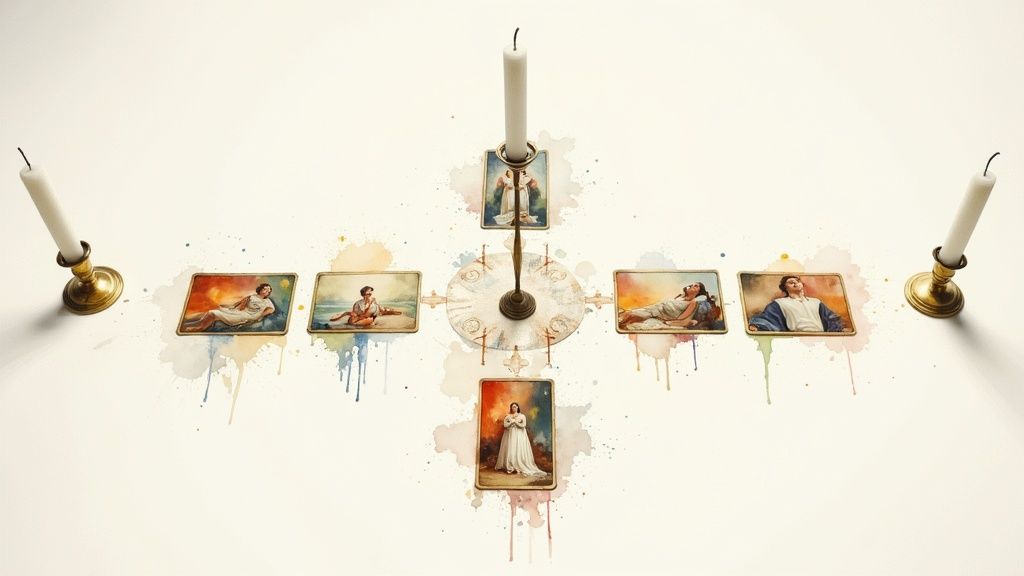
The spread consists of ten cards laid out in a distinctive cross-and-staff pattern. The first six cards form the cross, and the final four form the staff or pillar to the right.
┌─────────┐
│ Card 10 │
│(Outcome)│
└─────────┘
┌─────────┐
│ Card 6 │ ┌─────────┐
┌───┐ │(Future) │ │ Card 9 │
│ 5 │ └─────────┘ │ (Hopes) │
│(Above)└───┐ ┌───┘ └─────────┘
└─────────┘ │ │
┌─────────┐ │ 2 │ ┌─────────┐
│ Card 1 ├─┤(Cross)├─┤ Card 4 │
│(Present)│ │ │ │(Beneath)│
└─────────┘ └───┘ └─────────┘
┌───┐ ┌───┐ ┌─────────┐
│ 3 │ │ │ │ Card 8 │
│(Past) │ │ │(External)
└─────────┘ └─────────┘
┌─────────┐
│ Card 7 │
│ (You) │
└─────────┘
- Card 1: The Heart of the Matter – The present situation or central theme.
- Card 2: The Obstacle – The challenge or conflict crossing the situation.
- Card 3: The Foundation – The recent past or root cause of the situation.
- Card 4: The Recent Past – Events that have just passed but still influence the present.
- Card 5: The Crown – The best possible outcome or goal; what is consciously being worked toward.
- Card 6: The Near Future – What is likely to happen next in the immediate future.
- Card 7: Your Position – Your own feelings, attitude, or role in the situation.
- Card 8: External Influences – The environment, other people, or outside energies affecting you.
- Card 9: Hopes and Fears – Your underlying hopes or anxieties regarding the outcome.
- Card 10: The Final Outcome – The most likely result if things continue on their current path.
How to Read the Spread
Reading the Celtic Cross is about storytelling and connecting the dots between positions.
- Formulate Your Question: Be clear about the complex situation you want to explore. This spread works poorly with simple yes/no questions.
- Shuffle and Lay Out: As you shuffle, focus intently on your question. Lay the ten cards out in the specified order, one by one.
- Read the Central Cross (Cards 1 & 2): Start by interpreting the first two cards together. This pair defines the central dynamic of your situation: the core issue and what’s challenging it.
- Analyze the Vertical Axis (Cards 3, 1, 5): Read these cards as a timeline of consciousness. Card 3 is the subconscious foundation, Card 1 is the present awareness, and Card 5 is the conscious goal.
- Interpret the Horizontal Axis (Cards 4, 1, 6): Read these cards as a linear timeline of events. Card 4 is what just happened, Card 1 is what’s happening now, and Card 6 is what comes next.
- Read the Staff (Cards 7-10): Interpret these cards sequentially to understand your role (7), external factors (8), your inner desires or fears (9), and the probable conclusion (10).
- Synthesize the Narrative: Step back and look at all ten cards. What is the overarching story? Are there recurring suits, numbers, or themes? The final outcome card should be read in the context of everything that came before it.
Beginner’s Insight: Don’t get overwhelmed. Tackle the spread in mini-groups: the central cross, the vertical axis, the horizontal axis, and the staff. Write down a single sentence for each card before trying to weave them together.
Example Questions
This spread excels at exploring multifaceted situations:
- “What do I need to understand about my current career path and its potential?”
- “Can you provide a detailed overview of my relationship with [Person’s Name]?”
- “What are the dynamics at play regarding my decision to [make a major life change]?”
- “What is the story of my personal growth journey right now?”
Tips for a Deeper Celtic Cross Reading
Mastering this spread takes practice, but these tips will accelerate your learning:
- Start with a Six-Card Version: Practice with just the central cross (cards 1-6). This “mini-cross” gives you the core of the situation without the added complexity of the staff, making it a great stepping stone.
- Use a Cheat Sheet: Print or draw the layout with the position meanings next to it. Having a physical guide in front of you frees up mental energy to focus on interpretation rather than memorization.
- Read for Fictional Characters: Practice by doing readings for characters from your favorite books or movies. Asking “What is the overview of Harry Potter’s situation in The Prisoner of Azkaban?” is a low-pressure way to see how the cards tell a known story.
- Focus on the Story: Avoid getting stuck on a single card’s meaning. The power of the Celtic Cross comes from the interplay between positions. Ask yourself, “How does the Past (Card 3) explain the Obstacle (Card 2)?” This is a key skill for moving beyond basic tarot spreads for beginners and into more advanced reading.
4. The Five-Card Spread (Quintessence)
The Five-Card Spread is a versatile and insightful layout that acts as a perfect stepping stone from simple three-card pulls to more complex readings. It offers a comprehensive narrative without being overwhelming, making it one of the most practical tarot spreads for beginners looking to deepen their practice. Its structure provides a clear story arc, detailing a situation from multiple angles and culminating in a single, powerful piece of wisdom.
This spread is designed to give you a well-rounded snapshot of a specific issue. It explores the core situation, internal and external factors, recommended actions, and the potential outcome, making it ideal for problem-solving and gaining clarity on multifaceted challenges.
Card Position and Layout
The cards are typically laid out in a cross or a line, with the fifth card often placed centrally or above the others to signify its overarching importance.
┌─────────┐
│ │
│ Card 5 │
│ │
└─────────┘
┌─────────┐ ┌─────────┐ ┌─────────┐ ┌─────────┐
│ │ │ │ │ │ │ │
│ Card 1 │ │ Card 2 │ │ Card 3 │ │ Card 4 │
│ │ │ │ │ │ │ │
└─────────┘ └─────────┘ └─────────┘ └─────────┘
- Card 1: The Situation. The heart of the matter or the present circumstances.
- Card 2: The Challenge. The primary obstacle or conflict affecting the situation.
- Card 3: Advice/Action. The recommended course of action or what you should do.
- Card 4: Potential Outcome. The likely result if you follow the advice in Card 3.
- Card 5: Quintessence/Overall Theme. The spiritual lesson or core energy summarizing the entire reading.
How to Read the Spread
Reading this spread involves weaving the first four cards into a coherent story, then using the fifth card to understand the ultimate lesson.
- Define Your Question: Focus on a specific situation you need clarity on. This spread thrives on well-defined questions.
- Shuffle and Lay Out: Shuffle while concentrating on your question. Lay the five cards out in their designated positions.
- Read the Narrative (Cards 1-4): Interpret the first four cards as a sequence. Start with the situation (1), identify the challenge (2), consider the advice (3), and then see the potential outcome (4). Notice how they interact.
- Synthesize with the Quintessence (Card 5): Now, look at Card 5. This card is the “spirit” of the reading. It provides the overarching theme or the key takeaway that unifies the other four cards. How does this central theme color your understanding of the situation and its outcome?
- Journal the Story: Write down the story the cards tell. How does the advice card directly address the challenge? How does the outcome logically follow from the action? Finally, what is the core lesson from the quintessence card?
Beginner’s Insight: The fifth card, the Quintessence, is your anchor. If the first four cards seem contradictory or confusing, use the fifth card’s energy as the lens through which to view them. It reveals the “why” behind the entire situation.
Example Questions
This spread is excellent for exploring situations that require a clear plan of action:
- “What do I need to understand about this conflict at work?”
- “How can I best support my friend through their current difficulty?”
- “What is the path forward for my creative project?”
- “What is the core lesson I need to learn from this relationship issue?”
Tips for a Deeper Five-Card Reading
To elevate your understanding of this spread, focus on the connections between the cards:
- Master One Framework: There are many variations of the five-card spread. Choose one set of position meanings (like the one above) and stick with it for at least ten readings before experimenting with others to build confidence.
- Practice Card Relationships: Pay close attention to how the cards “speak” to each other. Does the Advice card (3) directly counter the Challenge card (2)? Does the Outcome card (4) look like a natural progression from the Situation card (1)?
- Journal the Connections: Don’t just write down what each card means. Explicitly write one sentence on how Card 1 connects to Card 2, how Card 3 answers Card 2, and so on. This builds your storytelling muscle.
- Calculate the Quintessence: For a more advanced layer, you can calculate a quintessence card. Add the numerical values of the four cards (or all five) and reduce the sum to a number between 1 and 22. The corresponding Major Arcana card becomes an additional, powerful theme card for the reading. This technique is a fantastic next step after mastering the basic layout of tarot spreads for beginners.
5. The Relationship Spread (Two-Person Spread)
The Relationship Spread is a crucial tool and one of the most insightful tarot spreads for beginners looking to explore interpersonal dynamics. It moves beyond a single perspective to create a dialogue between two viewpoints, offering a balanced look at the energies connecting two individuals. This spread is invaluable for examining romantic partnerships, friendships, family ties, or even professional collaborations.
Its purpose is to illuminate the perspectives, feelings, and contributions of each person, revealing how their energies interact to shape the relationship’s core. It provides a roadmap for understanding mutual strengths, challenges, and the shared path forward, making it a go-to for anyone seeking clarity on a connection.
Card Position and Layout
This spread typically uses six cards, arranged in two columns representing each individual, with a central card bridging them.
┌─────────┐ ┌─────────┐
│ │ │ │
│ Card 1 │ │ Card 2 │
│ │ │ │
│ │ │ │
└─────────┘ └─────────┘
┌─────────┐ ┌─────────┐
│ │ │ │
│ Card 3 │ │ Card 4 │
│ │ │ │
│ │ │ │
└─────────┘ └─────────┘
┌─────────┐ ┌─────────┐
│ │ │ │
│ Card 5 │ │ Card 6 │
│ │ │ │
│ │ │ │
└─────────┘ └─────────┘
- Card 1: Person A’s perspective, feelings, and energy in the relationship.
- Card 2: Person B’s perspective, feelings, and energy in the relationship.
- Card 3: What Person A brings to or wants from the connection.
- Card 4: What Person B brings to or wants from the connection.
- Card 5: The current challenge or block for Person A.
- Card 6: The current challenge or block for Person B.
How to Read the Spread
Reading this spread is an exercise in comparison and synthesis.
- Set Your Intention: Focus on the relationship you wish to understand. Hold the names or images of both individuals in your mind as you handle the deck.
- Shuffle and Draw: Shuffle while concentrating on the connection. Lay out the six cards according to the diagram above.
- Read Column by Column: First, interpret the cards for Person A (1, 3, 5) to understand their side of the story. Then, do the same for Person B (2, 4, 6).
- Compare and Contrast: Now, look at the cards horizontally. Compare Card 1 to Card 2 to see how their core feelings align or conflict. Compare Cards 3 and 4 to see if their needs are compatible. Compare Cards 5 and 6 to identify shared or individual struggles.
- Synthesize the Story: Weave the individual narratives together to form a complete picture of the relationship’s current state. What is the overarching theme?
Beginner’s Insight: The real magic happens when you stop seeing two separate people and start seeing one dynamic. Look for mirroring cards (like two Cups cards) or contrasting suits (like a fiery Wand versus a watery Cup) to quickly identify harmony or friction.
Example Questions
This spread is perfect for exploring the “how” and “why” of a connection:
- “How do we see this relationship differently?”
- “What are our individual strengths and challenges within this partnership?”
- “What unspoken needs exist between us?”
- “How can we better understand each other’s perspective right now?”
Tips for a Deeper Relationship Reading
To get the most from this spread, consider these approaches:
- Add a Bridge Card: For more depth, pull a seventh card and place it in the middle, between the two columns. This card can represent the relationship’s core theme, its potential, or a shared outcome.
- Remain Neutral: When reading for yourself and another, strive to be an objective observer. Avoid letting your personal feelings color the interpretation of the other person’s cards.
- Look for Repeats: Pay close attention if the same number, suit, or Major Arcana card appears in both columns. This indicates a powerful, shared theme or lesson for both individuals.
- Read with a Partner: If the other person is open to it, performing and discussing the spread together can be a profound communication tool, fostering honesty and mutual understanding. This collaborative approach makes it one of the most powerful tarot spreads for beginners to practice.
6. The Yes/No Spread
While tarot often excels at exploring nuance and “how” or “why” questions, sometimes you just need a straightforward answer. The Yes/No Spread is a simple, effective method designed for exactly that. As one of the most practical tarot spreads for beginners, it teaches you to make decisive interpretations and associate card meanings with clear, binary outcomes.
This spread provides quick guidance for specific, closed-ended questions. It forces you to create a system and stick to it, building your confidence in making clear judgment calls. While it can give a yes or no, it also cleverly leaves room for a “maybe” or “reconsider,” offering more depth than a coin flip.
Card Position and Layout
This spread typically uses three cards to determine the overall leaning of the answer. A five-card layout can be used for more certainty.
┌─────────┐ ┌─────────┐ ┌─────────┐
│ │ │ │ │ │
│ Card 1 │ │ Card 2 │ │ Card 3 │
│ │ │ │ │ │
│ │ │ │ │ │
└─────────┘ └─────────┘ └─────────┘
- Cards 1, 2, and 3: These cards collectively form the answer. The majority of “Yes” or “No” cards determines the outcome.
How to Read the Spread
Reading this spread requires setting your rules before you draw the cards.
- Establish Your System: Before shuffling, decide on your criteria for “Yes,” “No,” and “Maybe.” A common system is assigning suits (e.g., Wands/Cups = Yes, Swords/Pentacles = No) or using uprights for “Yes” and reversals for “No.”
- Focus on Your Question: Formulate a clear, specific question that can be answered with a yes or no. Avoid vague or complex questions. Hold the question firmly in your mind.
- Shuffle and Draw: Shuffle your deck well. When you feel ready, draw three cards and lay them face up in a row.
- Tally the Results: Look at the cards one by one and classify them according to your pre-defined system. The answer is determined by the majority. Two “Yes” cards and one “No” card equals a “Yes.”
- Interpret the Nuance: Even with a clear answer, look at the cards themselves. A “Yes” with The Tower and the 10 of Swords suggests a difficult path, while a “Yes” with The Sun and the 10 of Cups is far more encouraging.
Beginner’s Insight: Be honest with yourself about whether a question can truly be answered with a simple yes or no. If you find yourself wanting more detail, it’s a sign to use a different spread.
Example Questions
This spread is tailor-made for direct, unambiguous questions:
- “Is it a good time to start looking for a new job?”
- “Will I hear back about the application this week?”
- “Should I pursue this creative project right now?”
- “Is this the right apartment for me?”
Tips for a Deeper Yes/No Reading
To enhance the accuracy and depth of this seemingly simple spread, try these techniques:
- Define “Maybe” Cards: Designate certain cards as “Maybe” or “Uncertain.” The Major Arcana cards like The Fool or The Hanged Man, or cards like the 2 of Pentacles or 7 of Cups, work well for this.
- Use a Five-Card Pull: For more important questions, draw five cards instead of three. This makes a tie impossible and gives you a stronger consensus for the answer.
- Strong vs. Weak Answers: Consider a system where Major Arcana cards are a “Strong Yes/No,” while Minor Arcana are a “Weak Yes/No.” This adds a layer of intensity to the reading.
- Trust the First Pull: Avoid the temptation to re-draw if you don’t like the answer. The power of this spread lies in its directness, and second-guessing it undermines your practice. This is a key discipline for all tarot spreads for beginners.
7. The Chakra Spread (Seven-Card Spread)
The Chakra Spread bridges the ancient wisdom of tarot with the spiritual practice of chakra healing. This holistic seven-card layout is one of the more profound tarot spreads for beginners looking to explore the connection between their spiritual, emotional, and physical well-being. By aligning each card with one of the body’s seven main energy centers, it offers a detailed energetic “X-ray” of your inner landscape.
Its primary purpose is to identify energetic blocks, strengths, and imbalances within your system. This spread is perfect for self-care check-ins, understanding the root cause of recurring issues, and finding guidance on how to restore balance and promote holistic healing.

Card Position and Layout
The seven cards are laid out vertically, mirroring the spine and the location of the chakras from the base to the crown of the head.
┌─────────┐
│ Card 7 │ (Crown)
└─────────┘
┌─────────┐
│ Card 6 │ (Third Eye)
└─────────┘
┌─────────┐
│ Card 5 │ (Throat)
└─────────┘
┌─────────┐
│ Card 4 │ (Heart)
└─────────┘
┌─────────┐
│ Card 3 │ (Solar Plexus)
└─────────┘
┌─────────┐
│ Card 2 │ (Sacral)
└─────────┘
┌─────────┐
│ Card 1 │ (Root)
└─────────┘
- Card 1 (Root Chakra): Your foundation, security, and physical well-being.
- Card 2 (Sacral Chakra): Your creativity, emotions, and passions.
- Card 3 (Solar Plexus Chakra): Your personal power, self-esteem, and will.
- Card 4 (Heart Chakra): Your capacity for love, compassion, and connection.
- Card 5 (Throat Chakra): Your communication and self-expression.
- Card 6 (Third Eye Chakra): Your intuition, insight, and wisdom.
- Card 7 (Crown Chakra): Your connection to spirituality and higher consciousness.
How to Read the Spread
Reading this spread is a meditative journey through your energy centers.
- Ground and Center: Before shuffling, take a few deep breaths. Visualize roots extending from the base of your spine into the earth.
- Set Your Intention: Hold the deck and ask for insight into your energetic well-being or a specific area of imbalance.
- Shuffle and Lay Out: Shuffle while focusing on your intention. Lay the seven cards out from bottom to top, starting with the Root Chakra (Card 1).
- Interpret Card by Card: Address each card individually, considering its meaning in the context of its corresponding chakra. For example, a challenging card in the Throat Chakra position might point to a fear of speaking your truth.
- Look for Connections: After interpreting each card, look at the spread as a whole. Are there patterns? Do cards in lower chakras seem to be impacting those in higher chakras? A block in personal power (Solar Plexus) could be affecting your spiritual connection (Crown).
Beginner’s Insight: You don’t need to be a chakra expert. Start with the basic theme for each energy center (e.g., Root = security, Heart = love). The card’s imagery will provide the specific details you need for the reading.
Example Questions
This spread responds best to broad inquiries about your overall state of being.
- “What is the current state of my energetic well-being?”
- “Where are my main energetic blocks, and how can I release them?”
- “What do I need to know to find more balance in my life?”
- “Which area of my life requires the most attention for healing right now?”
Tips for a Deeper Chakra Reading
To elevate this powerful diagnostic spread, try these techniques:
- Pre-Reading Study: Briefly review the basic meanings and colors of the seven chakras before you begin. A simple chart can be a great reference tool during the reading.
- Body Scan Meditation: As you place each card, bring your awareness to that part of your body. Notice any physical sensations, feelings, or intuitive hits that arise.
- Color Association: Pay attention to how the colors in the tarot card interact with the traditional color of that chakra (e.g., a fiery red card in the blue Throat Chakra position might indicate angry words).
- Journal with a Focus: When journaling about this spread, dedicate a small section to each chakra. Write down the card’s message and one small, actionable step you can take to bring more balance to that energy center. This makes the guidance practical and grounded.
Comparison of Beginner Tarot Spreads
| Spread | 🔄 Complexity | ⚡ Resources & time | 📊 Expected outcomes | 💡 Ideal use cases | ⭐ Key advantages |
|---|---|---|---|---|---|
| One-Card Draw | Very low (1 card) | Minimal — seconds to 2 mins | Focused single insight; quick clarity — ⭐⭐⭐ | Daily guidance, meditation, beginner practice | Quick; builds card familiarity; minimal setup |
| The Three-Card Spread | Low (3 cards) | Minimal — ~2–5 mins | Balanced short narrative (Past/Present/Future etc.) — ⭐⭐⭐⭐ | Daily readings, quick decisions, learning card relations | Flexible frameworks; fast; good for practice |
| Five-Card Spread (Quintessence) | Medium (5 cards) | Moderate — ~5–10 mins | Nuanced narrative with a synthesis card — ⭐⭐⭐⭐ | Intermediate practice, decision-making, trend analysis | Balances depth and manageability; adaptable layouts |
| The Chakra Spread (Seven-Card) | Medium (7 cards) + chakra knowledge | Moderate — ~10–15 mins | Holistic wellness and energy mapping — ⭐⭐⭐ | Wellness/spiritual practice, yoga/meditation | Integrates chakra work; clear position meanings; holistic view |
| The Relationship Spread (Two-Person) | Medium (6–7 cards) | Moderate — ~10–15 mins | Comparative perspectives; interaction dynamics — ⭐⭐⭐⭐ | Couples, partnership analysis, communication work | Direct comparison of viewpoints; clarifies dynamics |
| The Yes/No Spread | Low (3–5 cards) | Very fast — ~1–3 mins | Binary answer with optional nuance (maybe/clarifier) — ⭐⭐⭐ | Quick decisions, building decisiveness, daily choices | Clear outcomes; trains quick interpretation; simple system |
| The Celtic Cross Spread | High (10 cards) | High — ~20–40 mins | Comprehensive situational analysis; layered insights — ⭐⭐⭐⭐⭐ | Complex life questions, professional readings, in-depth analysis | Deep narrative; classical structure; reveals influences/outcomes |
Integrating Tarot Spreads into Your Daily Practice
You’ve just explored seven foundational tarot spreads for beginners, each a unique gateway to self-discovery and intuitive insight. From the quick clarity of a One-Card Draw to the in-depth narrative of the Celtic Cross, you now possess a versatile toolkit to approach any question with confidence. The true magic, however, lies not in knowing these spreads, but in using them to build a meaningful and consistent practice.
The journey from novice to confident reader is paved with practice, patience, and personal connection. Think of these spreads as conversational frameworks. The Three-Card Spread offers a structured dialogue about your past, present, and future, while the Relationship Spread facilitates a conversation about your connections with others. The Chakra Spread, on the other hand, helps you check in with your own energetic well-being. The key is to start small and build from there.
Your Actionable Path Forward
Memorizing every card position for every spread isn’t the immediate goal. Instead, focus on integration. Here are your next steps to transform this knowledge into a lived practice:
- Choose Your Starting Point: Select one or two spreads that resonate most with you. Is it the straightforward guidance of the Five-Card Spread or the decisive nature of a Yes/No Spread? Pick one for daily pulls and another for weekly reflections.
- Commit to a Journaling Practice: A tarot journal is your most powerful learning tool. For each reading, document the date, your question, the spread used, the cards you pulled, and your initial interpretations. This creates an invaluable record of your intuitive hits and recurring patterns.
- Ask Better Questions: Move beyond simple “what will happen” inquiries. Use your spreads to ask empowering questions like, “What do I need to understand about this situation?” or “What energy can I bring to achieve my desired outcome?” This shifts your role from a passive observer to an active co-creator in your life.
- Trust Your Intuitive Nudges: The card meanings are your foundation, but your intuition is the spark. If a card’s traditional meaning doesn’t feel right for the situation, listen to that inner voice. What does the imagery on that specific card say to you in this moment? That personal connection is where true insight is born.
Weaving Tarot into Your Life’s Fabric
Mastering these tarot spreads for beginners is about more than just predicting the future; it’s about navigating the present with greater awareness. Each spread is a mirror, reflecting the energies, patterns, and potentials that exist within and around you. By engaging with these layouts regularly, you are not just learning to read cards, you are learning to read the language of your own soul.
This practice empowers you to make conscious choices, understand your own motivations, and find clarity amidst life’s complexities. It’s a tool for empowerment, a method for mindfulness, and a pathway to deeper self-trust. As you continue to pull cards, lay out spreads, and interpret the stories they tell, you’ll find that the line between learning tarot and learning about yourself begins to blur beautifully. You are building a lifelong dialogue with your own inner wisdom.