
So, you’re curious about tarot. That’s a wonderful first step into a world of self-reflection and deep personal insight. Forget what you’ve seen in the movies—tarot isn’t about predicting a gloomy, unavoidable future. It’s a symbolic language, a deck of 78 cards designed to help you connect with your own inner wisdom and see your life with a little more clarity.
Your First Steps Into the World of Tarot
Welcome to the start of your journey. I know that looking at a full tarot deck for the first time can feel overwhelming, like you have to memorize 78 secrets just to get started. But the truth is much more empowering.
Think of tarot less like a crystal ball and more like a mirror. Each card holds up a reflection of your inner world, tapping into universal human experiences, archetypes, and emotions. It offers a new lens through which to view your questions and challenges.
This guide is here to walk you through it all, making your first steps feel approachable and meaningful. We’re going to demystify the cards and show you how to build a real relationship with your deck. Soon, it’ll feel less like a pack of cards and more like a trusted friend for self-discovery.
What You Will Learn in This Guide
To make sure you don’t get lost, I’ve structured this guide to build your confidence one step at a time. By the end, you’ll have everything you need to start reading with intention and clarity.
Here’s a look at what we’ll cover together:
- The Deck’s Structure: We’ll break down the Major and Minor Arcana in a way that actually makes sense, exploring the four suits and how they connect to the real-world stuff you deal with every day.
- Connecting With Your Deck: I’ll share some practical rituals for choosing your first deck, cleansing its energy, and creating a personal bond that makes it uniquely yours.
- Your First Readings: You’ll get simple, step-by-step instructions for your first tarot spreads—from a quick one-card daily draw to the classic three-card layout.
- Building Your Intuition: We’ll go beyond the little white book. I’ll teach you techniques like tarot journaling to help you trust your own gut feelings and interpretations.
Tarot is a symbolic language that helps you listen to the wisdom you already possess. It doesn’t give you answers you don’t have; it helps you uncover them for yourself.
By the time you finish this guide, you won’t just understand the cards—you’ll have the tools to use them as a genuine force for personal growth. This is about exploring your own story, one card at a time. Let’s get started.
What’s Inside a Tarot Deck? A Look at the 78 Cards
At first glance, a 78-card tarot deck can seem pretty intimidating. But once you understand its structure, it all starts to click into place. The entire deck is neatly organized into two main parts: the Major Arcana and the Minor Arcana.
Think of it like a storybook of your life. The Major Arcana cards are the big, unmissable plot twists—the major life lessons and turning points that define your journey. The Minor Arcana, on the other hand, are the details that fill the pages—the daily feelings, conversations, and challenges that make up the story.
This structure is a beginner’s best friend. Instead of memorizing 78 separate ideas, you can learn the roles of these two sections and the four suits within them. It makes the whole system feel far more intuitive and less like a chore.
The diagram below really captures how tarot works as a tool for introspection.

You can see how the cards act as a prompt, helping you connect with your intuition and process your thoughts to arrive at a deeper personal insight.
Let’s take a closer look at the two sections of the deck to see how they’re different and what roles they play in a reading.
Major Arcana vs Minor Arcana Overview
| Attribute | Major Arcana (22 Cards) | Minor Arcana (56 Cards) |
|---|---|---|
| Focus | Major life themes, spiritual lessons, archetypes | Daily situations, actions, emotions, and thoughts |
| Role in a Reading | Highlights the “big picture” and karmic influences | Provides context, details, and immediate advice |
| Represents | Significant life events, turning points, and phases | The “how” and “what” of your current circumstances |
| Structure | 22 individual cards, numbered 0-21 | Four suits, each with 14 cards (Ace-10, plus four Court Cards) |
This simple breakdown shows how the two parts of the deck work together to give you a complete picture—the Major Arcana sets the stage, and the Minor Arcana populates it with the details of your life.
The Major Arcana: The Soul’s Journey
The Major Arcana is made up of 22 cards, numbered from 0 to 21. These are the heavy hitters of the deck. They represent the universal archetypes and significant life lessons we all move through, from big beginnings to profound endings.
This sequence is famously known as “The Fool’s Journey.” It starts with Card 0, The Fool, who steps off a cliff with nothing but blind faith—a symbol of new beginnings and pure potential. From there, the journey winds through encounters with mentors (The Hierophant), sudden shake-ups (The Tower), and moments of pure joy (The Sun), finally concluding with Card 21, The World, which represents wholeness and completion.
When a Major Arcana card shows up in your reading, it’s a signal to zoom out and look at the bigger picture. The universe is likely pointing to a powerful theme or a crucial stage in your personal growth.
The Minor Arcana: The Stuff of Everyday Life
The other 56 cards form the Minor Arcana. These cards are all about the day-to-day—the practical concerns, fleeting emotions, and passing thoughts that color our reality. If the Major Arcana is the epic novel, the Minor Arcana is the daily journal entry.
Just like a regular deck of playing cards, the Minor Arcana is split into four suits. Each suit has 14 cards: ten numbered cards (Ace to 10) and four Court Cards (Page, Knight, Queen, and King).
Getting a handle on these four suits is the key to unlocking the Minor Arcana. Each one governs a different sphere of human experience.
The four suits of the Minor Arcana act as a compass for navigating your daily life. They point to the core energies at play, whether emotional, intellectual, creative, or practical.
Here’s a quick breakdown of what each suit is all about:
- Wands (Fire): This is the suit of action, ambition, and creativity. Wands cards deal with your passions, career moves, and that spark of inspiration that gets you moving.
- Cups (Water): Representing the world of emotions, relationships, and intuition, Cups speak directly to matters of the heart. Think love, friendship, feelings, and artistry.
- Swords (Air): This suit rules the mind. Swords cards are about thoughts, communication, truth, and conflict. They bring clarity but can also point to difficult decisions and mental struggles.
- Pentacles (Earth): Tied to the material world, Pentacles cover everything from your finances and job to your health and home. These cards deal with security, abundance, and your connection to the physical realm.
Learning these associations gives you an incredible head start. The moment you see a Pentacles card, you instinctively know the reading is touching on something tangible and practical in your life.
How to Choose and Connect with Your First Deck
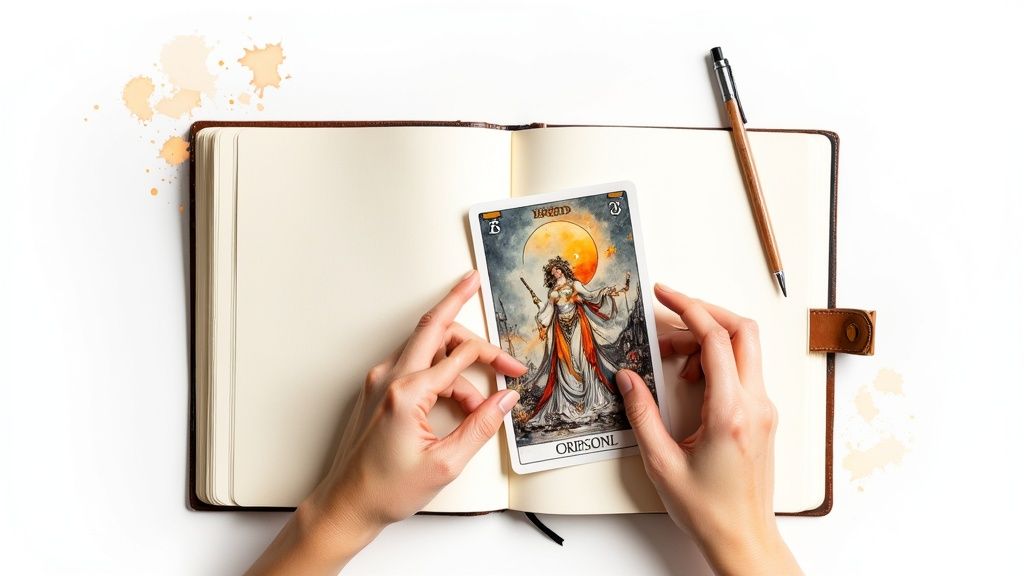
Alright, this is one of the best parts of starting your tarot journey: picking out your very first deck. It’s a bit like a rite of passage, and this is where the magic really begins. Before we go any further, let’s bust a huge myth right out of the gate: your first deck does not need to be a gift.
I see this old superstition trip up so many new readers. The single most important thing is finding a deck that you connect with. Think of it like meeting a new friend—you want someone whose personality clicks with yours, whose way of communicating just makes sense to you.
Finding a Deck That Resonates
When you’re brand new to this, the classic Rider-Waite-Smith (RWS) deck is a fantastic place to start. It was first published way back in 1909, and its rich, narrative imagery became the blueprint for modern tarot. Almost every beginner’s guide you’ll find uses the RWS system as its foundation, which will make your learning curve a whole lot smoother.
But please, don’t feel boxed in by tradition if the RWS artwork just doesn’t do it for you. We’re lucky to live in a time with an explosion of tarot creativity! You can find decks with modern art, diverse representation, and themes for just about any niche you can imagine. The key is to find pictures that get your own intuition humming.
As you start browsing, keep these things in mind:
- Art Style and Symbolism: Do the images pull you in? Can you look at a card and feel a story starting to unfold? If the art feels flat, confusing, or just plain not your vibe, you’re going to have a hard time connecting.
- Card Stock Quality: Your deck is a hands-on tool. You’ll be shuffling it, laying it out, and handling it constantly. Look for cards that feel substantial and can stand up to repeated use without getting all bent and frayed.
- Guidebook: Does it come with one? A good little guidebook (often called an LWB or “little white book”) can be a lifesaver for a beginner, giving you a solid starting point for what each card might mean.
Think of your deck as your partner in self-reflection. When you choose one that feels good in your hands and delights your eyes, the whole practice becomes more joyful and insightful.
Building a Connection with Your New Deck
Once you’ve brought your deck home, the next step is to make it yours. You want to transform it from a simple pack of printed cardboard into a personal, trusted tool for insight. This really just means spending time with it and getting to know its unique personality.
A few simple rituals can really help forge that bond. These aren’t strict rules you have to follow, but more like intentional practices to get you and your cards in sync.
First up, give your deck a good cleansing. This is all about clearing out any stagnant energy it might have picked up on its journey from the printer to you. You can do this in a few ways:
- Knocking: Square up the deck and give it three firm but gentle knocks. It’s like waking it up and saying, “Hey, I’m here!”
- Shuffling: Honestly, one of the best ways to cleanse a deck is to just shuffle it. As you do, hold the intention of clearing away old energy and infusing it with your own.
- Smoke Cleansing: If you’re into it, you can pass the deck through the smoke of cleansing herbs like sage, rosemary, or even some nice incense.
- Moon Bathing: Let your deck soak up some lunar energy by leaving it on a windowsill overnight during a full moon.
After it feels fresh and clear, a “deck interview” is a beautiful way to get acquainted. It’s like a first date with your cards! Shuffle them and pull a few cards in response to questions like, “What are your greatest strengths?” or “What kind of lessons are you here to teach me?” This first conversation really sets the tone for your entire relationship.
Performing Your First Tarot Reading
Alright, you’ve cleansed your deck, and you’re ready to go. This is the moment where all the theory gets put into practice and you start to actually talk to your cards. Don’t worry, this isn’t about memorizing complicated rituals. It’s really just about creating a quiet moment to listen to what the cards—and your own intuition—have to say.
Before you even think about shuffling, take a breath. Seriously. Find a spot where you won’t be interrupted for a few minutes, close your eyes, and just breathe. Think about the question you want to ask. Holding that question in your mind turns a simple shuffle into a powerful act of intention. As you mix the cards, you’re literally infusing them with the energy of your query.
How to Ask Good Tarot Questions
This is probably one of the most important skills you’ll develop, and it’s a game-changer for beginners. The depth of your reading almost always comes down to the quality of your question. The best, most insightful readings spring from open-ended questions, not from questions that can be answered with a simple “yes” or “no.”
Think of your tarot deck less like a magic eight ball and more like a wise, insightful advisor. Instead of asking, “Will I get the promotion?” try reframing it to something that gives you agency. A much better question would be, “What can I focus on to improve my chances of getting the promotion?” or “What is the key lesson for me in my career right now?”
Here are a few simple frameworks for crafting powerful questions:
- “What do I need to understand about…?”
- “What is the hidden dynamic in this situation?”
- “How can I best support myself as I move through…?”
- “What is the primary lesson for me in…?”
Asking open-ended questions invites a story, not a verdict. It gives the cards room to offer guidance, perspective, and actionable advice, putting the power back in your hands.
When you shift your framing like this, everything changes. You’re no longer passively waiting for a prediction. Instead, you’re an active participant, using the cards to explore your options and make conscious, empowered choices.
Simple Tarot Spreads for Beginners
A “spread” is just the pattern you lay your cards out in. Each position in the layout has a specific meaning and represents a different facet of your question. While you’ll find countless elaborate spreads online, it’s best to start with the basics. Simple spreads help you build confidence and, more importantly, teach you how to see the narrative developing between the cards.
Here’s a quick look at three fantastic starter spreads that are perfect for your first few readings.
Beginner-Friendly Tarot Spreads
This table summarizes three simple, effective spreads that will help you get comfortable reading the cards without feeling overwhelmed.
| Spread Name | Number of Cards | Best For |
|---|---|---|
| One-Card Draw | One | Daily guidance, a quick check-in, or getting a single point of focus. |
| Past-Present-Future | Three | Understanding the flow of a situation and its likely trajectory. |
| Mind-Body-Spirit | Three | A holistic self-assessment to check in on your personal alignment. |
Let’s break down exactly how you can use each of these to get started right now.
The One-Card Draw
This is tarot in its purest form. The one-card draw is perfect for a daily morning practice—just ask, “What energy do I need to bring into my day?”—or for getting a quick, potent hit of insight on a specific issue.
- Shuffle the deck while holding your question in your mind.
- Cut the cards (or don’t, whatever feels right!) and pull one from the top.
- Reflect on what this single card’s energy means in the context of your question.
Let’s try an example: You ask, “What do I need to know about my new creative project?” and you pull the Ace of Wands. This card is all about that initial spark of passion, inspiration, and raw potential. The message is crystal clear: the energy is right to begin. Take that first step!
The Past-Present-Future Spread
This is a classic for a reason. This three-card spread is brilliant for mapping out the timeline of a situation. It tells a little story, showing you where you’ve come from, what’s happening now, and the potential path ahead.
- Shuffle your deck, focusing on the situation you need clarity on.
- Lay out three cards in a row, from left to right.
- Read them like a story:
- Card 1 (The Past): This represents the foundation of the issue or past events that got you here.
- Card 2 (The Present): This is what’s happening right now—the core of the situation or the main challenge.
- Card 3 (The Future): This points to the likely outcome or direction things are headed if you stay on the current path.
Another example: You ask about a new relationship. You pull the Three of Swords (Past), The Lovers (Present), and the Two of Cups (Future). This tells a powerful story of moving from a place of past heartbreak (Three of Swords) into a moment of making a significant, soul-aligned choice (The Lovers), which is leading toward a beautiful and reciprocal partnership (Two of Cups).
The Mind-Body-Spirit Spread
This spread is an amazing tool for a personal check-in. It helps you get a quick snapshot of your inner world and see if anything is out of alignment.
- Shuffle with a general intention to connect with your overall well-being.
- Lay three cards out in a row.
- Interpret each position:
- Card 1 (Mind): Represents your current thoughts, beliefs, and mental patterns.
- Card 2 (Body): Speaks to your physical health, your energy, and how grounded you are.
- Card 3 (Spirit): Reflects your emotional and intuitive self, and your connection to your deeper purpose.
Start with these three spreads and get comfortable with them. Practice often, write down your readings, and most of all, trust the stories that the cards begin to tell you.
Developing Your Intuition with a Tarot Journal
Let’s get one thing straight: reading tarot is so much more than just memorizing 78 keywords from that little white book that came with your deck. While knowing the traditional meanings gives you a solid starting point, the real magic kicks in when you learn to listen to your intuition.
This is the skill of tuning into your inner voice and connecting with the cards on a deeply personal, symbolic level. Think of it this way: the classic card meanings are like the grammar of a language. They give you the structure. But intuition? That’s the poetry. It’s how you weave those basic meanings together to create a story that actually speaks to your specific situation.
It’s the difference between seeing The Empress and just thinking “motherhood,” versus feeling a rush of creative abundance or noticing how the wheat field in the card reminds you of a passion project you’re carefully nurturing.
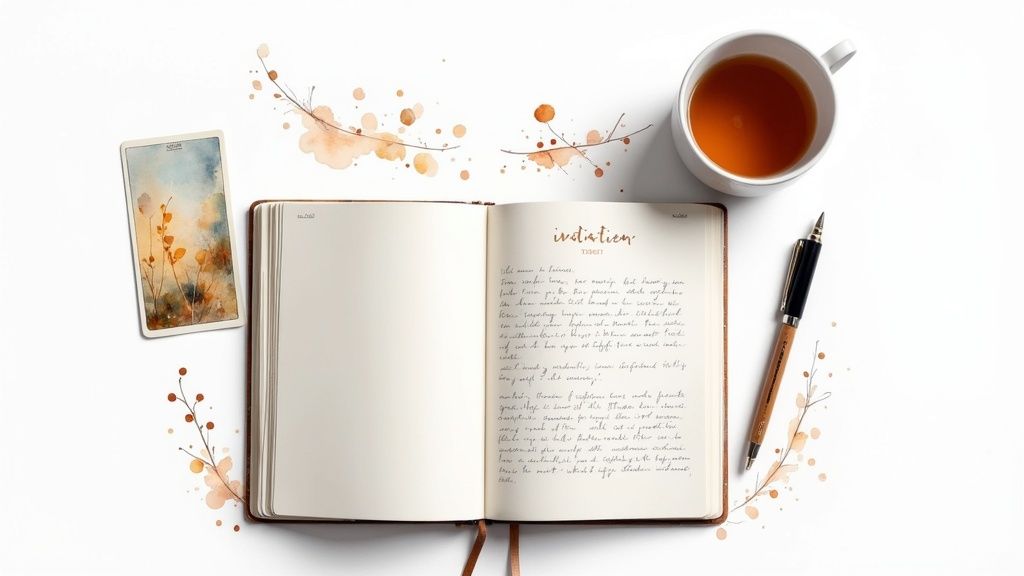
This intuitive connection is what elevates tarot from a party trick into a powerful tool for self-reflection. And one of the best ways to build that muscle is by keeping a tarot journal.
Why You Absolutely Need a Tarot Journal
Starting a tarot journal is like having a direct line to your subconscious mind and keeping a detailed record of your conversations. It’s your own private space to unpack your readings without any pressure, track how you grow, and spot the personal patterns that show up over time. If you’re just starting out, this practice is non-negotiable.
A tarot journal creates a tangible record of your intuitive journey. It allows you to see how your interpretations evolve and helps you build a personal library of card meanings based on your own lived experience.
This isn’t just a niche hobby anymore. The tarot card market is projected to hit $93.80 million by 2027, thanks in large part to younger generations looking for tangible tools to help them navigate a stressful world. As online learning makes tarot more accessible, practices like journaling have become a go-to for beginners who want to deepen their understanding at their own pace. You can explore more on this growing trend over at Cognitive Market Research.
How to Start Your Tarot Journal
Getting started is the easy part. All you really need is a notebook you love and a pen. Seriously, that’s it. The goal isn’t to be perfect, but to build a consistent habit of jotting down your readings and thoughts. Make an entry for every reading you do, even if it’s just a quick one-card pull for the day.
Here’s a simple framework to get you started:
- Date and Time: Always note when you did the reading. You might start to see patterns related to certain days of the week, times of day, or even astrological transits.
- Your Question: Be specific! Write down the exact question you asked the cards. This context is everything when you look back on it later.
- The Cards You Pulled: List the cards and what position they landed in (e.g., Past, Present, Future). If you’re feeling artsy, you can even try sketching the cards.
- Your Gut Reaction: This is the most important step. Before you even think about looking up a meaning, write down your immediate feelings, thoughts, colors, or symbols that jump out at you. What’s your first impression?
- The “Book” Meanings: After you’ve recorded your own insights, go ahead and consult your guidebook or other resources. Jot down the traditional meanings.
- Put It All Together: Now, connect the dots. How do your intuitive hits and the book meanings merge to answer your question? Write a short summary of the reading’s core message.
- Follow-Up Later: Leave some space at the bottom of the page to revisit the entry in a week or a month. How did things actually play out? Was your interpretation on the mark?
This simple, structured habit will help you build a rich, personal relationship with your deck. Before you know it, your journal will become your most valuable tarot resource—one filled with insights that are completely and uniquely yours.
Common Beginner Mistakes and Reading Ethics
Every tarot reader I know—no matter how skilled they are now—started exactly where you are. As you take your first steps, you’re going to stumble. That’s not just okay; it’s part of the process. Knowing the common pitfalls ahead of time can help you navigate them and build a practice that feels authentic and empowering right from the start.
One of the biggest hurdles for new readers is the temptation to ask the cards simple yes/no questions. It seems like the easiest way to get an answer, but it actually boxes the tarot in. The cards truly come alive when you use them to explore possibilities and uncover hidden dynamics, not to get a simple thumbs-up or thumbs-down.
Another classic beginner move is becoming glued to the little white book that came with your deck. It’s an essential tool, for sure, but the real goal is to build your own personal connection with the cards. If you’re constantly reaching for the book, you’re not giving your intuition a chance to speak up.
Navigating Common Pitfalls
Let’s talk about a few of those common early stumbles and how you can reframe your thinking to get much richer, more insightful readings.
- Fearing “Scary” Cards: I get it. Seeing cards like Death, The Tower, or the Ten of Swords can feel like a punch to the gut. But instead of fearing them, try to see them as messengers pointing to necessary change. Death almost never means a literal death; it’s about an ending that clears the ground for a powerful new beginning.
- Reading for Others Too Soon: It’s so exciting when you start learning, and the first thing you want to do is share it. But reading for another person is a real responsibility. Give yourself time to build confidence and a solid foundation with the cards before you start interpreting them for your friends or family.
- Forcing an Interpretation: Sometimes, a card just won’t click. It will seem completely out of place, and you’ll be tempted to jam it into the narrative. Don’t. Just make a note of it in your journal and let it be. The meaning often reveals itself later, sometimes days after the reading is over.
Building a tarot practice is a journey, not a race. The “mistakes” you make along the way are often your most valuable teachers, showing you where you need to deepen your understanding and trust your intuition more.
Establishing Your Tarot Ethics
The moment you pull a card for yourself or someone else, you’ve stepped into an ethical practice. Setting up a personal code of conduct isn’t just a formality; it protects both you and the person you’re reading for (often called the “querent“).
Your ethical foundation should be built on three pillars: respect, responsibility, and clear boundaries. The first rule of thumb is to always set a clear intention before a reading. What are you hoping to achieve? Are you seeking clarity, exploring options, or looking for empowerment?
It’s also crucial to remember your role. You are a guide, not an all-knowing fortune-teller. The cards provide perspective and highlight potential paths, but the querent always holds the power of free will.
Finally, know your limits. Tarot is an incredible tool for spiritual insight, but it is not a substitute for professional medical, legal, or mental health advice. A huge part of reading ethically is knowing when to lovingly suggest that someone seek help from a qualified professional in those fields.
Frequently Asked Questions About Learning Tarot
As you dive into the world of tarot, you’re going to have questions. That’s not just normal—it’s a great sign! It means you’re engaging with the cards and thinking critically. Let’s tackle some of the most common questions that pop up for beginners, so you can move forward with a bit more confidence.
How Long Does It Take to Learn Tarot?
This is probably the number one question I get, and the real answer is: it’s a lifelong practice. You can absolutely get the basics down in a few weeks or months. Learning the 78 card meanings and a few simple spreads is totally achievable.
But true fluency? That comes with time. Think of it like learning an instrument or a new language. You learn the notes and scales first, but becoming a musician happens over years of practice, feeling the music, and developing your own style. Every reading you do will deepen your understanding and build that personal connection with the cards.
Do I Need to Be Psychic to Read Tarot?
Absolutely not. Let me say that again: you do not need to be psychic. While tarot is a fantastic tool for tapping into and strengthening your own intuition, you don’t need any pre-existing “gift” to get started.
At its heart, tarot is a beautiful system of symbols and archetypes that mirror the human journey. A great reading comes from understanding what those symbols mean, knowing how to ask good questions, and then piecing together the story the cards are showing you.
Tarot is a tool for self-reflection and insight. It’s not some mystical power you either have or you don’t. It’s accessible to anyone with an open mind and a willingness to learn.
Can I Read My Own Tarot Cards?
Yes! And honestly, you really should. Reading for yourself is one of the best ways to learn. It’s your private laboratory for experimenting with card meanings and interpretation, all without the pressure of reading for someone else. Your daily draws and journal entries will become your most valuable teachers.
What If I Keep Pulling the Same Cards?
When the same card keeps showing up, pay attention. It’s not just a random coincidence; your deck is trying to get a message through to you. We often call these “stalker cards,” and they’re pointing to a major theme, a lesson, or an energy in your life that needs to be looked at.
When this happens, don’t just shuffle it back in. Take that card out, spend some extra time with it, and really journal about why it might be appearing for you right now.
The incredible surge in people learning tarot is part of a bigger trend toward self-discovery. The global tarot service market was valued at $1.20 billion and is expected to climb to $3.00 billion in the coming years. This growth means there are more amazing resources than ever for beginners, from apps to online groups, making it easy to find your community. You can find more stats on this growing industry at OpenPR.com.