
At its core, tarot is a tool for self-reflection and psychological discovery—not a crystal ball for predicting an unchangeable future. The best way to think of the 78 symbolic cards is as a deck of mirrors. Each one reflects a different facet of your own insight and subconscious mind.
Unlocking Your Inner Wisdom with Tarot
Many people get hung up on the idea that tarot’s only job is fortune-telling, but its modern use is far more personal and empowering. Instead of asking the cards for rigid answers about what will happen, the real work is in exploring complex situations, understanding your own motivations, and mapping out potential paths forward. It shifts the focus from passively waiting for the future to actively creating it.
This approach turns the deck from a mystical oracle into a practical guide for life. It’s a structured way to have a conversation with yourself, using the rich, archetypal imagery to unlock insights that were waiting just below the surface.
The diagram below shows how tarot’s modern purpose centers on self-empowerment through reflection, decision-making, and personal insight.
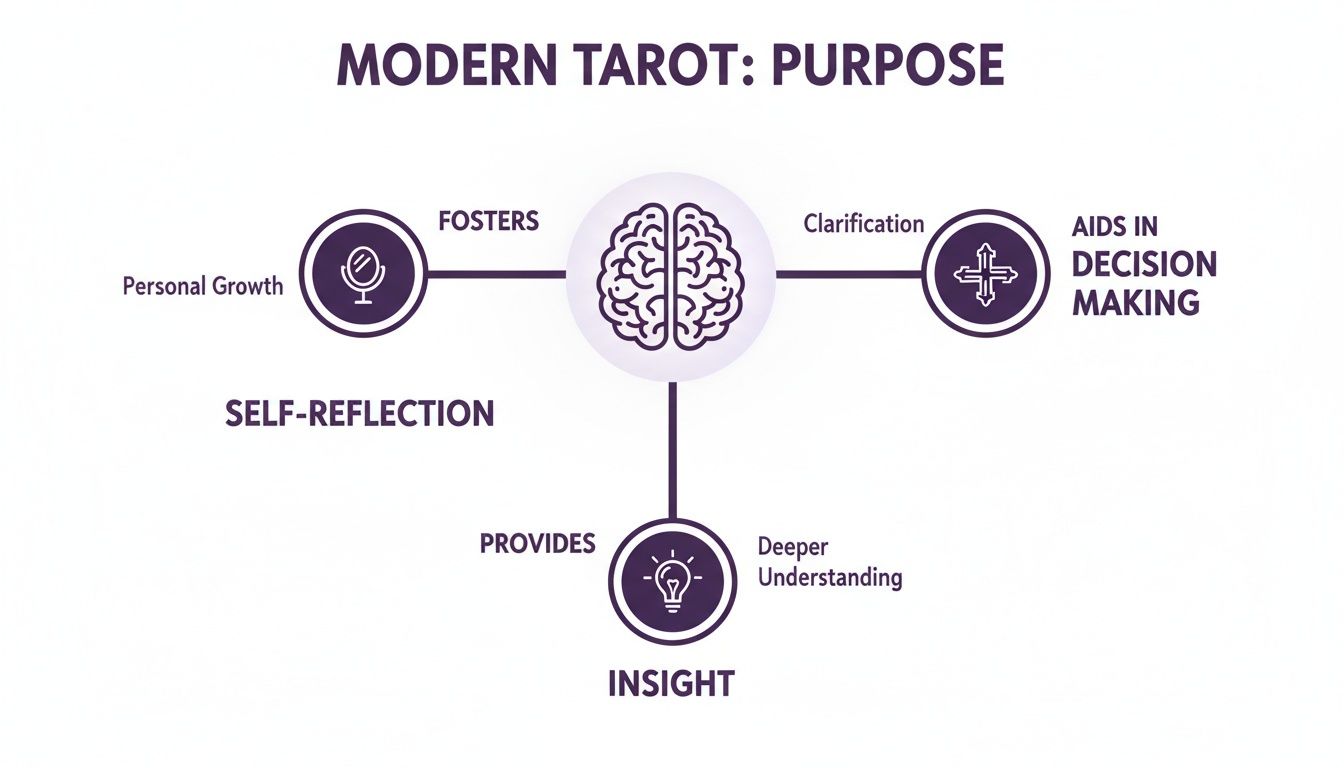
As you can see, these core functions are all interconnected. They work together to help you build a stronger, more honest relationship with your inner world.
A Tool for Introspection, Not Prediction
The real magic of tarot is its ability to externalize what’s going on inside you. When you pull a card, you’re not just seeing an image; you’re projecting your own thoughts, feelings, and experiences onto its symbolism. That simple act can reveal hidden patterns, unspoken fears, or deep-seated desires you hadn’t consciously acknowledged.
Tarot is less about predicting the future and more about creating it consciously. The cards illuminate the path you’re currently on, empowering you to either stay the course or choose a different direction.
By using the cards as prompts for journaling, meditation, or even just quiet contemplation, you can unlock entirely new perspectives and find solutions that were there all along.
The Key Functions of Modern Tarot
Today, tarot is used in all sorts of ways that go far beyond simple divination. Its versatility makes it a valuable companion for anyone on a journey of personal growth.
Here’s a quick look at how these different applications come together, shifting the focus from fortune-telling to a more grounded, insightful practice.
Modern Tarot Applications at a Glance
| Primary Purpose | How It Works | What You Gain |
|---|---|---|
| Deepening Self-Awareness | The cards act as prompts to explore your values, beliefs, and emotional state. | A clearer, more honest understanding of who you are and what you want. |
| Clarifying Decisions | Tarot helps you lay out all the factors and potential outcomes of a situation. | The ability to see your choices clearly and make decisions that feel truly aligned. |
| Fostering Mindfulness | The ritual of shuffling, drawing, and interpreting cards grounds you in the present. | A sense of calm, focus, and a deeper connection to the here and now. |
Ultimately, each of these functions serves the same goal: to help you listen to your own intuition and navigate life with greater confidence and clarity.
How Tarot Evolved From a Parlor Game to a Spiritual Tool
To really get what tarot cards are for today, you have to look back at their surprisingly humble beginnings. The beautiful decks we now link with deep spiritual insight didn’t start that way. They were just a simple parlor game. Knowing this history helps us see tarot not as some rigid, ancient oracle, but as a flexible tool that has changed right along with our own search for meaning.
The story kicks off in 15th-century Italy. Wealthy families commissioned artists to create gorgeous, hand-painted decks to play a trick-taking card game called “tarocchi.” For centuries, that’s all they were—a fun pastime for the upper class, with zero mystical strings attached.
This purely recreational use went on for more than 300 years as the game spread across Europe. All the rich symbolism we now spend hours decoding was, back then, just artistic decoration. The idea of using these cards for self-reflection or to see into the future was completely off the radar.
The Great Transformation of Tarot’s Purpose
Everything changed in the late 18th century, thanks mostly to a group of French occultists. It was a time of fascination with ancient wisdom and hidden knowledge, which set the stage perfectly for tarot’s dramatic reinvention. A French scholar named Antoine Court de Gébelin was the one who really lit the fuse.
In 1781, Court de Gébelin published an essay with a bombshell claim: tarot wasn’t an Italian game at all, but a secret book of ancient Egyptian magic. He argued the cards held the lost wisdom of the god Thoth, smuggled out of Egypt and disguised as a game to survive the ages. His theory was completely wrong from a historical standpoint, but it didn’t matter. It completely reshaped how people saw the cards.
Tarot’s evolution from a game to a divinatory tool highlights a fundamental truth: its purpose is not fixed by its origin but defined by our intention. The cards became a spiritual tool because people saw their potential to mirror the human experience.
This fascinating new origin story captured the imagination of mystics all over Europe. The goal shifted from winning a card game to unlocking ancient secrets. Just like that, the modern purpose of tarot began to take form.
From Egyptian Myths to Psychological Mirrors
Court de Gébelin’s ideas paved the way for other occultists like Jean-Baptiste Alliette (who went by Etteilla) and Eliphas Lévi. They built on his foundation, weaving tarot into other esoteric systems and cementing its new identity as a tool for divination and inner work.
This history is so important. Tarot cards were created in the mid-15th century in Europe as playing cards, plain and simple. Early decks, like the Visconti-Sforza deck from around 1440, were made just for gameplay. It wasn’t until Antoine Court de Gébelin’s 1781 publication, ‘Le Monde Primitif,’ reframed them as relics of Egyptian wisdom that their mystical career took off. You can explore more about this market shift and its historical context to see just how profound this change was.
What this journey proves is that tarot’s power doesn’t come from some dusty, unbroken line of ancient mystics. Its real strength is its incredible adaptability—its ability to become a mirror for whatever culture and consciousness is holding it.
Using Tarot as a Mirror to Your Inner World
Forget everything you’ve seen in movies. The most profound way to use tarot today isn’t about fortune-telling; it’s about self-revelation. Think of your tarot deck as 78 mirrors, each one polished to reflect a different corner of your inner world. When you draw a card, you aren’t glimpsing a fixed future. You’re catching a glimpse of your own subconscious, right here, right now.
It’s a surprisingly straightforward process. The rich, symbolic art on every card is designed to bypass your logical mind and speak directly to your intuition. A card doesn’t contain some secret, objective truth. Instead, it holds a story, and your personal reaction to that story is where the real magic happens.
Projecting Your Inner Reality
Let’s say you pull The Hermit, a card that depicts a solitary figure holding a lantern. What’s your gut reaction? For one person, it might bring up feelings of loneliness and isolation. For another, it could spark a sense of wisdom, quiet introspection, and the peacefulness of being alone.
Here’s the thing: neither interpretation is wrong. Your response is a classic case of psychological projection. You’re instinctively mapping your own hopes, fears, and emotions onto the image you see. The card simply acts as a screen, allowing the movie playing in your mind to become visible. It shows you what’s really going on beneath the surface of your everyday thoughts.
A tarot reading is a way of externalizing your internal landscape. The cards don’t tell you anything you don’t already know on some level; they just give your intuition a vocabulary to speak with.
This conversation between you and the cards is the heart of modern tarot. It’s a way to tune into the parts of yourself that get drowned out by the noise of daily life, making it an incredible tool for genuine self-discovery.
Mapping the Human Experience with Archetypes
So, why does this work so consistently? The answer lies in the work of psychologist Carl Jung. He theorized that all humans are connected through a collective unconscious—a shared well of universal symbols and experiences he called archetypes. These are the primal patterns of human behavior that pop up in our myths, dreams, and art across every culture and era.
The 22 cards of the Major Arcana are essentially a roadmap of these archetypes. They chart the big milestones and universal lessons of the human journey, from the boundless potential of The Fool to the sense of completion found in The World.
When you draw one of these powerful cards, you’re tapping into a deep, universal current of human experience. For instance:
- The Empress: This is the archetype of the Nurturer, embodying creativity, fertility, and abundance.
- The Chariot: Here we see the Victor, a symbol of sheer willpower, discipline, and forward momentum.
- The Tower: This card represents Radical Change—a sudden, disruptive event that clears the way for something new.
Working with these archetypes helps place your personal wins and struggles into a much broader context. It’s a powerful reminder that your experiences are part of a larger human story, which can help you navigate life’s challenges with more perspective and a lot more self-compassion.
Starting a Conversation with Yourself
This isn’t just abstract theory; it’s a deeply practical tool. You don’t need to memorize complex spreads or study for years to start this inner dialogue. One of the best ways to begin is with a simple daily practice.
The One-Card Daily Draw
Think of this as your daily intuitive workout. It’s a small ritual designed to build self-awareness and make self-reflection a habit.
- Set Your Intention: Each morning, before the day gets hectic, take a quiet moment. Ask a simple, open-ended question like, “What energy do I need to focus on today?” or “What should I be aware of?”
- Shuffle and Draw: Hold your question in your mind as you shuffle the deck. When it feels right, draw a single card.
- Observe and Reflect: Before you even think about looking up the meaning, just look at the card. What’s the first feeling or thought that pops into your head? Does the scene remind you of anything in your life?
- Journal Your Insights: Jot down your immediate impressions. Later, you can look up the traditional meaning and see how it connects. Pay attention throughout your day to see how the card’s theme or energy shows up.
This simple act transforms tarot from an idea into a living, breathing guide. It’s a daily check-in with yourself that builds a stronger connection to your intuition, one card at a time. It proves that the deepest purpose of tarot is to help you understand the most fascinating subject you’ll ever encounter: yourself.
Making Better Decisions with Tarot Spreads
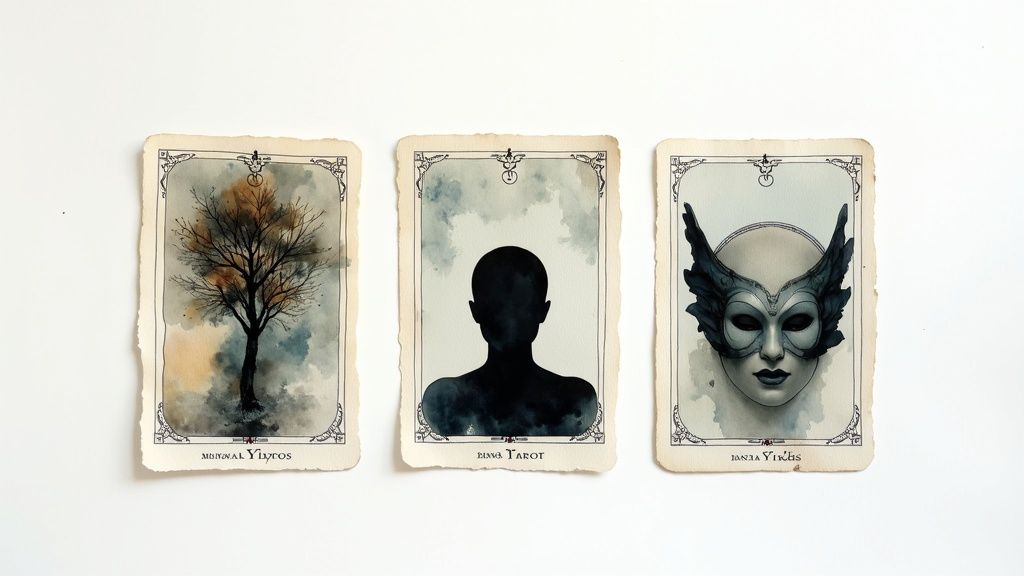
Beyond looking inward, one of the most practical ways to use tarot is as a thinking partner when you’re staring down a tough choice. When you hit a crossroads, the cards can help you see the situation from every angle, turning personal insight into clear, decisive action.
This isn’t about asking a simple “yes” or “no” question and waiting for magic. In fact, that’s probably the least helpful way to approach tarot for decision-making. The real magic happens when you ask open-ended questions that illuminate possibilities instead of shutting them down.
So, instead of asking, “Will I get the new job?” try asking, “What strengths can I lean on to move my career forward?” That small shift changes the whole dynamic. Suddenly, you’re not looking for a passive prediction; you’re having an active strategy session with your own intuition.
Crafting Questions That Empower
The trick is to frame your questions in a way that invites exploration. A good question opens the door to understanding hidden influences, untapped potential, and obstacles you haven’t even seen yet. This approach gives you actionable insights, not a simple, and often useless, binary answer.
It’s this very function that has fueled tarot’s massive growth. The industry is on track to become a USD 1.43 billion market, attracting a mix of spiritual seekers (45%), enthusiasts (30%), and those using it for entertainment (25%). This tells us that people are turning to tarot not just for fortune-telling, but as a legitimate tool for mental wellness and navigating life’s big questions. You can learn more about the cultural integration of tarot on TechSci Research.
By asking better questions, you get a 360-degree view of your situation. And that’s the first step toward making a choice you can stand behind.
Tarot doesn’t make the decision for you. It lays out the map of your current situation—showing you the hills, valleys, and potential roadblocks—so you can choose the best route forward with confidence.
A Practical Example: A Career Crossroads
Let’s walk through a classic dilemma. Imagine you’re stuck between staying in a stable but soul-crushing job and taking a leap of faith on a new career that actually excites you. You’ve been weighing the pros and cons for weeks and you’re just spinning your wheels. This is the perfect time for a simple, yet incredibly powerful, three-card spread.
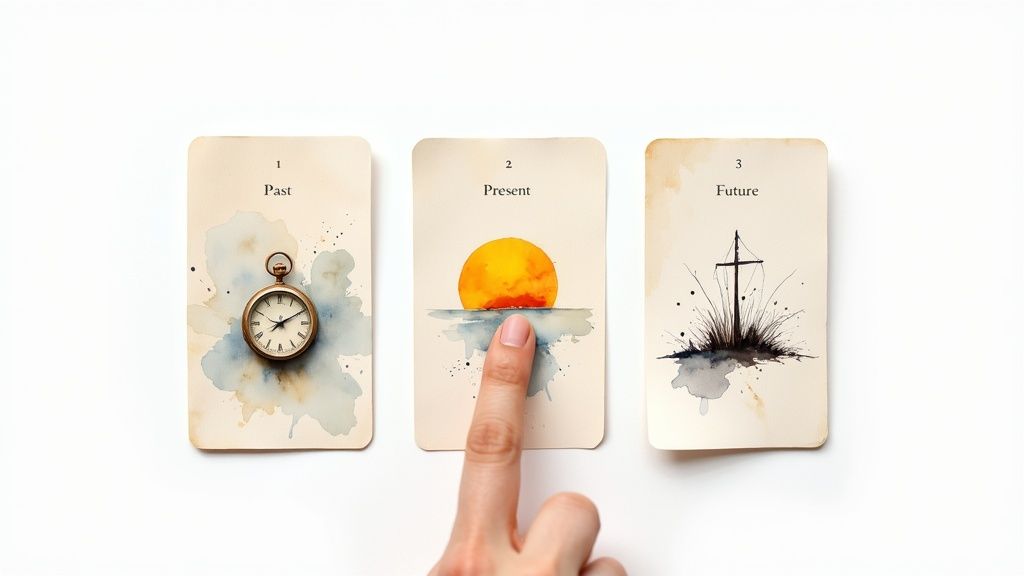
We’ll use the classic Past, Present, Future spread to see how this works.
- Card 1: The Past: This card shows the foundation—the past experiences and energies that brought you to this very moment. It can reveal the baggage you’re carrying or the wisdom you’ve earned along the way.
- Card 2: The Present: This is the heart of the matter. It shines a light on your current situation, your mindset, and the central challenge or opportunity in front of you right now.
- Card 3: The Future: Think of this card not as a prediction, but as a signpost. It points to a potential outcome, showing where your energy is headed if you stay on your current path.
Now, let’s say you pull the Eight of Pentacles for the Past, a card of dedicated work and mastering a craft. For the Present, you get the Four of Cups, which often points to apathy, boredom, and feeling disconnected. Finally, for the Future, you draw The Fool—the ultimate card of new beginnings and taking a leap of faith.
When you put these cards together, a story emerges. Your past is defined by diligence and skill-building (Eight of Pentacles), but your present is colored by dissatisfaction (Four of Cups). The path unfolding before you is all about a brand-new start (The Fool).
This spread doesn’t shout, “Quit your job!” What it does is validate your feelings of burnout and show that your energy is already pulling you toward something new. It empowers you by confirming that this desire for change isn’t just a whim; it’s the natural next chapter in your story. That kind of clarity is exactly what you need to make a truly informed choice.
Why Tarot Is a Mainstream Wellness Tool
Tarot has officially made the leap from dusty occult shops to the mainstream wellness aisle, and it’s not hard to see why. What was once whispered about as a mysterious, fringe practice is now openly embraced as a practical tool for mindfulness, self-discovery, and mental clarity. This isn’t just a coincidence; it’s a direct answer to the needs of a world that often feels chaotic and disconnected.
In an era of endless digital noise, we’re all looking for tangible, offline ways to ground ourselves and reconnect. The simple ritual of shuffling a deck, focusing on a question, and reflecting on the images that appear offers a powerful moment of pause. It carves out a dedicated space for introspection, pulling you away from screens and turning your attention inward.
This growing desire for mindful tools has propelled tarot into a significant cultural and economic phenomenon. The market’s incredible growth reflects a deep shift in how we see tarot cards—not as a gimmick, but as a vital part of a modern spiritual and wellness toolkit.
A Global Trend Toward Introspection
The surge in tarot’s popularity isn’t just a fleeting trend; it’s a global movement that’s gaining serious momentum. The numbers are staggering, showing explosive growth in the tarot industry, especially in North America and the Asia-Pacific regions. It’s a clear sign of a worldwide search for meaning and self-awareness.
The industry was valued at a cool USD 1.2 billion in 2019 and is projected to hit USD 1.8 billion by 2030, growing at a steady 5.50% each year. Tarot decks themselves are the biggest piece of the pie, making up a 60% share, while professional readings and workshops account for 25%. The fastest-growing segment, at 15%, is online platforms, proving just how much digital access is fueling this boom.
The audience is a fascinating mix, too: 35% are enthusiasts, 40% are spiritual seekers, and 25% use tarot for entertainment. You can dig deeper into the tarot industry’s growth on HTF Market Insights. These figures tell a compelling story—the core purpose of tarot is connecting with a broad audience looking for practical ways to navigate their lives.
Tarot has become a modern ritual for grounding. In a world that pulls our attention outward, the act of drawing a card invites us to turn our focus inward, providing a moment of sacred pause and personal reflection.
Making Ancient Wisdom Accessible
Another huge reason for tarot’s mainstream success is just how easy it is to get started. You no longer have to hunt down a specialty shop or a seasoned expert to begin your journey. Technology has brought tarot right to our fingertips, tearing down old barriers and welcoming a whole new generation of explorers.
This newfound accessibility shows up in a few key ways:
- User-Friendly Apps: Countless mobile apps now offer daily card pulls, digital readings, and learning guides, making it simple to weave tarot into your daily routine.
- Thriving Online Communities: Social media and online forums are buzzing with vibrant communities where beginners and veterans share spreads, trade interpretations, and offer support.
- Modern and Inclusive Decks: Today’s artists are designing breathtaking tarot decks that reflect a huge range of cultures, identities, and artistic visions. This means more people can finally see themselves in the cards.
This blend of cultural relevance and digital convenience has solidified tarot’s place as a respected wellness practice. It has beautifully bridged the gap between ancient symbolism and modern life, offering a timeless method for understanding ourselves in a world that never stops changing.
A Practical Guide to Reading Tarot Ethically
Once you understand what tarot is really for, using the cards responsibly becomes second nature. A healthy, sustainable tarot practice is built on a solid ethical foundation—one that makes every reading feel empowering, not frightening. It’s all about creating a safe space for honest exploration, with you as the guide for your own inner wisdom.
This starts with how you even sit down with your deck. Your mindset and emotional state matter, a lot. Trying to read the cards when you’re feeling incredibly anxious, angry, or desperate is a recipe for a confusing, unhelpful session. Your own intense feelings can’t help but color your interpretation, which can easily create a negative feedback loop.
Phrasing Questions for Empowerment
The single most important ethical practice is learning how to ask the right kind of questions. A well-phrased question opens up a world of possibilities and encourages genuine self-reflection. A poorly-phrased one, on the other hand, just shuts down the conversation and can even create a sense of dependency on the cards.
The key is to avoid closed-ended questions that are fishing for a simple “yes” or “no.” This type of question essentially hands all your power over to a stack of paper and completely ignores your own free will in any situation. Instead, focus on open-ended questions that explore your role and agency.
Instead of: “Will I get the job?”
Try asking: “What should I focus on to advance my career right now?”
Instead of: “Does he love me?”
Try asking: “How can I cultivate more love and connection in my life?”
See the difference? This simple shift changes the entire purpose of the reading. You move from seeking a rigid prediction to looking for actionable guidance. You become an active participant in shaping your future, not just a passive observer waiting to see what happens.
The role of a tarot reader—whether you’re reading for yourself or others—is that of a guide, not a psychic. The goal is to illuminate the path, explore the options, and empower the individual to make their own best choices.
Avoiding Common Ethical Pitfalls
A responsible tarot practice also means being aware of a few common psychological traps. Keeping these in mind helps you maintain clarity and ensures your readings stay constructive and helpful.
One of the biggest hurdles is confirmation bias, which is just our natural human tendency to see what we want to see. If you’re desperate for a certain outcome, you might unintentionally twist the meaning of the cards to support it, all while ignoring messages that point toward a different, perhaps more realistic, path.
Another crucial thing to remember is that you always have free will. A tarot reading is just a snapshot of the current energy surrounding a situation; it is not a binding contract with fate. If the cards point toward a difficult outcome, think of it as a valuable heads-up. This insight gives you the power to make different choices and steer your life in a new direction. The future is never, ever set in stone.
By committing to these ethical guidelines, you’ll build a healthy, constructive, and deeply personal relationship with your cards. Your practice will become a reliable source of wisdom and empowerment, truly fulfilling the modern purpose of tarot.
Common Questions About the Purpose of Tarot
As you start exploring the world of tarot, you’re bound to have some questions. That’s completely normal. Getting clear on what the cards are actually for is the first step toward building a practice that feels both meaningful and empowering.
Let’s tackle some of the most common curiosities I hear. You’ll see they all point back to the same core idea: tarot is a tool for self-discovery and insight, not some mystical parlor trick.
Do I Need to Be Psychic to Use Tarot Cards?
Absolutely not. This is a big one that trips a lot of people up. For the vast majority of practitioners, the true purpose of tarot lies in psychological insight, not psychic phenomena.
Think of the cards as a deck of mirrors, each one reflecting a different facet of your own subconscious mind and intuition. The powerful symbols and universal stories are just there to get the conversation started with your own inner wisdom. Anyone can learn this skill—it’s about introspection, not a supernatural gift.
Can Tarot Cards Actually Predict the Future?
This is probably the biggest myth out there. Tarot is less like a crystal ball and more like a weather forecast. It shows you the likely outcome if you keep heading in your current direction, but it doesn’t lock you into an unavoidable fate.
Its real power is in giving you the foresight to make conscious choices today that will shape the future you want tomorrow. It’s about taking the wheel, not waiting for destiny to unfold.
The cards simply highlight where your current energy is leading. This gives you an incredible opportunity to either stay on that path or consciously choose a new one.
Is There a Right or Wrong Way to Interpret a Card?
While learning the traditional meanings of the cards gives you a solid foundation, the most profound interpretations will always come from your own personal connection. The goal here is to spark your own insight, not just recite a definition from a book.
If a card’s imagery triggers a specific feeling, memory, or thought that feels relevant to your question, that is the reading. Trust that inner voice. The “right” interpretation is the one that gives you that “aha!” moment of clarity.
How Do I Choose My First Tarot Deck?
The best advice is also the simplest: go with your gut. Look at different decks, whether online or in a shop, and see which one you feel drawn to. The artwork is the visual language of the cards, so finding a style that resonates with you is crucial.
That said, many beginners start with a classic like the Rider-Waite-Smith deck. Its imagery is straightforward and so widely referenced in guidebooks that it makes learning the foundational meanings much easier.