

So, what exactly is a tarot card reading? At its heart, it’s a way of using a deck of illustrated cards to gain deeper insight into the questions you have about your life. It’s not about predicting a fixed, unavoidable future. Instead, think of it as a powerful tool for self-reflection and personal guidance.
Unlocking Your Story with Tarot Cards
A tarot reading is a lot like having a conversation with your own intuition. The deck’s 78 cards are a kind of visual alphabet, each one packed with symbolic meaning that comes together to tell a story. When you ask a question and lay out the cards, you’re not seeing a glimpse of your destiny. You’re building a narrative that illuminates where you are now, what challenges might be in your way, and what your most empowered path forward looks like.
I’ve always found it helpful to think of the cards as a symbolic mirror. The images reflect your own inner landscape—your hopes, fears, and wisdom—right back at you. It’s amazing how often they bring a hidden perspective to light, showing you an answer you already knew deep down.
To give you a clearer picture, let’s break down the essential components you’ll encounter in any reading.
Key Concepts in Tarot at a Glance
| Concept | Brief Explanation |
|---|---|
| The Querent | This is you—the person asking the question and seeking guidance from the cards. |
| The Question | A clear, open-ended question is best. It forms the foundation of the reading. |
| The Deck | The 78-card deck, divided into the Major Arcana (life’s big themes) and Minor Arcana (daily life). |
| The Spread | The specific pattern or layout in which the cards are placed to answer your question. |
| Interpretation | The art of reading the story the cards tell by combining their individual meanings with your intuition. |
This table is just a starting point, of course. The real magic happens when you bring these elements together and let the story unfold.
Where Did Tarot Come From?
While tarot feels like an ancient mystical art, its history is actually quite surprising. The cards first appeared in mid-15th century Italy, but they weren’t for divination. They were created for a card game called tarocchini—essentially, a fun parlor game for the wealthy.
For hundreds of years, that’s all they were. It wasn’t until much later, around the 18th and 19th centuries, that esoteric and spiritual circles began assigning them the deeper, symbolic meanings we use today. This journey from simple game to profound tool shows just how adaptable tarot is. For a deeper dive into its evolution, you can explore detailed tarot statistics and historical data.
The Core Purpose of a Reading
If it’s not about telling the future, then what’s the point? The real purpose of a reading is to empower you. By laying out all the energies surrounding a situation, tarot helps you:
- Gain Clarity: When you feel stuck or confused, the cards can offer a fresh perspective that cuts through the noise.
- Identify Patterns: Notice recurring themes or behaviors in your life that you might be overlooking.
- Explore Options: See the potential consequences and opportunities tied to different choices you could make.
- Promote Mindfulness: A reading grounds you in the present moment, helping you connect with how you truly feel right now.
A tarot reading doesn’t just hand you the answers. It helps you ask better questions. It gives you a framework for looking inward, so you can find your own conclusions with more confidence and awareness.
Learning to read tarot is like learning a new language—a language of symbols, archetypes, and intuition. It’s a way to have a meaningful dialogue with yourself, navigate life’s twists and turns, and start writing your next chapter with intention.
Understanding the Language of a Tarot Deck
Before you can really get what a tarot reading is, you have to get a feel for the language of the cards themselves. That standard 78-card deck isn’t just a random pile of pictures; it’s a whole system, almost like an alphabet for the human experience. Learning it is a bit like learning the grammar of a new language before you can start having conversations.
The whole deck is split into two main sections: the Major Arcana and the Minor Arcana. They each have a different job, but they work together to paint a surprisingly detailed picture in a reading.
The Major Arcana: Your Spiritual Road Map
The 22 cards of the Major Arcana are the heavy hitters. They represent the big, universal themes and spiritual lessons we all encounter on our journey. Think of them as the archetypes and major turning points that define our lives.
When one of these cards shows up, it’s a sign to pay attention. You’re likely dealing with a major life event or a profound lesson that’s knocking on your door.
If your life were a novel, the Major Arcana cards would be the pivotal chapters—the moments you fall in love (The Lovers), navigate a massive transformation (Death), or celebrate a hard-won victory (The World). They’re the core plot points of your story.
This is where tarot acts as a symbolic mirror, helping you see yourself and your situation from a new perspective.
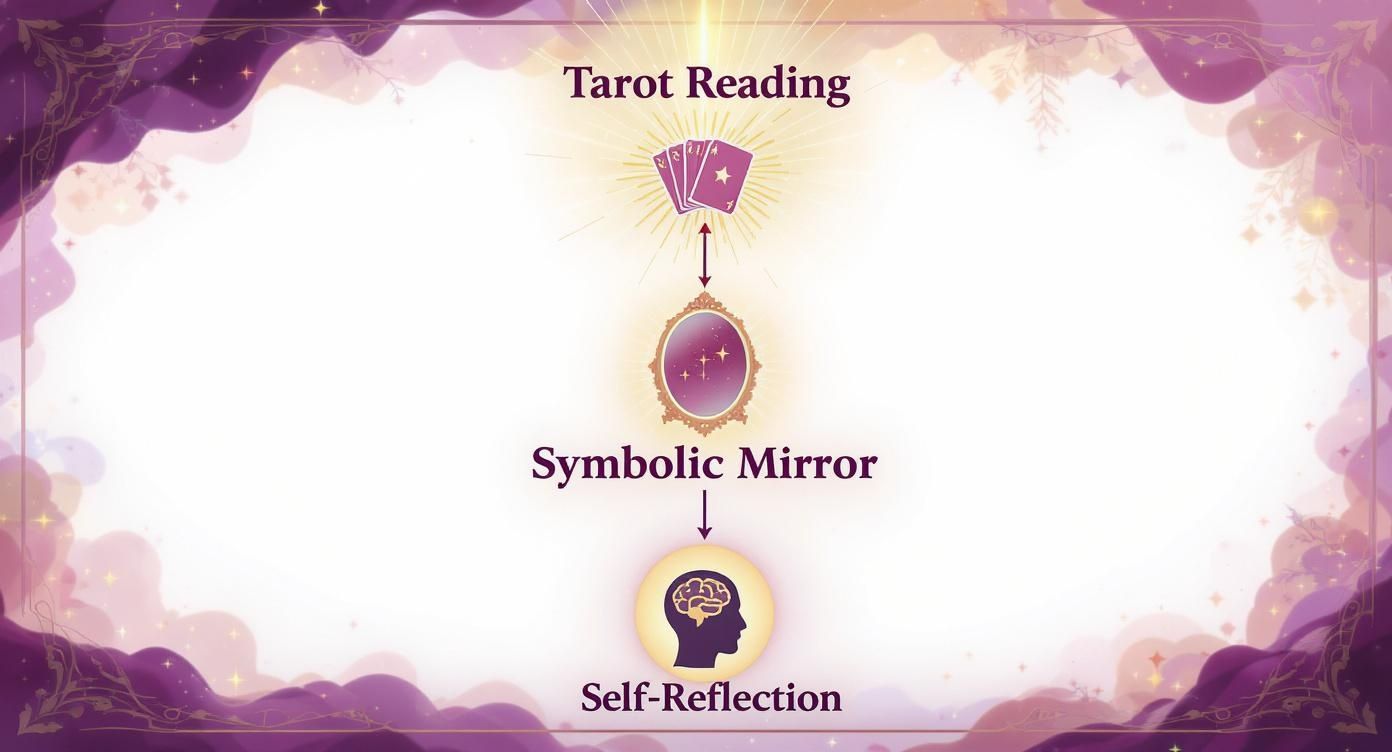
The reading process is really about translating this symbolic imagery into clear, personal insight.
The Minor Arcana: Scenes From Daily Life
Next up, we have the 56 cards of the Minor Arcana. If the Major Arcana are the main chapters of your life’s book, the Minor Arcana are the scenes, dialogues, and everyday details that fill those pages. They deal with the practical, day-to-day stuff—the moods, challenges, and little victories we all experience.
The Minor Arcana is broken down into four suits, which you might recognize from regular playing cards. Each suit governs a different area of life, giving the reading even more texture and detail.
- Wands (Fire): This is the suit of action, passion, and ambition. Wands cards often point to career moves, creative sparks, and the raw energy driving you forward.
- Cups (Water): Cups are all about emotions, intuition, and relationships. They tune into matters of the heart, your connections with others, and your inner emotional landscape.
- Swords (Air): The suit of Swords relates to our thoughts, beliefs, and communication. These cards highlight mental clarity, tough decisions, and the conflicts we face.
- Pentacles (Earth): Pentacles are grounded in the physical world. They speak to our finances, work, health, and sense of stability—all the tangible parts of life.
Each suit has ten numbered cards (Ace through Ten) plus four Court Cards: a Page, Knight, Queen, and King. The numbered cards track the evolution of that suit’s energy, while the Court Cards often show up as people in your life, or even different facets of your own personality.
It’s the combination of the Major Arcana’s big-picture lessons and the Minor Arcana’s everyday details that makes a tarot reading so rich. This interplay helps you see not just what is going on, but why it’s happening and how you can move through it with more awareness.
How a Tarot Reading Actually Works
Forget the crystal balls and smoke-filled rooms you see in movies. A real tarot reading is a grounded, interactive conversation—a three-way dialogue between you, the reader, and the cards. It’s less about predicting a sealed fate and more about creating a quiet space to reflect and tap into the wisdom you already have.
Think of it as a partnership. The reader is there to interpret the rich, symbolic language of the cards, but it’s your context and personal experience that bring the reading to life. You’re working together to uncover insights that were just below the surface.
Setting the Stage with a Good Question
Every powerful reading begins with a thoughtful question. If you ask a vague or simple yes/no question, you’ll likely get a cloudy, unhelpful answer. For instance, asking “Will I get the promotion?” closes you off to possibilities.
A much better approach is to ask something like, “What can I do to align myself with my career goals?” See the difference? The first question asks for a prediction, while the second asks for guidance. It shifts the focus from passively waiting for something to happen to actively co-creating your future.
Here are a few examples:
- Instead of: “Will I find love soon?”
- Try: “What energy can I embody to attract a healthy partnership?”
- Instead of: “Is my current job the right one for me?”
- Try: “What aspects of my career path need my attention for greater fulfillment?”
Getting the question right is key because it sets the intention for the whole reading. You’re telling the universe—and your own subconscious—exactly what you’re hoping to understand.
The Shuffle: The Power of Intention
With a clear question in mind, it’s time to shuffle. This isn’t just about mixing up the cards; it’s a moment to pour your energy and intention into the deck. As you or the reader shuffles, you’re meant to hold your question firmly in your mind.
It’s like tuning an old-school radio to a specific frequency. The act of shuffling infuses the deck with the unique energetic signature of your question, connecting your personal energy to the cards and preparing them to mirror your situation.
A tarot reading is not a passive event where the future is handed to you. It is an active process of inquiry where the cards reveal potential pathways and offer perspectives, empowering you to make conscious, informed choices.
The cards don’t spell out a fixed, unchangeable destiny. They show you the energies at play, the challenges you might run into, and the strengths you already possess. They give you a map of the current terrain, but you are always the one in the driver’s seat.
Laying the Cards and Weaving the Story
Once the shuffling is done, the reader lays the cards out in a specific pattern called a spread. Each spot in the spread has a job. For example, one card might represent your past, another your present, and a third a potential path forward.
Let’s walk through a quick example. Imagine someone feeling stuck at work asks, “What should I focus on for professional growth?” A simple three-card spread is pulled:
- The Situation (The Tower): Whoa. This card often points to a sudden, dramatic shake-up. Maybe a project just got canceled, or there was an unexpected restructuring at their company. It feels chaotic.
- The Action (Eight of Pentacles): This card is all about craftsmanship and diligent work. It’s an invitation to hunker down and master a new skill or pour your energy into becoming an expert at what you do.
- The Potential Outcome (The Star): After the storm comes the calm. The Star is a beautiful card of hope, inspiration, and renewed faith in the future.
Now, a good reader doesn’t just list off these meanings. They weave them into a story that answers the original question. The narrative isn’t about doom and gloom (The Tower), but about an opportunity. It suggests that by embracing the chaos and focusing on skill-building (Eight of Pentacles), you can emerge from this difficult period with a new sense of purpose and optimism (The Star).
The reading offers a clear, empowering path forward—not a prediction, but a strategy.
Beginner Tarot Spreads You Can Try Today
Alright, you’ve got the basics down. Now for the fun part: actually laying out the cards and seeing what they have to say. This is where a tarot spread comes in. Think of a spread as a storyboard for your reading; it’s a specific pattern for laying out the cards, and each position in that pattern has a job to do.
For someone just getting their hands dirty with tarot, simple spreads are your best friend. They give the cards’ messages a clear structure, helping you build a coherent story instead of just staring at a jumble of images. You don’t need a massive, complicated layout to find a profound answer. Often, the most powerful insights come from the simplest arrangements.
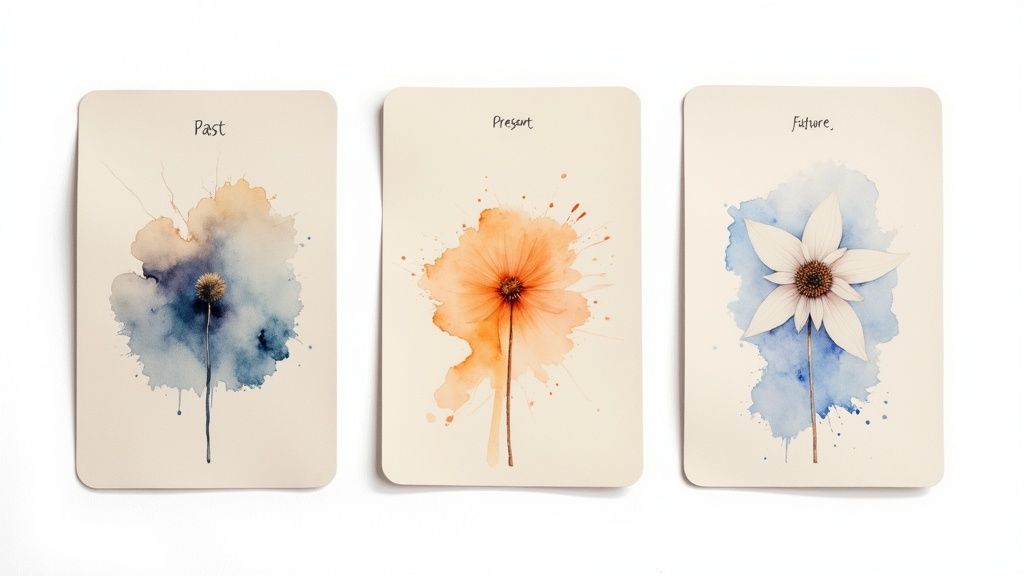
Let’s walk through two of the most essential spreads that are perfect for getting started.
The Classic Three-Card Spread
This is the bread and butter of tarot reading for a reason. It’s direct, easy to remember, and surprisingly deep. The Three-Card Spread gives you a quick, clean look at the momentum of a situation—where it’s been, where it is, and where it’s headed. After you shuffle your deck with a question in mind, you just lay three cards side-by-side.
Here’s what each position usually means:
- Card 1 (The Past): This card points to the history of your question. It reveals the events, energies, or choices that created the situation you’re in now. It’s your backstory.
- Card 2 (The Present): This is the heart of the matter. It shows you what’s happening right now—the main challenge you’re facing, the core energy at play, or the opportunity in front of you.
- Card 3 (The Future): This card offers a glimpse of the likely outcome if you stay on your current track. Remember, this isn’t set in stone! It’s more of a weather forecast than a sealed fate, showing you where today’s actions might lead tomorrow.
This spread is fantastic for a daily draw or when you need a straightforward answer on a specific issue. It’s the perfect training ground for learning how to connect cards into a flowing narrative.
An Introduction to the Celtic Cross
Once you feel more confident with your deck, you might find yourself wanting a more detailed picture. Enter the Celtic Cross. It’s one of the oldest and most famous spreads out there, and it gives you a rich, multi-layered analysis of a situation. The full 10-card spread can look a little intimidating at first, but just getting familiar with its structure is a great next step.
The Celtic Cross is more than just a timeline. It’s like an ecosystem map for your question, showing you everything from subconscious drivers and hidden obstacles to your own hopes and the attitudes of others around you.
Let’s break down its core components in a simplified way:
- The Heart of the Matter: Two cards are placed in the center, one over the other. They represent the central issue and the immediate challenge crossing it.
- The Foundation and Crown: A card below the center shows what’s driving you subconsciously, while a card above shows your conscious thoughts and goals.
- Past and Future: Just like in the three-card spread, cards to the left and right show the recent past and the immediate future.
- The Staff: A final column of four cards on the right explores your own power in the situation, your environment, your inner hopes or fears, and the final potential outcome.
Don’t feel like you have to master this one right away. Start by just learning the positions and what they mean. The most important thing is to simply begin, and these two foundational layouts give you the perfect place to start your practical journey with tarot.
Why Tarot Is Becoming a Modern Wellness Tool
Tarot isn’t some dusty relic anymore. Far from it. It’s making a huge comeback, stepping out of the shadows and into the mainstream as a powerful tool for self-care and mental well-being. People are reaching for a tarot deck for the same reasons they might start a journal or practice meditation.
In a world that feels increasingly chaotic, tarot offers a structured moment to pause and just check in with yourself. It creates a quiet space for introspection, helping you untangle complicated feelings or get clear on a big decision. Think of it as a mindfulness practice that grounds you in the present and helps you listen to that quiet inner voice—your intuition.
A Mirror for Self-Exploration
A huge part of tarot’s modern appeal is its power as a tool for self-discovery. Each card is like a psychological prompt, inviting you to look at different parts of your life, from strengths you never knew you had to challenges you’ve been avoiding. The point isn’t to get some mystical, definitive answer from an external force; it’s about using the cards to unlock the wisdom you already carry inside.
This shift toward personal empowerment is a massive reason for its growing popularity. A good tarot session can help you:
- Process complex emotions by giving them a name and a face through symbolism.
- Spot recurring patterns and subconscious beliefs that might be holding you back.
- Build trust in yourself by flexing and strengthening your intuitive muscles.
- Navigate uncertainty with a stronger sense of purpose and control.
This psychological approach takes the “spooky” out of the practice and makes it a legitimate part of any modern wellness routine. It’s really just a structured way to have a conversation with your subconscious, using the cards as a shared vocabulary.
Tarot doesn’t predict a fixed future; it shines a light on your present. By revealing the energies and patterns at play right now, it empowers you to make more conscious, aligned choices for the path ahead.
Modern Decks and Easy Access
Another huge driver behind tarot’s revival is how incredibly accessible it’s become. Online communities, slick apps, and a treasure trove of digital guides have flattened the learning curve completely. On top of that, a whole new wave of independent artists are creating breathtakingly beautiful and diverse decks that resonate with a new generation.
This cultural embrace is showing up in the numbers, too. The global tarot card market is expected to grow by USD 209.7 million between 2025 and 2029, a trend fueled by a growing interest in personal wellness. E-commerce has made finding the perfect deck as easy as a few clicks, feeding a vibrant global community of readers and collectors.
The growing demand for tarot cards is not limited to one region; it’s a worldwide phenomenon. Let’s look at the projected growth in a few key markets.
Projected Regional Growth in the Tarot Market
| Region | Anticipated Growth Rate |
|---|---|
| North America | 3.8% |
| Europe | 4.2% |
| Asia-Pacific | 5.1% |
| South America | 3.5% |
As the table shows, the interest in tarot is climbing steadily across the globe, with the Asia-Pacific region leading the charge. If you’re interested in the details, you can read more about the tarot market’s growth.
Ultimately, tarot has evolved into a dynamic, living practice that feels right at home in the 21st century. It offers a tangible way to connect with your inner self, make sense of life’s beautiful messes, and mindfully chart a course toward a more aware and fulfilling life.
A Sample Reading: From Question to Insight
Theory is one thing, but seeing tarot in action is where it all clicks. Let’s walk through a simple, complete reading to connect all the dots. You’ll see exactly how a well-framed question and a few cards can weave together a story that offers real clarity.
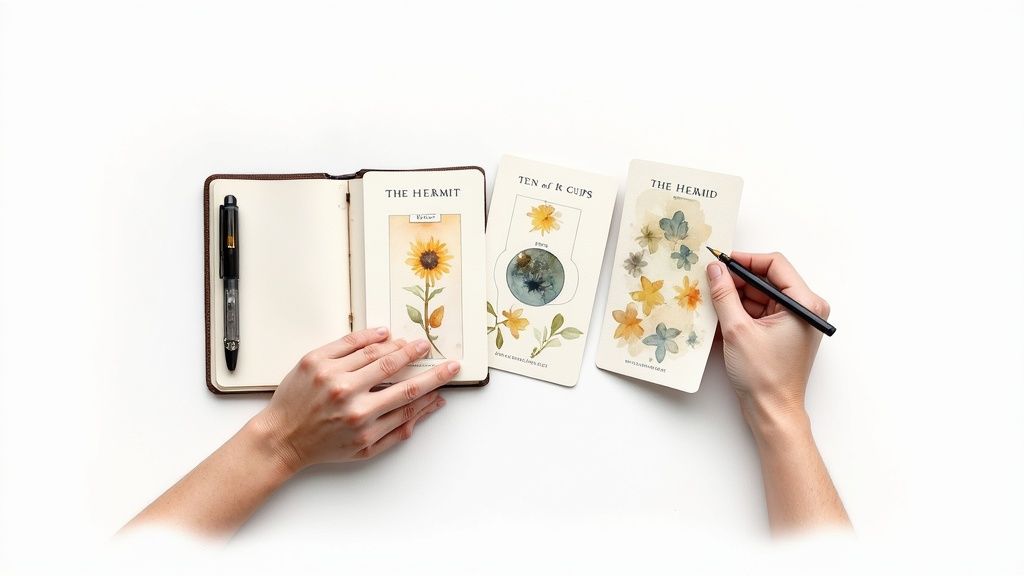
Think of this as a mini case study, showing how the symbolic pictures on the cards translate into actionable guidance for a real-life situation.
Setting the Stage: The Question
Our reading starts with a classic, open-ended question that’s perfect for anyone feeling a bit adrift. Notice we aren’t asking for a prediction; we’re asking for a way to empower ourselves.
The Question: “What energy should I embrace for personal growth right now?”
This is a fantastic question because it invites guidance instead of demanding a simple “yes” or “no.” It puts the power back in your hands, focusing on what you can actually do. After you focus on this intention while shuffling, you draw three cards.
The Cards Drawn: A Three-Act Story
For this reading, we’ll use a simple Past-Present-Future spread to get a feel for the flow of energy. Let’s imagine these are the three cards that came up: The Hermit, the Ten of Cups, and The Star. Each one tells a piece of the story.
- Card 1 (Past): The Hermit. This card points to a recent time of introspection and soul-searching. It suggests you’ve intentionally stepped back from the noise to find answers within.
- Card 2 (Present): Ten of Cups. Seeing this card in the present position is a wonderful sign that your inner work is bearing fruit. It speaks to a deep sense of emotional fulfillment, harmony, and feeling connected to your people.
- Card 3 (Future): The Star. What a beautiful card to end on! This is all about hope, inspiration, and a renewed sense of faith. It promises a future where you feel a true sense of purpose and alignment with the universe.
Each card gives you a snapshot, but the real magic happens when you start weaving them together into a single narrative.
A tarot reading isn’t about looking at isolated symbols; it’s about building a story. The real skill is in seeing the connections between the cards and understanding the journey they’re mapping out.
Weaving the Narrative: From Symbols to Action
Okay, let’s connect the dots. The story starts with The Hermit, showing that you’ve been on a necessary solo journey, turning inward to find your own truth. This wasn’t about being lonely—it was about purposeful solitude that created the foundation for where you are now.
That inner work leads you right to the Ten of Cups in your present. The self-knowledge you uncovered in that quiet time has allowed you to create—or finally recognize—true emotional abundance in your life. You’re in a moment of genuine joy and harmony, whether that’s with family, friends, or your community.
And finally, The Star lights up your path forward. It’s encouraging you to hold on to the hope and clarity you’re feeling right now. The message is crystal clear: trust the wisdom you’ve gained, share your true self with the world, and have faith in the journey ahead. Your time of searching has led to a place of fulfillment, and that feeling is now fueling a future guided by pure inspiration. The energy to embrace is one of hopeful, authentic purpose.
Common Questions About Reading Tarot Cards
As you start to think about tarot and how it might fit into your life, a few questions are bound to pop up. It’s totally normal. Getting some clear answers can really help pull back the curtain and make the whole practice feel less intimidating. Let’s dig into some of the most common things beginners wonder about.
Probably the biggest myth out there is that you have to be psychic to read the cards. I’m here to tell you that couldn’t be further from the truth.
Do I Need to Be Psychic to Read Tarot?
Absolutely not. While tarot will absolutely sharpen your intuition, it’s a skill that anyone—and I mean anyone—can learn. Try to think of the cards less like a mystical crystal ball and more like a deck of psychological flashcards.
Each card is packed with symbols and archetypes that tap into a language we all understand on some level. Learning to read tarot is really about learning to speak this visual language. It’s a way to connect with your own inner wisdom, not about channeling messages from some mysterious outside force. It’s a practice of interpretation and self-reflection, and it’s open to everyone.
This brings up another great question: who should you read for? A lot of people feel pressured to read for others right away, but that’s not where the journey has to start.
Can I Read Tarot Cards for Myself?
Yes, and you absolutely should! In fact, reading tarot for yourself is one of the best ways to get comfortable with the cards and build a real relationship with your deck. It’s an incredible tool for things like daily journaling, quick self-check-ins, or just getting a clearer perspective when you’re feeling stuck.
When you read for yourself, you’re creating a judgment-free zone where you can be totally honest about what you’re feeling. This practice is a powerful way to build self-awareness and learn to trust your own gut feelings without any outside pressure.
Tarot is fundamentally a tool for dialogue with the self. Reading for yourself is not just practice; it is the core purpose of the art—to better understand your own story and the energies shaping it.
Now, picking your very first deck can feel like a huge deal, but it doesn’t have to be stressful.
How Do I Choose My First Tarot Deck?
Honestly, the best first deck is one that just feels right to you. Spend some time browsing online or in a local shop, just looking at different art styles. When you find a deck that you think is beautiful or intriguing, the learning process will feel so much more personal and exciting.
If the sheer number of options feels overwhelming, here’s a simple way to approach it:
- Look for that spark: Does the artwork make you curious? Do the images get your imagination going? Your personal connection is the most important thing.
- Start with a classic: The Rider-Waite-Smith deck is the go-to recommendation for beginners for a good reason. Its symbolism is very direct, and almost every guidebook and online resource uses its imagery as a foundation, which makes learning the ropes much, much easier.
Finally, a lot of newcomers get a little nervous about what happens if they pull a “bad” card.
What if I Draw a Scary Card?
It’s understandable to feel a jolt when a card like Death, The Devil, or The Tower shows up in a reading. The first thing to remember is that these cards almost never point to literal, physical events. In tarot, they represent major—and often necessary—life experiences.
The Death card, for instance, rarely means a literal death. Instead, it signals a powerful transformation—the end of one cycle to clear the way for a fresh start. Likewise, The Devil often highlights feelings of being trapped or pointing out unhealthy attachments you have the power to break. These cards aren’t here to scare you; they’re invitations to look at the tough but essential parts of growth with a bit more courage and awareness.