
Interpreting tarot card combination meanings is really where the tarot comes alive. It’s the art of seeing the story that unfolds when multiple cards land together in a spread. Instead of looking at each card as a standalone message, you start to see how they talk to each other, blending their meanings to offer insights that are far more specific and layered. It’s a bit like eavesdropping on a conversation—one that reveals the deeper narrative of your reading.

Seeing the Bigger Picture in Your Tarot Readings
Ready to take your tarot practice to the next level? While a single card can pack a punch, the real magic happens when the cards start having a conversation. In a reading, cards rarely work alone; they influence, challenge, and support one another, weaving a story that’s full of rich detail.
Think of it like learning a language. You can know a lot of individual words, but you can’t truly communicate until you can string them together into sentences. It’s the same with tarot. Reading card combinations turns a series of simple definitions into a meaningful story, uncovering layers you’d completely miss otherwise.
From Static Symbols to a Dynamic Story
Learning to spot these connections is what separates a novice from an experienced reader. It’s the difference between staring at a pile of ingredients and tasting a fully prepared meal. The individual flavors matter, of course, but it’s how they come together that creates the real experience.
This shift helps you see the flow of a situation—the cause and effect, the hidden obstacles, and the likely paths forward—with so much more clarity. For instance, a challenging card like The Tower might feel daunting on its own, but when it’s followed by The Star, the story suddenly becomes one of hope and healing after a crisis.
By observing how cards interact, you get out of the details of a singular image and begin to assess the landscape as a whole. This bird’s-eye view allows you to see the flow and energy of the entire spread.
Before we dive into the nitty-gritty techniques, let’s get a high-level overview of the core principles at play. This table summarizes the fundamental ways tarot cards influence one another.
Core Principles of Card Interaction
| Interaction Principle | What It Means | Simple Example |
|---|---|---|
| Modification | One card alters or clarifies the meaning of another. | The Lovers (choice) + Two of Swords (indecision) = A difficult choice you’re avoiding. |
| Amplification | Two cards with similar energy strengthen each other’s message. | The Sun (joy) + Six of Wands (success) = A major, public celebration of an achievement. |
| Storytelling | Cards create a sequence of events, showing a progression. | Three of Swords (heartbreak) → Eight of Cups (walking away) → The Fool (new beginning). |
| Context | A card’s position in the spread defines its role in the reading. | The Devil in a “challenge” position points to addiction, while in an “outcome” it could warn of a trap. |
Think of these principles as your basic toolkit. We’ll be exploring each one in depth, but having this framework in mind will make the process much more intuitive.
Why Reading Combinations Matters
Honestly, understanding how cards play off each other is what makes for a truly insightful reading. It’s the skill that moves you from just looking up meanings in a book to intuitively interpreting the unique story the cards are telling you.
- Deeper Insight: Combinations get to the “why” behind a situation, not just the “what.”
- Greater Specificity: They give you advice that feels tailor-made for your question.
- Improved Intuition: Practicing this skill is like a workout for your intuitive muscles.
- More Nuanced Readings: You can start to identify complex feelings, conflicting energies, and clearer paths forward.
By learning the principles of tarot card combination meanings, you’re giving yourself the keys to unlock the incredible wisdom your deck holds. This guide will walk you through it, step-by-step, so you can start seeing these connections and build real confidence as a reader.
Getting Fluent in the Language of Tarot
To really get the hang of tarot card combination meanings, you have to learn how the cards talk to each other. It’s not about memorizing a giant list of pairs. It’s about understanding the grammar of tarot—the basic rules of how they interact. Once you get these building blocks down, you can read any combination of cards that lands in front of you.
Think of it like learning to cook. Sure, you could memorize a handful of recipes. But a real chef understands how flavors work together. They just know why a squeeze of lime cuts through a rich sauce, how a pinch of salt makes something sweeter, and which herbs create a sense of harmony. Tarot is exactly the same. When you understand the core principles, you can create a meaningful story from whatever ingredients the cards serve up.
Interpreting tarot combinations has grown into its own rich, symbolic language. Over the years, readers have developed clear frameworks for making sense of the 3,081 possible two-card pairings in a deck. There are really four main ways modern readers decode these interactions. Mastering them gives you a complete toolkit for pulling the stories out of your spreads. You can dive deeper into these frameworks and their history over at Unknown Truth Tarot.
Blending Keywords for a Clearer Message
The most straightforward place to start is with keyword blending. Every single card in the deck has a core set of meanings or keywords attached to it. When you pull two cards, you can simply blend their keywords to create a new, more specific message.
Let’s say you draw The Fool (new beginnings, leaps of faith) next to the Eight of Pentacles (mastery, diligence, skill-building). Putting those ideas together could point to a new career that demands dedicated study. Or maybe it’s about a new hobby you’re excited to become an expert in. It’s a simple technique that gives you an immediate foundation to build on.
Understanding Suit and Elemental Dynamics
For a little more depth, you can look at how the suits interact through their elements. Each suit carries the energy of one of the four classical elements, and just like in nature, their chemistry can completely change the feel of a reading. Think of it like social dynamics—some people just click, and others create friction.
- Friendly Elements: Fire (Wands) and Air (Swords) are both active and feed each other. Water (Cups) and Earth (Pentacles) are passive and nurturing, so they get along beautifully. When these pairs show up, the energy flows. For instance, the passionate drive of Wands gets focused and directed by the sharp intellect of Swords.
- Opposing Elements: Fire (Wands) and Water (Cups) can create steam—a classic clash. Air (Swords) and Earth (Pentacles) often feel at odds, like an idea that can’t quite get off the ground. These combinations often highlight tension, roadblocks, or a need to find some balance.
- Neutral Elements: Air and Water can coexist peacefully, as can Fire and Earth. How they interact really depends on the specific cards, but they don’t have that built-in friction.
This elemental grammar tells you a ton about the energy of a situation. Are things working together smoothly, or is there an undercurrent of tension you need to pay attention to? It’s a brilliant diagnostic tool.
Analyzing Court Card Relationships
When Court Cards appear, you’ve suddenly got characters on the stage. Reading their interactions is like watching a scene from a play. Are they looking at each other? That could suggest an alliance, a conversation, or a close relationship. If they’re facing away, it might signal a disagreement or a growing distance.
Also, look at their rank and suit. A King and Queen of the same suit could represent a true power couple. A Knight of Wands charging toward a Page of Cups might be a passionate messenger bringing some emotional news. These little details reveal the human dynamics and power structures that are part of the story.
This method turns your reading into a cast of characters, each with their own motivations and influence. It helps you understand who is involved in a situation and what roles they are playing.
Building a Sequential Story
Finally, you can simply read the cards like panels in a comic book, telling a story from left to right. This works especially well in spreads with three or more cards. The first card often sets the scene or shows the past, the middle card is the present situation, and the final card points toward a potential future.
For example, imagine a line-up of the Ten of Swords (a painful ending), followed by The Hermit (introspection), and ending with The Sun (joy, clarity). That tells a pretty clear story, doesn’t it? It speaks of moving on from a tough conclusion, taking some necessary time alone to process it, and finally stepping into a place of happiness and understanding. This storytelling approach weaves the individual card meanings into a timeline that makes sense and gives you a path forward.
A Practical Method for Interpreting Card Pairs
Okay, we’ve covered the “grammar” of tarot. Now it’s time to get our hands dirty and actually put it to work. Theory is great, but the real magic—and the real skill—develops when you’re sitting with the cards in front of you. This is my go-to, step-by-step process for making sense of any two cards you pull, turning those abstract ideas into a reliable, practical habit.
Think of it like learning to cook a new dish. At first, you follow the recipe closely. Over time, your intuition takes over, but that initial structure is what gets you there. This framework gives you a consistent starting point, which helps quiet that “am I doing this right?” voice and builds your confidence with every single reading.
Step 1: Pinpoint the “Subject” Card
First things first, you need to figure out which card is setting the scene. This card is the “subject” or the “noun” in your two-card sentence—it tells you what the situation is fundamentally about. It’s the anchor of the whole interpretation.
More often than not, this will be a Major Arcana card. They carry the big-picture energy and represent major life themes. If you pull two Majors, the one with the higher number often points to the dominant energy or a more developed stage of the journey. If they’re both Minors, trust your gut. Which one feels more central to the question you asked?
Step 2: Identify the “Action” Card
Once you have your subject, the second card becomes the “verb” or the “adjective.” It modifies the first card, telling you how that theme is playing out, what action is happening, or what feeling is coloring the whole situation. This is the card that adds the specific flavor and context.
Let’s say The Emperor (structure, authority) is your subject card. By itself, it’s a solid, stable energy. But pair it with the Eight of Cups (walking away, leaving something behind emotionally), and the story completely changes. Now, it’s not just about authority; it’s about walking away from that structure. The second card directs the energy of the first.
This flowchart gives you a great visual for how these pieces fit together to build a reading.
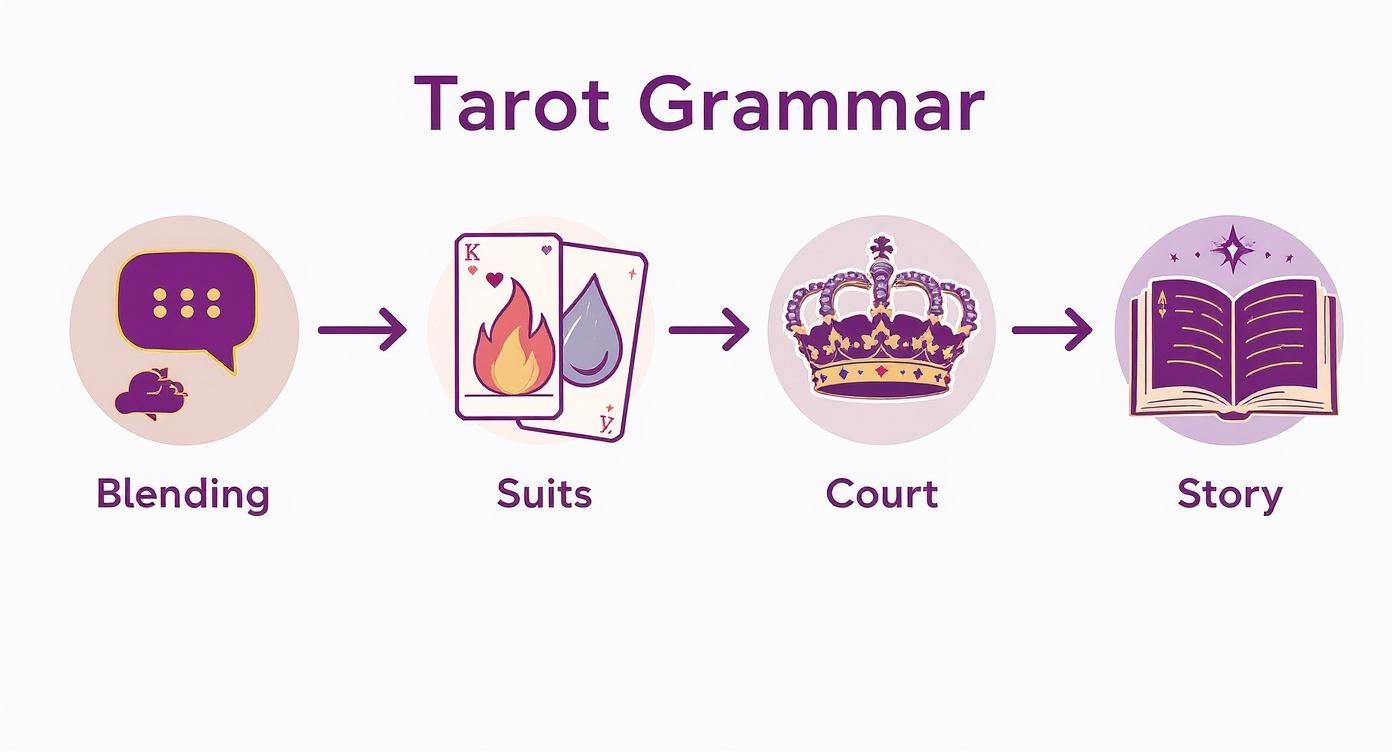
You can see how simple concepts like blending elements build up to create a rich, compelling story.
Step 3: Check the Chemistry Between the Cards
Now, take a step back and look at the dynamic between the two cards. This is where we bring back that tarot grammar. How do these two cards get along? A few questions can guide you here:
- Elemental Vibe: Do their elements work together (like Fire and Air) or do they clash (like Fire and Water)? Harmony suggests things are flowing easily. Conflict points to tension, friction, or a challenge you need to navigate.
- Numerical Flow: Do the numbers tell a story of progression? For example, going from a Three of Swords (heartbreak) to a Nine of Cups (wish fulfillment) clearly shows a journey from pain to healing.
- Visual Clues: Look at the artwork. Are the figures in the cards facing each other, or are they looking in opposite directions? This can give you powerful hints about agreement, conflict, or a total disconnect.
I always think of this step as a chemistry check. It tells you about the undercurrent of the combination—are these cards working in harmony, or are they creating static?
Step 4: Tell the Story
Finally, it’s time to bring it all together. This is where you graduate from analyzing keywords to telling a story. Weave the subject card, the action card, and their energetic relationship into one clear, cohesive message.
Try to avoid just rattling off memorized meanings. Instead, narrate what’s happening. Let’s walk through a classic, powerful pairing to see how this works in a real reading.
Example: The Tower & The Star
Imagine you’re asking about your career and you pull The Tower and The Star. Yikes, right? Let’s break it down.
- The Subject: The Tower (Major Arcana 16) is the unmistakable subject here. It screams sudden, dramatic change and the collapse of old structures. The very foundation of your career is being shaken.
- The Action: The Star (Major Arcana 17) follows, and it completely changes the outlook. Its energy is all about hope, healing, and peace after a storm. It tells you what comes after the chaos.
- The Chemistry: Both are Major Arcana, signaling a massive life event. And their numerical order is key—The Star literally follows The Tower in the deck. This isn’t just a random pairing; it’s a natural, if intense, progression from crisis to recovery.
- The Story: “It looks like a sudden and maybe chaotic shake-up is happening in your career (The Tower). While it feels destructive right now, it’s actually clearing the path for a period of incredible hope, healing, and renewed purpose. This isn’t just a random crisis; it’s a necessary breakdown that will ultimately lead you to a career path that is far more authentic and aligned with who you truly are (The Star).”
By following these four steps, you move beyond single card meanings and start having a real conversation with the tarot. This repeatable process is your foundation for mastering tarot card combination meanings.
Putting It All Together: A Look at Common Tarot Card Pairings
Alright, now that we have a solid process down, let’s get into the fun part: exploring some of the most common and powerful tarot card combination meanings. Think of this section as your cheat sheet and practice arena all in one. By looking at pairs that show up all the time, you’ll start to see the principles we’ve discussed come to life, which will make it so much easier to apply them in your own readings.
While a standard deck can spit out thousands of unique pairings, you’ll find that tarot interpretation has focused on a core set of “classic” combinations over time. In fact, most published guides only focus on about 8-12% of all the mathematical possibilities. If you’re curious about how these interpretations have evolved, HowStuffWorks has a great piece on the history of tarot. This focus helps readers quickly spot the major themes popping up in a spread without getting overwhelmed.
To make this practical, we’ll break down a few key examples in three major life areas: career, relationships, and personal challenges. This will give you a real feel for how the cards’ energies talk to each other depending on the context of the question.
Powerful Combinations for Career and Ambition
Career readings are often about finding purpose, building skills, and navigating structures. The following pair is a perfect example of what it looks like to build something with dedication and authority.
The Emperor + Eight of Pentacles
This is an absolute powerhouse for career growth and mastering your craft. The Emperor brings that big-picture energy of leadership, structure, and vision, while the Eight of Pentacles is all about the daily grind—the diligent, focused work of honing a skill.
- The Story: When you see these two together, they’re telling a story of building a solid, respected career through consistent, hands-on effort. Your hard work is not just paying off; it’s cementing your place as an authority. This isn’t about a lucky break. It’s about becoming a true master within your field.
- The Energy: The Emperor’s ambitious Fire energy (through its link to Aries) perfectly fuels the grounded, practical Earth energy of the Pentacles. This blend is what turns ideas into tangible, productive results. It’s the ideal energy for starting a business, climbing the ladder, or becoming the go-to expert everyone relies on.
Journaling Prompt: Where in my career am I building something that will last? How can I blend my big-picture ambition (The Emperor) with my daily, focused practice (Eight of Pentacles) to achieve true mastery?
Revealing Combinations for Love and Relationships
Relationships are one of the most common topics in tarot, and certain card pairs speak volumes about connection, harmony, and making the right choices.
The Lovers + Two of Cups
This is one of the most beautiful and affirming pairs you can pull for love. The Lovers card points to a significant choice and a deep alignment of values, while the Two of Cups represents that soul-level partnership and mutual emotional connection we all crave.
- The Story: When these cards show up side-by-side, they amplify each other to signal a bond that is truly special. This isn’t just a fleeting romance. It’s a relationship built on shared values, mutual respect, and a deep emotional understanding. It often means you’ve made the “right choice” in love and are stepping into a harmonious, committed union.
- The Energy: You have the thoughtful Air energy of The Lovers (Gemini) mingling with the emotional Water energy of the Cups. It’s a gorgeous blend, suggesting a partnership that works on every level—it has intellectual spark and deep emotional resonance. This is a connection of both the head and the heart.
Journaling Prompt: What does a truly aligned partnership feel like to me? How can I honor both the deep emotional bond (Two of Cups) and the conscious choice to be together (The Lovers) in my relationships?
Insightful Combinations for Personal Challenges
Tarot is brilliant because it doesn’t shy away from the hard stuff. Some combinations are incredibly skilled at pinpointing our struggles and showing us the way through them.
The Devil + Five of Pentacles
This is a tough combination, but it’s an important one. It points directly to the feeling of being trapped by a scarcity mindset. The Devil represents our self-imposed chains—addiction, negative patterns, and limiting beliefs. The Five of Pentacles is the raw feeling of hardship, isolation, and being left out in the cold.
- The Story: Together, they paint a stark picture: feeling stuck in a difficult situation because you believe there’s no way out. The material hardship of the Five of Pentacles feels so much worse because of the psychological chains of The Devil. It’s a powerful hint that the feeling of lack might be more about perception and limiting beliefs than an unchangeable reality.
- The Energy: The heavy Earth energies from both cards (Capricorn for The Devil, Pentacles for the Five) can feel dense, stagnant, and completely immovable. The feeling of being stuck is very real. But the message here is that the key to unlocking the situation is a mental shift—realizing the chains aren’t actually locked.
Journaling Prompt: What limiting beliefs about money or security (The Devil) are keeping me feeling isolated and poor (Five of Pentacles)? What’s one small step I can take today to challenge that mindset?
By studying these common pairings, you start to build your own mental library of tarot card combination meanings. This foundation will help you spot these stories in your own spreads, allowing you to give much more confident and insightful readings.
How We Learned to Read the Cards Together
To really get a feel for tarot card combination meanings, you have to understand that this whole practice didn’t just appear out of thin air. The cards have a fascinating backstory, starting as a simple game and slowly becoming the profound tool for insight we know today. This history isn’t just trivia; it shows us that reading cards together is a tradition built on centuries of evolving spiritual ideas.
The tarot’s journey started way back in 15th-century Italy. Back then, it was a trick-taking card game called trionfi, played by the nobility. For hundreds of years, that’s all it was—a game. The idea of using these beautifully illustrated cards for divination was still a long way off.
The real shift from game to guide began in the late 18th century. This was an era electric with new ideas and a renewed interest in ancient wisdom and esotericism. Thinkers and mystics started looking at the tarot’s powerful allegorical images and seeing something more—a connection to deeper, universal truths. They were laying the groundwork for a whole new way of working with the cards.
The Moment Tarot Changed Forever
The big turning point came in 1770. A man named Jean-Baptiste Alliette, writing under the pseudonym Etteilla, published the very first guide dedicated to tarot card reading. This was a huge deal. It marked the official end of tarot’s 300-year history as a parlor game and the beginning of its new life as a spiritual tool. If you’re curious, the Smithsonian Magazine’s exploration of tarot history offers a great deep dive into this shift.
Etteilla’s work was groundbreaking because he assigned specific divinatory meanings to each card and introduced the idea of reading them in spreads. He was the first person to formalize the concept that the cards could tell a story, creating the very foundation for reading combinations that we still build on.
This shift gave the tarot a new purpose—not just to be played, but to be interpreted. It swung the doors wide open for future mystics to develop a rich, complex symbolic language around the cards.
The Influence of Secret Societies
The art of interpreting tarot combinations was refined even further in the late 19th century, thanks to the Hermetic Order of the Golden Dawn. This influential secret society was home to some of the biggest names in tarot, including A.E. Waite and Pamela Colman Smith—the minds behind the iconic Rider-Waite-Smith deck.
The Golden Dawn didn’t just wing it. They systematically integrated tarot with other esoteric systems like astrology and Qabalah, creating a truly cohesive framework for interpretation. They were obsessed with how different elements and symbols worked together, which led them to develop a much more structured approach to reading card combinations. Their work is the direct ancestor of most modern tarot practices.
The system they developed included:
- Astrological Correspondences: Linking Major Arcana cards to specific zodiac signs and planets.
- Qabalistic Connections: Tying the cards to the Hebrew alphabet and the Tree of Life.
- Elemental Dignities: Formalizing rules for how the four suits—and their corresponding elements—strengthen or weaken one another.
This historical journey shows that reading tarot card combinations is a skill that has been thoughtfully honed over generations. It’s not just about looking at random pictures; it’s about stepping into a long and meaningful tradition of seeking wisdom through symbolic storytelling. When you sit down to interpret a pair of cards, you’re tapping into this deep well of collective insight.
Got Questions About Tarot Combinations? Let’s Talk.
As you start weaving the stories between the cards, you’re bound to have some questions pop up. It’s totally normal. This section is here to tackle some of the most common things readers wonder about when they start looking beyond single-card meanings. Think of it as a friendly chat to clear up any confusion so you can keep building your confidence.
Reading tarot combinations is a skill that really grows with you. The more you practice, the more naturally you’ll start to see these connections and develop your own unique way of interpreting them.
How Many Cards Should I Read Together at Once?
It’s tempting to lay out a huge spread, but honestly, the best place to start is with simple pairs and trios. Learning to read just two or three cards together is the absolute foundation of tarot storytelling. Once you can nail the dynamic between a couple of cards—spotting the subject, the action, and the outcome—you can take that skill and apply it to anything, even a big, complex spread like the Celtic Cross.
Starting small keeps you from getting overwhelmed and lets you really zoom in on the specific energies interacting. It’s a bit like learning a few chords on a guitar before you try to play a whole song.
The real magic isn’t in the number of cards you pull. It’s in the depth of your interpretation. A truly insightful reading of two cards will always be more powerful than a quick, surface-level scan of ten.
When you master the art of reading small clusters of cards, you’re building the intuitive muscle you need to see the bigger story in any layout.
Do Reversals Really Change a Combination’s Meaning?
Oh, absolutely. A reversed card throws a new kind of energy into the mix, and it can dramatically shift the entire story. A reversal often signals that something is a bit off-kilter.
It could point to:
- Blocked or Internalized Energy: The card’s upright potential is there, but it’s stuck or struggling to come out. Picture The Empress reversed next to the Four of Pentacles—that could easily be a creative idea (Empress) that’s being stifled (reversed) by a fear of not having enough resources (Four of Pentacles).
- Too Much or Too Little of Something: The card’s energy is out of balance. The Chariot reversed can mean a total lack of direction. Pair that with the Five of Wands, and you’re looking at a chaotic, pointless conflict where no one is steering the ship.
- An Inverted Meaning: Sometimes, it’s as straightforward as flipping the card’s core message. The Sun is all about joy, but The Sun reversed next to the Ten of Cups could turn a story of happy family life into one where the joy has temporarily faded or there’s a disconnect at home.
When a reversal shows up, pay close attention. It’s often shining a spotlight on the central challenge or the root of the problem within the combination.
What If Two Cards Seem to Completely Contradict Each Other?
This is where the real work—and the real wisdom—of tarot comes in. When you pull a pair like The Lovers (union, alignment) and the Three of Swords (heartbreak, pain), it’s not a mistake. It’s the cards reflecting the beautiful messiness of real life.
These kinds of pairings almost always point to a tough decision, an internal conflict, or a situation where you can’t have one thing without the other. Here are a few ways you can approach these tensions:
- Use a “But” Statement: Frame the interpretation as “this, but also that.” For example: “You’re at a crossroads in a major relationship (The Lovers), but making a choice is causing you a lot of pain (Three of Swords).”
- Look for Cause and Effect: Read them in order, as a sequence of events. “Committing to this path (The Lovers) will unfortunately lead to a necessary but painful separation (Three of Swords).”
- Identify the Obstacle: See one card as the thing getting in the way of the other. “The unresolved heartbreak you’re carrying (Three of Swords) is making it impossible for you to make a clear, wholehearted choice (The Lovers).”
Don’t back away from these contradictions. They’re often where the deepest insights are hiding. Learning to sit with that complexity is what turns a good tarot reader into a great one.