
Learning to trust your intuition isn’t about mastering some mystical power. It’s a practical skill, like learning to read a new language—the language of your own inner wisdom. It’s about getting quiet enough to hear the subtle signals, understanding what your body is trying to tell you, and building confidence one small, validated insight at a time.
What It Really Means to Trust Your Intuition
Ever had a gut feeling that just wouldn’t quit? That quiet nudge telling you to call a friend, or a strange sense of unease about a job offer that looked perfect on paper? That’s your intuition.
Think of it less as a crystal ball and more as your brain’s lightning-fast data processor. Your intuition is a powerful form of subconscious pattern recognition. It instantly sifts through a massive internal library of every experience, conversation, and observation you’ve ever had, connecting the dots in ways your conscious mind can’t. This is why an intuitive hit often arrives as a sudden “knowing” without a neat, logical explanation attached.
The Science Behind Your Gut Feeling
Your logical mind is brilliant but slow. It works through information step-by-step. Your intuition, on the other hand, operates beneath the surface, piecing together a puzzle you didn’t even realize you were solving. It’s an indispensable tool for making sense of complex situations where the hard facts only tell part of the story.
Trusting this inner sense is more common than you might think. A study from Ohio State University revealed that 50.3% of people agree with the statement, “I trust my gut to tell me what’s true and what’s not.” This instinct is crucial in high-stakes fields where quick decisions save lives. Firefighters, ER nurses, and pilots constantly rely on their trained intuition to navigate chaos when there’s no time for a spreadsheet. You can explore more insights on how professionals blend data and intuition to see just how vital this skill is.
“Intuition isn’t something you have to earn; it’s your birthright. It speaks in nudges, not blueprints. It doesn’t always make sense to your logical mind, which is exactly why we doubt it.”
Distinguishing Intuition from Emotional Noise
One of the biggest challenges is learning to tell a true intuitive hit from plain old emotional static. Fear, excitement, and wishful thinking can all feel incredibly powerful, but they come from a different place than your intuition. Getting clear on the difference is game-changing.
It can be tough to distinguish a genuine intuitive signal from a reactive emotion, especially when feelings are running high. This quick guide can help you spot the difference.
Intuitive Signals vs Emotional Reactions
| Signal Type | Characteristics | Common Feeling |
|---|---|---|
| Intuition | Calm, quiet, persistent, neutral, and matter-of-fact. It feels like a simple knowing. | Clear, steady, expansive. |
| Fear / Anxiety | Loud, chaotic, repetitive, and emotionally charged. Often creates worst-case scenarios. | Constricting, panicked, heavy, urgent. |
| Wishful Thinking | Attached to a specific outcome, exciting but ignores potential red flags. Based on desire. | Eager, impatient, floaty, overly optimistic. |
| Ego / Pride | Feels defensive, righteous, or superior. Focused on being “right” or proving a point. | Rigid, inflated, argumentative. |
Learning to notice the quality of a feeling—not just its intensity—is the key. Is it a calm, steady hum or a loud, frantic alarm? Paying attention to these subtle differences is the first real step toward building unshakeable trust in your internal compass.
Recognizing Your Personal Intuitive Style
Ever notice how advice to “trust your gut” feels a little vague? That’s because intuition doesn’t speak to everyone in the same way. Just like we all have unique personalities, our intuition has its own distinct language. Learning to trust it really begins with figuring out how it communicates with you.
It’s not always a dramatic, movie-style gut feeling. Sometimes, it’s a fleeting image that flashes in your mind, a faint sound that no one else hears, or a sudden, unshakable idea that seems to pop in from nowhere.
When you can pinpoint your dominant intuitive style, you learn which signals to pay attention to. Instead of waiting for a booming voice from the heavens, you can start tuning into your own subtle yet powerful inner guidance. This awareness is what turns intuition from an abstract idea into a practical, everyday tool.
The flowchart below gives you a glimpse into the cognitive side of this. It shows how our feelings, memories, and pattern-recognition skills all work together behind the scenes.
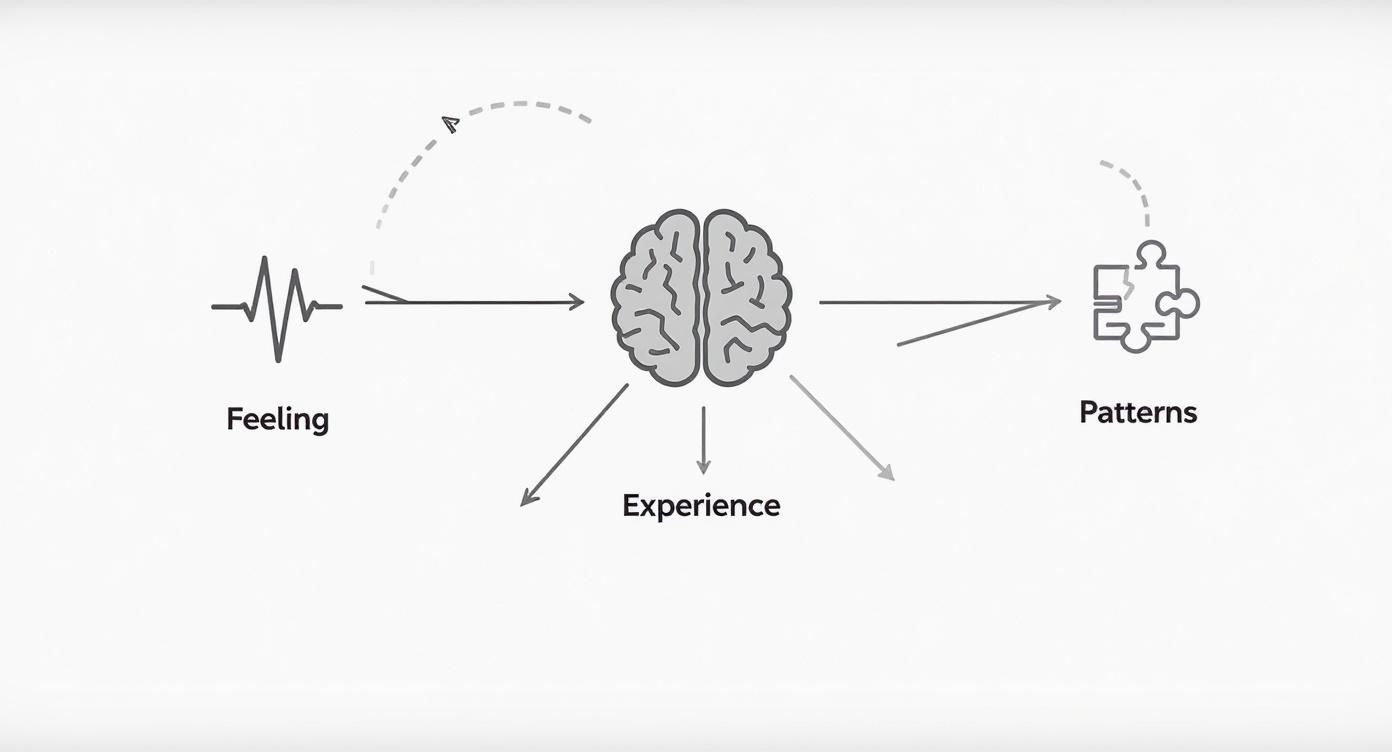
As you can see, intuition isn’t just magic—it’s your mind making connections on a deeper level, filtering feelings through experience to see the bigger picture. Let’s break down the four main ways it shows up.
Clairsentience: The Empathic Feeling
Clairsentience, or “clear feeling,” is probably the most well-known intuitive style. This is your classic gut feeling, where information arrives through physical sensations and emotions. You don’t just think the answer; you literally feel it in your body.
You might be clairsentient if you experience:
- A sudden knot in your stomach when something feels off.
- Goosebumps or a full-body tingle when you hear a profound truth.
- A wave of unexplainable peace that washes over you when you’ve made the right call.
- Feeling suddenly drained or heavy after being around a certain person or in a specific place.
Here’s a real-world example: You’re weighing two job offers. On paper, Job A is the clear winner—more money, better title. Yet, every time you think about accepting it, a sense of dread settles in your chest. When you consider Job B, though, you feel light and expansive. That physical reaction? That’s clairsentient guidance talking.
Claircognizance: The Sudden Knowing
Claircognizance, or “clear knowing,” is the most direct and, honestly, sometimes the most confusing channel. It’s an instant download of information. An insight arrives fully formed in your mind without any logical steps to get there.
There’s no emotion or gut feeling attached—just a profound, unshakable certainty. This is that “it just popped into my head” kind of moment. People who are strongly claircognizant are often fantastic problem-solvers who can see the solution without needing to work through all the steps. They just know.
A claircognizant hit doesn’t argue or debate. It simply presents itself as a fact, leaving you with a sense of certainty that requires no external validation. Trusting it means accepting the knowledge without needing to know exactly how you got it.
For instance, you might be driving and have a sudden, absolute urge to take a different route home. You can’t explain why, but the feeling is insistent. Later, you find out a major accident shut down your usual route. That was claircognizance at work.
Clairvoyance: The Inner Vision
Clairvoyance, or “clear seeing,” communicates through mental images, symbols, dreams, and visions. This isn’t about seeing ghosts; it’s about information appearing in your mind’s eye, like a memory or a daydream. The images can be literal or highly symbolic, offering clues rather than direct answers.
If clairvoyance is one of your go-to styles, you might notice:
- Seeing fleeting images or “mini-movies” in your mind when thinking about someone.
- Having incredibly vivid and meaningful dreams that feel like they’re telling you something important.
- Noticing repeating numbers, animals, or symbols in your daily life that feel oddly significant.
Imagine you’re trying to decide whether to trust a new business partner. As you think about them, you get a brief mental flash of a cracked mask. This symbolic image could be your clairvoyant intuition warning you that this person isn’t being entirely transparent.
Clairaudience: The Inner Voice
Finally, there’s clairaudience, or “clear hearing.” This is intuition that speaks to you through inner sound. It’s rarely a booming voice from the clouds. More often, it sounds like your own voice in your head, offering a single word, a short phrase, or a piece of gentle advice.
This inner hearing can be incredibly subtle and easy to dismiss as your own internal monologue. The key difference is that clairaudient messages often feel distinct. They might have a different tone, use words you wouldn’t normally pick, or offer an insight that seems to come from a wiser, calmer part of yourself.
A classic example is hearing a quiet but firm “no” in your mind right before you agree to something you know you’ll regret later. Or maybe you hear a friend’s name in your thoughts, prompting you to call them at the exact moment they needed you. The first step is simply learning to listen.
Daily Practices to Strengthen Your Intuition
Think of your intuition not as some mystical gift, but as a muscle. The more you use it, the stronger it gets. Building a reliable connection with your inner guidance doesn’t happen overnight; it’s about weaving small, consistent practices into your daily life.
These aren’t meant to be another chore on your to-do list. Instead, think of them as creating little pockets of stillness in your day, moments where you can quiet the outside noise and actually hear what your gut is trying to tell you.

Create an Intuition Journal for Evidence
One of the best ways to start trusting your intuition is to prove to yourself that it works. Your logical mind loves data, and an intuition journal is your personal data-gathering tool. This isn’t about writing long, soul-searching entries. It’s about quick, factual documentation: what was the hunch, and what happened next?
By doing this, you’re building your own “Book of Evidence.” Over time, you’ll present your analytical brain with undeniable proof that your gut feelings are a credible source of information, shifting intuition from the “weird and woo” category to a “trustworthy internal compass” category.
Grab a notebook and dedicate it to this practice. Each day, just jot down any nudges, weird feelings, or premonitions you have. A few simple prompts can get the ball rolling.
Journaling Prompts to Get You Started:
- Morning Intention: “What’s one intuitive nudge I want to listen for today?”
- Decision Log: “My gut says _____ about this, but my head says _____.”
- Outcome Tracking: “I had a feeling about _____, and here’s what actually happened.”
- Physical Sensations: “When I thought about _____, my stomach clenched / my shoulders relaxed / I felt _____.”
Soon, you’ll see the patterns. You’ll learn the unique language of your intuition and see just how often it’s pointing you in the right direction.
Quiet the Mental Chatter with Mindfulness
Your intuition is always online, but it’s often drowned out by the constant static of daily life—emails pinging, social media scrolling, and that endless mental to-do list. Mindfulness is the practice of turning down the volume on all that noise so you can finally hear the quieter signals.
You don’t need to meditate for an hour on a mountaintop. Seriously. Just five minutes of focusing on your breath can calm your nervous system enough to create a little space. When your mind is less cluttered, those subtle intuitive whispers can finally make their way through.
“To truly come home to ourselves, we need to start reversing the order of our internal guidance system Spirit first, then body, then mind. Intuition can’t live in a spreadsheet.”
Imagine your mind is like a lake. When it’s churning with thoughts and stress, the water is murky. But when you allow it to be still, the sediment settles, and you can see straight to the bottom. That clarity is where intuition thrives.
Distinguish Intuition from Anxiety with Grounding
This is a big one. It’s so easy to mistake a wave of anxiety for a genuine intuitive warning. While both can create physical reactions, their energy feels completely different. Intuition is usually calm, neutral, and matter-of-fact. Anxiety, on the other hand, is loud, frantic, and emotionally charged.
Grounding techniques are your secret weapon here. They are simple, physical exercises that pull you back into the present moment and help you tell the two apart.
Simple Grounding Techniques to Try:
- The 5-4-3-2-1 Method: Pause and name five things you can see, four things you can physically feel, three things you can hear, two things you can smell, and one thing you can taste. This immediately yanks your awareness out of a spinning mind and into your physical reality.
- Feel Your Feet: Whether you’re sitting or standing, press your feet firmly into the floor. Imagine roots growing from the soles of your feet deep into the earth. It sounds simple, but this creates a powerful sense of stability.
- Hold a Grounding Object: Keep a smooth stone or a small, textured object in your pocket. When you feel overwhelmed, hold it. Focus completely on its weight, its temperature, its texture.
When you practice grounding, you establish a baseline of calm. From that centered place, it becomes much easier to ask, “Is this a real intuitive hit, or just a passing anxiety storm?” That clarity is everything when it comes to building an inner guidance system you can actually rely on.
Practical Tools to Validate Your Gut Feelings
So, you’ve started tuning into your intuitive style and you’re doing the mindfulness work. That’s fantastic. But there’s often a lingering question: “Can I really trust this?” Your logical mind, trained to run on facts and figures, can be a pretty tough customer. This is where tangible validation tools become your best friend. They act as a bridge, connecting that quiet inner knowing with the solid, outside world.
These methods give you a way to test and verify your gut feelings, building a rock-solid foundation of confidence piece by piece.
Instead of feeling like you have to take a blind leap of faith, these techniques let you play with your intuition in low-stakes situations. You’re essentially creating a feedback loop that proves to your skeptical brain that your intuition knows what it’s talking about.
Using Tarot and Oracle Cards as Intuitive Mirrors
Lots of people think of tarot or oracle cards as tools for predicting a fixed future. I prefer to see them as something much more powerful: mirrors for your own subconscious mind. The magic isn’t in the cards; it’s already inside you. The images, symbols, and archetypes are just prompts—they help you pull out the intuitive wisdom you already have but can’t quite put into words.
When you pull a card about a situation, you’re not getting an order from on high. You’re simply getting a different angle. The image on the card might spark a memory, trigger an emotion, or deliver a sudden aha! moment that cuts right through your mental noise. It’s a way of externalizing your inner world so you can actually see it.
Think of it like this: your intuition is speaking a language your conscious mind doesn’t fully understand. Tarot cards act as a translator, turning those nuanced feelings and subconscious patterns into a visual story you can interpret.
A Simple Tarot Spread for Intuitive Clarity
You don’t need to be a professional reader to get real value from tarot. A simple three-card spread is one of the best ways to get clear, focused insight on a specific question. As you shuffle the deck, just hold your question in your mind. Then, lay three cards out from left to right.
This quick spread gives you a narrative—a beginning, a middle, and a potential path forward—all based on the energy you bring to the cards.
Simple Tarot Spread for Intuitive Clarity
| Card Position | Question It Answers | Interpretation Focus |
|---|---|---|
| Card 1 (Left) | “What is the core of the situation or the past influence?” | This card helps ground you in the context of the issue, reflecting the underlying energy or what led you here. |
| Card 2 (Middle) | “What is the immediate challenge or current action needed?” | Focus on this card for present-moment guidance. It often highlights the main obstacle or the most helpful next step. |
| Card 3 (Right) | “What is the potential outcome or guiding wisdom moving forward?” | This card offers insight into where the current path is leading, providing wisdom to help you navigate what’s ahead. |
Let’s imagine you’re mulling over a career change. The first card might show your current job’s stagnation. The second could point to a fear of the unknown that’s keeping you stuck. And the third might reveal an image of new growth, confirming your gut feeling that it’s time to take the leap.
Low-Stakes Intuitive Testing in Daily Life
Another brilliant way to build trust is to turn your everyday life into an intuition playground. The idea is to test your gut feelings where the consequences are zero. This builds up your personal “Book of Evidence” with small, consistent wins, which makes it much easier to trust your gut when a really big decision lands in your lap.
Start with a few fun, simple games.
- The Phone Test: When your phone rings, don’t look. Take a breath and guess who it is. You’ll be surprised how often you get it right.
- The Email Guess: Before you open your inbox, try to sense how many new messages are there, or who the most important one is from.
- The Elevator Prediction: Waiting for the elevator? Guess which one will arrive first or how many people will be inside when the doors open.
The point isn’t to be 100% accurate. The point is to pay attention. Every correct guess is another little deposit in your self-trust account, reinforcing that link between an inner nudge and a real-world result.
This approach of blending inner sensing with external validation is surprisingly similar to what happens at the highest levels of business. The best leaders don’t choose between intuition or data; they’ve learned to combine both in what experts call ‘Quantitative Intuition’ (QI). In fact, a survey of over 1,000 senior executives revealed that highly data-driven organizations are three times more likely to report major improvements in their decision-making. In that world, intuition acts as the final check, making sure the numbers actually make sense in reality. You can find more research on how intuition complements data in business strategy.
How to Overcome Common Intuitive Blocks
Even after you decide to start trusting your intuition, you’re going to hit roadblocks. It’s inevitable. These are those nagging mental and emotional hurdles that make you second-guess that quiet inner voice. The good news is, just seeing these blocks for what they are is the first real step toward moving past them.
The most common obstacles aren’t some big mystery; they’re just part of being human. We’re talking about persistent self-doubt, the paralyzing fear of being wrong, and the constant noise of everyone else’s opinions. Learning to work with these challenges is a core part of the journey.

Addressing Persistent Self-Doubt
Self-doubt is probably the number one intuition killer. Most of us have been taught to lean on external proof and hard data our whole lives. So, when a gut feeling shows up without a neat, logical explanation, our inner critic immediately goes on the attack. It sounds a lot like, “How could you possibly know that? You’re just making it up.”
The trick is to change your relationship with that voice. Instead of fighting it, get curious. When the doubt creeps in, just acknowledge it. Say to yourself, “Okay, I hear you, doubt. Thanks for your input, but I’m going to stay open to this feeling anyway.” This simple act puts a little bit of space between you and the doubt, giving your intuition a chance to be heard.
Your logical mind wants to keep you safe by sticking to past experiences and proven facts. Your intuition, on the other hand, often points toward a future you haven’t lived yet. Self-doubt loves to live in that gap, but it doesn’t have to win the argument.
Overcoming the Fear of Being Wrong
The fear of making a mistake can be completely paralyzing. What if I follow my gut and it’s a total disaster? This is the fear that keeps us stuck, choosing the “safe” and logical option over the intuitive one. The best way I’ve found to dismantle this fear is to completely redefine what it means to be “wrong.”
Instead of seeing an intuitive miss as a failure, look at it as a data point. It’s feedback. Every time you follow a nudge, you learn something valuable.
- If it works out: Fantastic. You’ve just gathered more proof that your intuition is on your side.
- If it doesn’t: You’ve learned more about how your inner guidance system works. Maybe what you mistook for intuition was actually anxiety, or even just wishful thinking.
This reframe turns every decision into a win-win. You either get the outcome you wanted, or you get a clearer map of your inner world. All the pressure just melts away, making it much safer to experiment and trust.
Quieting External Noise and Opinions
We live in a world that’s constantly buzzing with information. It’s incredibly easy for the opinions, fears, and expectations of others to become louder than our own inner voice. Friends, family, and especially social media can create a storm of external noise that makes hearing yourself think, let alone feel, almost impossible.
Creating some gentle boundaries is non-negotiable here. It doesn’t have to be complicated. It might just look like:
- Scheduling quiet time: Carve out a few minutes each day to unplug from everything. No phone, no TV—just you and your thoughts.
- Limiting your advisors: When you have a decision to make, consciously limit how many people you ask for their opinion. Trust that you have the answer inside you first.
- Practicing mindful consumption: Pay attention to how you feel after scrolling Instagram or talking to certain people. If you feel drained, anxious, or more confused than before, that’s a sign to limit that particular input.
This isn’t about becoming a hermit. It’s about creating enough internal quiet to hear your own wisdom before the world rushes in with its two cents.
Still Have Questions About Trusting Your Gut?
As you start leaning into your intuition more, you’re bound to run into some tricky questions. It’s totally normal. Your logical brain has been running the show for a long time, so it’s natural for it to get a little skeptical when this other voice starts chiming in.
Let’s walk through some of the most common hurdles people face when they’re learning to listen to that inner guidance.
How Can I Tell Intuition from Anxiety?
This is the big one, right? Both can give you a powerful physical jolt, but they feel completely different once you learn to tell them apart.
Intuition usually feels quiet and neutral. It’s a simple, matter-of-fact knowing that lands without a lot of drama. It doesn’t spin wild “what if” stories or paint a picture of doom—it just delivers a piece of information.
Anxiety is the opposite. It’s loud, frantic, and loaded with emotion. It feels tight and constricting, often trapping you in repetitive, fearful thought loops about what might go wrong.
The next time a strong feeling hits, just pause. Ask yourself: is this a steady, calm hum or a blaring, chaotic alarm?
What If My Gut Contradicts the Facts?
This can be incredibly confusing. The job offer checks every box on your list, but something deep in your stomach is screaming “no.” All the data points one way, but a quiet, persistent voice is nudging you in another.
The key here isn’t to toss logic out the window. Instead, think of your intuition as a signal to look closer. What crucial detail might the facts be missing? That gut feeling could be picking up on something your conscious mind overlooked—like the subtle tension in the office during your interview, or a clause in the contract that just feels off.
Intuition doesn’t always make logical sense right away because it’s working with a much bigger set of data: your subconscious, your past experiences, and your sensory input. Use its signal as a reason to get curious and ask more questions, not to ignore the facts.
Can My Intuition Ever Be Wrong?
I find it’s more helpful to think in terms of “clear” versus “unclear” signals, rather than “right” or “wrong.” Sometimes, what we mistake for intuition is actually our own fear, ego, or wishful thinking wearing a clever disguise. If a decision doesn’t turn out how you hoped, it doesn’t mean your intuition failed you.
Look at these moments as feedback. Every time you misinterpret a signal, you learn more about what a true intuitive hit feels like compared to an emotional reaction. When you reframe these experiences as learning opportunities instead of failures, you take the pressure off. It makes it safer to keep listening.
This is exactly how you build real, unshakeable trust over time—through practice, patience, and a little bit of trial and error.