

Learning to read tarot cards is a fascinating journey. At its heart, it’s about using beautifully illustrated cards to tap into your intuition and get a clearer picture of the past, present, and potential future. It all starts with choosing a deck that feels right, connecting with it, and beginning to understand the stories woven into its 78 cards—the Major and Minor Arcana.
Starting Your Journey Into Tarot Reading
So, you’re ready to dive into the world of tarot. First thing’s first: let go of the idea that tarot is about predicting some rigid, unavoidable destiny. It’s much more useful to think of the cards as a mirror, reflecting your own inner wisdom and current situation through their powerful, archetypal imagery.
This first phase is all about creating a personal foundation. It’s where you take a simple deck of cards and turn it into a trusted guide. Your journey doesn’t begin with memorizing dozens of meanings; it begins with connection.
Finding a Deck That Speaks to You
Your very first, and maybe most important, step is to choose a tarot deck. With literally thousands of options out there—from historical decks to modern, indie creations—it can feel a little overwhelming. The secret is to find one whose artwork and overall vibe just clicks with you.
Don’t feel pressured to grab the most famous or traditional deck unless its art genuinely moves you. That connection is the foundation of every intuitive reading you’ll do.
- Trust Your Gut: Spend time browsing decks, whether online or in a local shop. See what catches your eye. Which one makes you feel curious? Inspired? Understood? That’s the one.
- Look at the Symbolism: Many decks are based on the classic Rider-Waite-Smith system, which is a great starting point for beginners. But others take a completely different artistic path, which might ignite your intuition in a whole new way.
- Check the Feel: If you can, pay attention to the cardstock and size. You’ll be shuffling and handling these cards a lot, so you want them to feel comfortable in your hands.
Cleansing and Connecting with Your New Deck
Once you’ve brought your deck home, it’s time to make it truly yours. This starts with cleansing it of any lingering energy from its creation, packaging, and journey to you. Think of this simple ritual as the official start of your relationship with the cards.
Even small, intentional acts can build a strong bond. The idea is to clear the slate and infuse the deck with your own energy and intentions, turning it into a sacred tool for your personal practice.
Think of it like this: You wouldn’t invite a new friend into your home without a warm welcome. Cleansing and connecting with your deck is your way of welcoming its wisdom into your personal space.
This simple practice helps set the stage for much clearer and more insightful readings down the road. It’s also fascinating to remember the cards’ own journey. While we use them for divination, tarot cards actually originated in mid-15th century Italy as playing cards. The French Tarot game, for example, grew to become the second most popular card game in France by the 1970s. This rich history adds yet another layer to the story in your hands. You can learn more about the multifaceted origins of tarot to appreciate their depth.
Understanding the Language of the 78 Cards
Every tarot deck holds a complete world within its 78 cards. The biggest mistake beginners make is trying to memorize each card’s meaning like a flashcard. Instead, think of it as learning a rich, symbolic language—one that tells the story of our lives.
The deck’s structure is your map. Once you get a feel for its layout—the difference between the Major and Minor Arcana—you’ll start to see how individual cards connect to weave a cohesive narrative. This framework is what turns a random collection of cards into a deeply personal story.
The Major Arcana: The Soul’s Journey
The first 22 cards you’ll encounter are the Major Arcana. These are the heavy hitters of the tarot, the showstoppers. They represent life’s biggest moments, major spiritual lessons, and the universal archetypes that define the human experience. When a Major Arcana card appears, pay attention. It’s a sign that you’re dealing with a powerful, overarching theme.
Think of the Major Arcana as the main chapters in the book of your life. It all starts with The Fool (card 0), buzzing with new beginnings and pure potential, and ends with The World (card 21), a symbol of completion and wholeness. Along the way, you’ll meet iconic figures like The Magician (manifestation), The High Priestess (intuition), The Emperor (structure), and The Lovers (relationships and choice).
Cards like The Tower point to sudden, necessary upheaval, while Strength speaks to your inner courage. And don’t fear Death! It almost always signifies an ending that’s making way for a much-needed new beginning. Getting to know these archetypes is the first real step to reading with depth and confidence.
The Minor Arcana: Everyday Life and Experiences
While the Major Arcana deals with the big picture, the Minor Arcana gets into the nitty-gritty of daily life. These 56 cards are divided into four suits, just like a regular deck of playing cards, and they give context to the major themes.
They cover the day-to-day joys, struggles, thoughts, and feelings that make up our reality. Understanding the four suits is crucial for adding nuance and detail to your readings.
Here’s a helpful way to think about it: The Major Arcana cards are the destination, but the Minor Arcana cards are the specific roads, detours, and coffee stops you take along the way.
Let’s quickly break down what each of the four suits represents.
The Minor Arcana suits are your key to understanding the specific energies at play in a reading. Each one governs a different part of the human experience.
The Four Suits Of The Minor Arcana
| Suit | Element | Represents |
|---|---|---|
| Wands | Fire | Passion, creativity, action, willpower, and inspiration. |
| Cups | Water | Emotions, relationships, intuition, love, and feelings. |
| Swords | Air | Thoughts, communication, conflict, truth, and intellect. |
| Pentacles | Earth | The material world, finances, work, health, and manifestation. |
Once you know the themes of each suit, you can start to see how the story unfolds.
Each suit contains ten numbered cards (Ace through 10) that show a progression. Think of the Ace of Cups as the first spark of a new feeling, while the Ten of Cups represents total emotional fulfillment. On the other hand, the Ace of Swords could be a brilliant new idea, but the Ten of Swords often points to a painful, final ending.
This beautiful structure allows you to see the full spectrum of a situation, from the first fiery spark of an idea in the Wands to the grounded, material results in the Pentacles.
The Court Cards: The Personalities in the Deck
Tucked inside the Minor Arcana are 16 special cards called the Court Cards: the Page, Knight, Queen, and King of each suit. These can be a bit tricky at first because they don’t just represent events—they often represent people, personality traits, or a specific way of approaching a situation.
When you pull a Court Card, ask yourself if it could be:
- A specific person: This might be you or someone else. The Queen of Cups could point to a compassionate, emotionally mature person in your life.
- A part of yourself: The card might be nudging you to embody a certain energy. The Knight of Wands is often a call to be more adventurous and just go for it.
- A level of maturity: Pages are beginners, Knights are about action, Queens have mastered their suit’s energy internally, and Kings master it out in the world.
Let’s say you ask about a career change and pull the King of Pentacles. This could represent a stable, successful mentor, or it could be advising you to adopt a more strategic and resourceful mindset to reach your goals. Learning to interpret these cards flexibly is what brings a reading to life, adding a deeply human layer to the story.
Time to Lay Out the Cards: Your First Spreads
Alright, you’ve got a feel for the individual cards—the big life lessons of the Major Arcana and the day-to-day happenings of the Minors. Now, let’s start putting them together to tell a story. That’s all a tarot spread really is: a structured layout that gives each card a job to do.
Think of it like this: if each card is a word, the spread is the sentence structure. It’s the framework that helps you see how different energies connect and weave a narrative. Without a spread, you just have a single card’s message; with one, you get a detailed, insightful conversation.
This visual shows how the deck’s components fit together. The Major Arcana set the main stage, while the Minor and Court cards bring in the specific actions, feelings, and people.
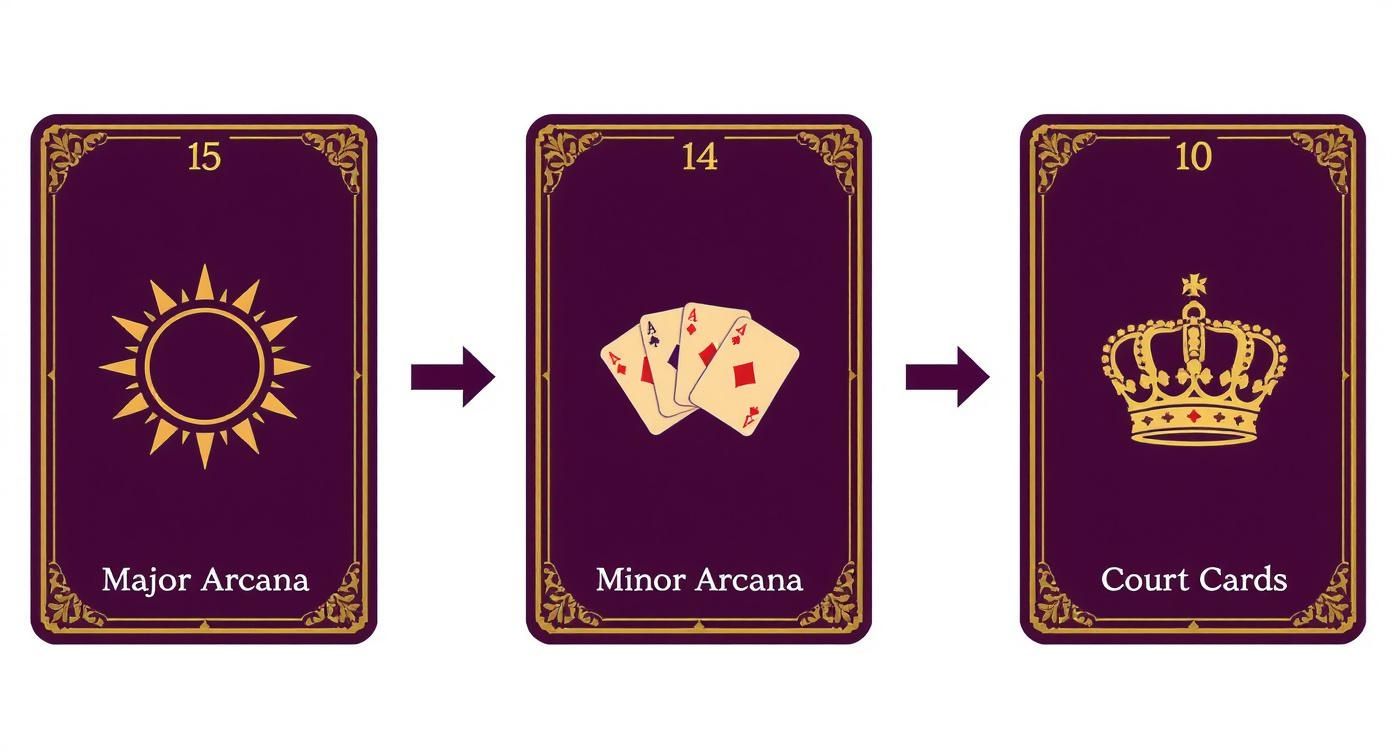
Keeping this structure in mind is a huge help when you’re reading. It reminds you to look for the main theme first, then fill in the details.
The Simple Yet Powerful Three-Card Spread
There’s a reason just about every reader loves the Three-Card Spread. It’s clean, direct, and gives you quick clarity without feeling like you’re trying to decipher a novel. For daily check-ins or straightforward questions, it’s my go-to.
The classic interpretation is a simple timeline:
- Position 1: The Past. What events and energies set the stage for where you are now?
- Position 2: The Present. This is the heart of the matter. What’s the core situation right now?
- Position 3: The Future. Where are things heading if the current energy continues?
This structure is a fantastic starting point, but don’t be afraid to get creative. You can easily adapt the positions to fit any question, like “Mind / Body / Spirit” or “Situation / Action / Outcome.”
The real magic happens when you look at the space between the cards. See how the “Past” card flows into the “Present,” and how that “Present” energy is building toward the potential “Future.” That’s where the story lives.
Let’s run through a quick example. Say you’re feeling a bit lost at work and ask, “What do I need to know about my professional path?”
You pull three cards:
- Past (Eight of Pentacles): You’ve been putting in the work. This points to a history of diligence, honing your skills, and really dedicating yourself to your craft.
- Present (The Hanged Man): Right now, things feel stuck. This isn’t a bad thing; it’s a call for a pause, a moment of surrender to see your situation from a completely different angle.
- Future (The Sun): If you embrace this pause, the potential outcome is incredible. We’re talking clarity, success, and pure joy. The Hanged Man’s suspension is the necessary quiet before a major breakthrough.
See how that story comes together? It’s not just about being “stuck.” It’s about a meaningful pause that’s a direct stepping stone to a much brighter future.
Diving Deeper With the Celtic Cross
When you’re ready to tackle a more complex issue from every angle, it’s time for the Celtic Cross. This 10-card spread is a classic for a reason. It gives you a full 360-degree view of a situation—your inner world, external pressures, your hopes, your fears, and the likely path forward.
It might look intimidating on the table, but it’s just a series of connected ideas that build on each other.
Here’s a breakdown of the card positions:
- The Heart of the Matter: The central theme of your question.
- The Challenge: An immediate obstacle or conflict crossing you.
- The Foundation: Deep-rooted issues or past events that form the base of the situation.
- The Recent Past: What just happened that’s led to this moment.
- The Crown (Potential Outcome): The best possible result you can aim for.
- The Near Future: What’s just around the corner.
- Your Attitude: Your own perspective and how you’re approaching this.
- External Influences: The people, places, or energies around you.
- Hopes and Fears: What you secretly want and what you’re afraid of.
- The Final Outcome: The most probable result if everything continues on its current course.
Imagine asking about a new relationship. If The Lovers shows up as the “Heart of the Matter,” you know the connection is significant. But if the Three of Swords appears as “The Challenge,” it signals that past heartbreak is a major hurdle right now.
This is where the Celtic Cross shines—it gives you those layers of insight. You don’t just see what is happening, but why. It’s a powerhouse spread for deep self-reflection and a huge step in learning how to read tarot cards with real confidence.
Fine-Tuning Your Intuitive Reading Skills
Knowing the textbook meanings of all 78 cards is your starting point, but the real magic of tarot happens in the space between your head and your gut. This is where you graduate from reciting definitions to having a real conversation with your deck. The most insightful readings always blend what you’ve learned with what you just feel.
Don’t worry, you don’t need to be a psychic to do this. Developing that intuitive muscle is really about learning to listen—to your own instincts and to the subtle whispers coming from the card’s imagery. It’s the skill that takes a reading from good to truly profound.
What to Do When Cards Show Up Reversed
Sooner or later, you’ll shuffle your deck and lay out a spread, and one or more cards will be upside down. These are reversed cards, and for a lot of beginners, they can trigger a little flash of panic. Do you just flip it over? Does it mean something awful is about to happen?
Take a deep breath. It’s much simpler and way less scary than that. A reversed card isn’t a bad omen; think of it more like the card’s volume being turned down, or its energy being expressed in a different way.
Here’s how you can think about it:
- Blocked or Internalized Energy: An upright Ace of Cups might signal a fresh start in your emotional life. Reversed, it could point to a creative or emotional block. Maybe it’s a sign you need to focus on self-love before you can pour your energy outward.
- A Nudge to Re-Examine: Sometimes a reversal is just asking you to look at a theme from a new angle. Reversed Strength doesn’t have to mean weakness. It might be an invitation to find a quieter, more gentle way to be strong instead of using brute force.
- Too Much or Too Little: Reversals can also highlight an imbalance. The Five of Wands reversed might mean you’re avoiding a conflict that really needs to happen, or it could mean you’re stuck in a loop of petty, pointless arguments.
Reading reversals is a personal choice, plain and simple. Plenty of seasoned readers don’t use them at all, preferring to find all the nuance they need within the upright card’s meaning. If you’re just starting out, it is perfectly fine to turn every card right-side up and just focus on its core message.
Seeing the Forest Before the Trees: Pattern Recognition
Once your cards are laid out, resist the temptation to dive in and analyze them one by one. Just for a moment, take a breath and look at the whole spread. What’s your first impression? What jumps out at you? That initial hit is your intuition talking, and it often points to the core theme of the reading before you even look at a single card.
This holistic approach is gaining traction as more people seek out intuitive practices. The tarot market has exploded, with the U.S. psychic services industry growing by 52% since 2005 to an estimated $2.2 billion. This points to a massive collective desire to connect with these deeper, pattern-based insights.
Next time you do a reading, look for these clues:
- Suit Dominance: Is one suit showing up more than others? A spread loaded with Cups is screaming that the situation is emotional. A bunch of Swords suggests it’s all in your head—a problem of thoughts, communication, and mindset. A flood of Pentacles points to practical, real-world matters like work or finances.
- Major Arcana Presence: Did a few Major Arcana cards make an appearance? This is a big deal. It tells you that the situation involves major life lessons and powerful archetypal forces. It’s a signal to pay extra attention.
- Number Repetition: Are you seeing the same numbers pop up? Maybe a couple of Fours or a few Eights? This repetition puts a spotlight on a specific theme or stage of a journey. Multiple Fours, for instance, might be hammering home a message about stability, foundations, and structure.
Weaving the Story Together
The final, most creative part is pulling it all together. You’re not just a reader; you’re a storyteller. This is where you blend the book meanings, the patterns you’ve noticed, and your own gut feelings into a coherent narrative.
Look closely at the actual artwork on your cards. What character, symbol, or color grabs your eye? That little detail might be a personal message meant just for you.
For example, you ask about a creative project and pull the Page of Wands. The book says something like “creative sparks” or “exploring a passion.” But when you look at the card, you notice the way the Page is staring off into the distance, and it gives you a jolt of wanderlust and excitement.
That is the key. Your interpretation becomes richer: “This is a time for a fiery new start, and it’s calling you to be adventurous. Don’t be afraid to explore unknown territory with passion and excitement.” By weaving your personal insight into the traditional meaning, you create a reading that is not only accurate but deeply, personally resonant.
Building a Consistent and Meaningful Practice
Real confidence with tarot doesn’t arrive in a flash of lightning. It’s built slowly, quietly, through practice. Turning tarot into a meaningful part of your life is all about creating small, sustainable habits that deepen the conversation between you, the cards, and your own intuition.
Forget about marathon reading sessions. The goal is to weave these moments of reflection into your daily life, transforming your deck from a tool you occasionally use into a trusted companion. It’s about finding a rhythm that feels supportive, not like a chore.
Cultivating a Daily Card Pull Habit
If there’s one thing that will build your relationship with your deck, it’s the daily card pull. It’s a simple practice that takes only a few minutes, but over time, it becomes a powerful anchor for your day and seriously sharpens your intuitive skills.
Think of it as a little spiritual check-in before the day gets hectic. As you shuffle, hold a simple question in your mind, something like, “What energy should I be aware of today?” or “Where should I focus my attention?”
Pull one card. Now, just sit with it for a minute. Before you even think about reaching for a guidebook, just look. What do you see? What colors, symbols, or characters jump out at you? How does it make you feel? This small act teaches you the unique language of your deck, building a personal connection that no book can give you.
The Power of a Tarot Journal
Honestly, keeping a tarot journal might be the single most impactful thing you can do to grow as a reader. It’s your personal, tangible record of the journey. You’ll start to notice patterns, track your readings, and see just how far your own interpretations have come.
Your tarot journal is more than a logbook; it’s a living document of your intuition in action. Over time, it will reveal personal card meanings and recurring life themes that no guidebook could ever teach you.
By writing things down, you start to connect the dots between the cards and what’s actually happening in your life.
- Log Your Daily Pull: Jot down the card, your gut reaction, and a few keywords. At the end of the day, circle back. How did that card’s energy show up?
- Track Recurring Cards: If The Tower keeps stalking you, your journal is where you’ll spot the pattern. You can then look at what area of your life might be ready for a major, necessary shake-up.
- Record Your Spreads: For bigger readings, sketch out the spread and write down your interpretation. Looking back on these entries weeks or months later can bring incredible moments of clarity and perspective.
Ethical Guidelines for Reading Tarot
As you get more comfortable, you’ll probably feel the pull to read for friends or family. This is an amazing way to practice, but it also comes with the responsibility of creating a space that feels supportive and empowering. Learning how to read tarot cards with integrity is non-negotiable for building trust and keeping your practice a positive force.
This is more important than ever. Interest in tarot is booming—about 22% of Americans have seen a psychic or medium, and almost a quarter of adults aged 18 to 29 use tarot cards each year. With this growing acceptance comes a real need for readers who are compassionate and responsible.
Here are a few core principles to guide you:
- Frame Empowering Questions: Gently help people rephrase their questions. Move them from a passive “Will I get the job?” to an active “What can I do to improve my chances of getting the job?” This puts the power back in their hands.
- Deliver Insights with Compassion: Even tough cards can be framed constructively. The Three of Swords isn’t a life sentence of sadness; it’s an acknowledgment of heartbreak that opens the door to healing.
- Respect Privacy and Consent: This is a big one. Always ask for permission before you read for someone. Never, ever read about a third party who isn’t present (e.g., “What does my ex think of me now?”). And what’s said in a reading, stays in the reading. Confidentiality is key.
Grounding your practice in consistency, reflection, and compassion ensures that tarot remains a profound and constructive tool for growth—for you and for anyone you read for.
Your Tarot Questions, Answered
As you get comfortable with your cards, you’re bound to have some questions. It’s a totally normal part of the process! Let’s clear up some of the most common things that come up for beginners so you can keep moving forward with confidence.
Do I Have to Be Psychic to Read Tarot?
Nope, not at all. Think of it this way: everyone is intuitive. Tarot is just a tool—a deck of 78 symbolic keys—that helps you unlock and understand what your intuition is already trying to tell you.
It’s less about predicting the future and more about having a really deep, honest conversation with yourself. The real magic happens when you learn the language of the cards and start trusting the connections your mind makes. It’s a skill you build with practice, not a mystical power you’re born with.
What if I Pull a “Scary” Card Like Death or The Devil?
First, take a breath. It’s a natural reaction to feel a little unnerved when these intensely-named cards show up. But in tarot, their meaning is almost never literal. Shifting your perspective to see them as messengers, not threats, is the key.
- The Death Card rarely, if ever, points to a physical death. It’s really about transformation. It signals the end of a chapter—a job, a relationship, a belief system—to clear the path for something new and necessary to grow in its place.
- The Devil Card isn’t about some evil entity. It shines a spotlight on the things that hold us back: unhealthy habits, toxic attachments, or limiting beliefs. It’s a powerful invitation to examine where you feel stuck and realize you have the power to break your own chains.
These cards are just powerful signposts. They highlight areas of your life that need attention so you can make conscious, empowering changes. Honestly, fighting the transformation they point to is usually way harder than leaning into it.
How Often Should I Read My Cards?
This is completely personal. There’s no hard-and-fast rule, and you should do whatever feels right and supportive for you. Some people pull a single card every morning to set a daily intention. Others prefer to do a more detailed weekly spread on a Sunday evening to reflect and prepare.
The goal is to use tarot for insight, not as a crutch for every little thing. If you find yourself pulling cards about the same question over and over, or feeling dependent on what they say, that’s a good cue to take a little break. Tarot is here to empower your judgment, not replace it.