
Giving yourself a tarot reading is simpler than you might think. At its heart, the process is about setting a clear intention, shuffling the deck while you mull over your question, and then laying out the cards. It’s less about fortune-telling and more about using the powerful imagery of the cards to spark a conversation with yourself and tap into your own inner wisdom.
Your First Step Into Personal Tarot Reading
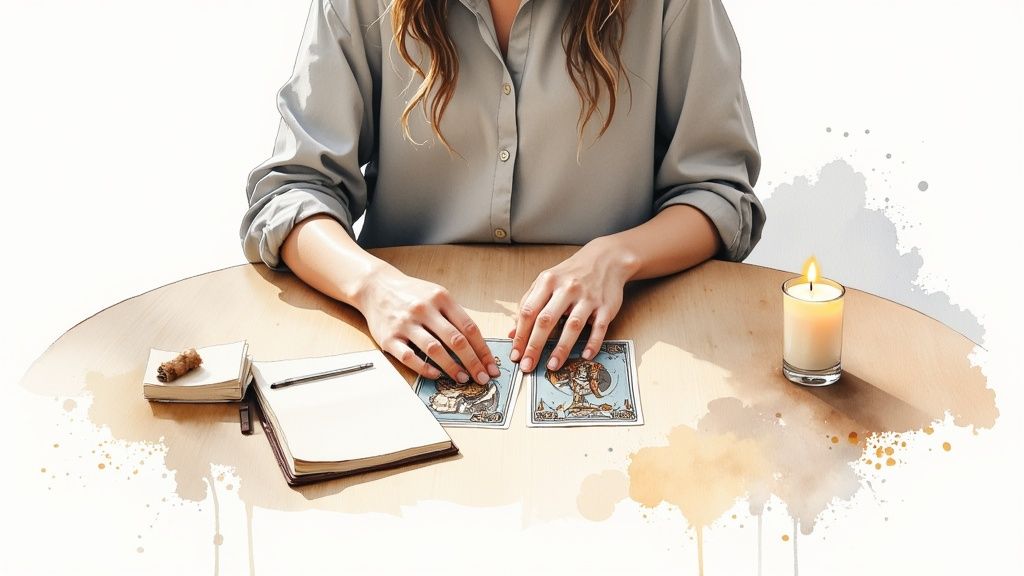
Learning to read tarot for yourself is an incredibly empowering practice. Think of it as a dedicated ritual for self-reflection—a way to check in with your intuition, feel out your current energy, and get a completely fresh perspective on whatever is on your mind. Forget the old, mystical stereotypes; for many people today, tarot is a practical, grounded tool for gaining personal insight.
This journey isn’t about frantically memorizing 78 card meanings overnight. It’s about slowly building a personal relationship with the archetypes and symbols in your deck. It’s a way to quiet all the external noise and finally hear the answers that are already inside you.
Why Self-Readings Are Gaining Popularity
More and more, people are turning inward for guidance, a trend clearly reflected in the expanding tarot market. This growth is driven by individuals who want to feel empowered in their own spiritual and reflective practices. As noted by industry analysts, the global tarot card market is seeing significant expansion, largely fueled by this DIY approach to spirituality. You can read more about the tarot market’s growth on Technavio’s website.
This personal approach comes with some real, tangible benefits:
- Privacy and Comfort: You can explore deeply personal questions without any fear of judgment, all from a space where you feel completely safe and at ease.
- Intuition Building: Reading for yourself regularly is like a workout for your intuition. It strengthens that inner voice, helping you trust your gut in all areas of your life.
- Cost-Effective: A deck of cards is a one-time purchase that offers endless opportunities for guidance. It’s an investment in yourself that keeps on giving.
A Roadmap for Your Journey
The process of a self-reading is a ritual, something that grounds you in the present moment. It follows a simple, repeatable flow that you can—and should—adapt to fit your own personal style. To keep things from feeling overwhelming, I find it helpful to break the process down into four core pillars.
This structure provides a reliable framework that moves you from a state of questioning to a place of new-found clarity. Before we dive into the nitty-gritty of each step, here’s a high-level look at the path we’ll be taking.
The Four Core Pillars of a Self-Tarot Reading
| Pillar | Objective | Key Action |
|---|---|---|
| Preparation | To ground your energy and focus your mind. | Creating a calm space and forming a clear, open-ended question. |
| The Draw | To connect with the cards and select your guidance. | Shuffling the deck while focusing on your question and drawing cards. |
| Interpretation | To decode the message within the cards. | Analyzing symbols, numbers, and archetypes to build a narrative. |
| Integration | To apply the insights to your life. | Journaling your reading and identifying actionable next steps. |
By understanding this simple roadmap, you’ll feel much more confident and prepared to begin your first reading, turning a deck of cards into a trusted confidant.
The real magic of a tarot reading isn’t in the cards themselves, but in the space they create for you to be truly honest with yourself. It’s a structured way to access your own subconscious wisdom.
Preparing Your Space and Your Mindset
A good tarot reading begins long before you pull the first card. The real magic happens when you intentionally create the right atmosphere—both in the room around you and inside your own head. Taking just a few minutes to set the scene can be the difference between a confusing jumble of cards and a genuinely insightful conversation with yourself.
Think of it like getting ready for a deep talk with a close friend. You wouldn’t do it in a loud, chaotic coffee shop. You’d find a quiet corner. The same idea applies here. A calm, dedicated space helps quiet the mental chatter, making it much easier to tune into your intuition and the subtle stories the cards want to tell.
This doesn’t have to be some elaborate, time-consuming ritual. It’s all about simple actions that tell your brain, “Okay, it’s time to focus inward.”
Creating Your Reading Nook
Your personal reading space can be anywhere you can snag 15 to 20 minutes of uninterrupted peace. It might be a corner of your bedroom, your comfiest armchair, or even a quiet bench in a park. What matters isn’t the location, but the intention you bring to it.
A few simple touches can make the space feel distinct from the everyday hustle:
- Light a Candle: The simple act of striking a match can be a powerful trigger, signaling the official start of your reading.
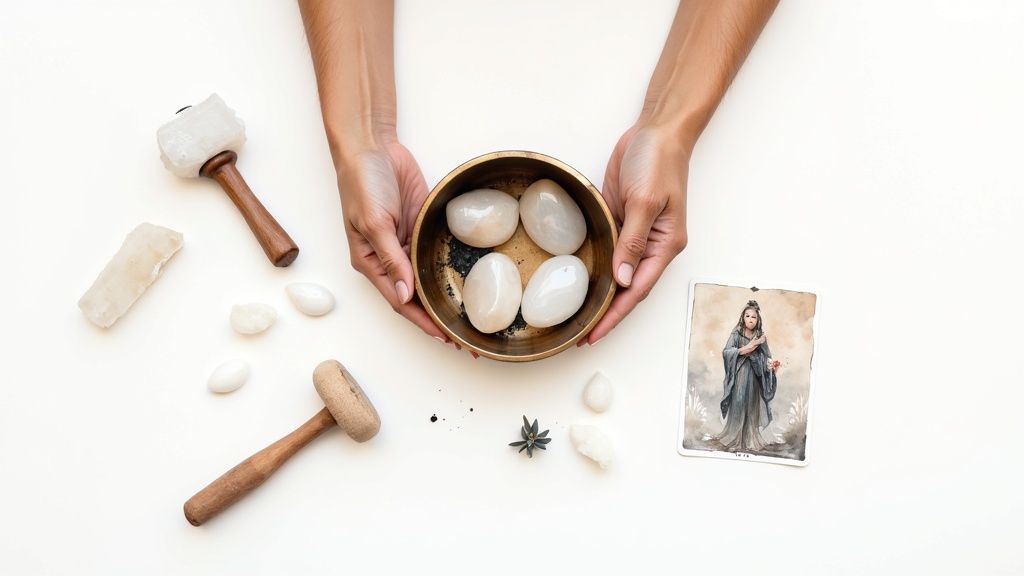
- Bring in Nature: A small plant, a favorite crystal, or even a cool rock you found can help you feel more grounded and connected.
- Kill the Distractions: This is a big one. Put your phone on silent and move it out of arm’s reach. If you live with others, let them know you need a little “do not disturb” time.
Once your physical space feels right, it’s time to think about your deck. Cards are like energetic sponges; they can pick up vibes from previous readings or just from sitting on a dusty shelf. A quick cleanse gives you a clean slate.
There are plenty of easy, smoke-free ways to do this. You can lay a piece of selenite or clear quartz on top of your deck for a bit. My personal favorite is to hold the deck in one hand and knock on it three times with the knuckles of the other, like knocking on a door. It’s a simple, physical way to “shake off” any stagnant energy.
Getting Your Mind Right
With your space and deck ready, the final—and most important—step is preparing yourself. Honestly, this is where the quality of your reading is truly decided. If your mind is racing with a million to-do lists and worries, you’ll never be able to hear the quiet voice of your intuition.
Start by taking three slow, deep breaths. A simple count works wonders: inhale for four, hold for four, exhale for six. This little exercise is fantastic for calming your nervous system and pulling your awareness into the here and now. Feel your feet on the floor. Notice the chair supporting you. This is grounding, and it’s absolutely essential.
A tarot reading is a mirror reflecting your inner state. If you approach it with a scattered mind, you’ll likely receive a scattered and confusing message. Taking time to center yourself first ensures the reflection is as clear as possible.
Now, you can turn your attention to the heart of the reading: your question. How you frame your query will completely change the kind of guidance you receive.
Crafting a Powerful Question
The best questions for tarot are open-ended. They’re about empowerment and exploration, not just demanding a yes or no. You’re asking for insight that you can act on, not for a crystal ball prediction of a future that’s set in stone.
Think about it this way: a closed question makes you a passive bystander, just waiting for things to happen to you. An open-ended question puts you back in the driver’s seat.
Let’s look at some real-world examples of this shift:
| Instead of This (Closed Question) | Try This (Open-Ended Question) |
|---|---|
| “Will I get the new job?” | “What energy should I embody to attract my ideal career opportunity?” |
| “Does my partner still love me?” | “How can I cultivate more connection and understanding in my relationship?” |
| “Will I move this year?” | “What perspective do I need on my current living situation?” |
See the difference? By framing your questions like this, you’re not trying to tell the future. You’re using the cards to better understand yourself and write a future you actually want. This mindset is the key to a truly powerful tarot practice.
Connecting With Your Deck: How to Shuffle and Draw Cards
Now that you’ve set the stage and have your question in mind, it’s time for the hands-on part. This is where you physically connect with your deck, infusing the cards with your energy and the specific intention of your reading. Don’t worry about finding one “right” way to do this—the best method is whatever ritual feels authentic and helps you get centered.
This physical interaction is what makes a self-reading so powerful. You’re not just flipping over paper; you’re engaging in a kind of active meditation. The act of shuffling and drawing helps quiet that loud, logical part of your brain, making space for your intuition to take the lead.
Finding Your Shuffling Style
Shuffling isn’t just about randomizing the cards. It’s the main way you channel your question and personal energy into the deck. While you’re shuffling, hold your question gently in your mind. Focus less on the exact words and more on the feeling you’re seeking clarity on.
There are a few go-to methods, and I really recommend playing around with them to see what clicks. You might even find you prefer one style for quick daily draws and another for deeper, more complex questions.
The Overhand Shuffle: This is the one most of us know from card games. You just hold the deck in one hand and slide small chunks of cards off the top with your other thumb, letting them drop back into your palm. It’s simple, effective, and gets the job done.
The Riffle Shuffle: Think casino dealer. You split the deck into two piles and bend the corners, letting them cascade together. It’s satisfying, for sure, but it can be a bit rough on your cards over the long haul. If you love the feel of it, just be gentle!
The “Washing Machine” Shuffle: My personal favorite for a big, energetic reset. Just spread all the cards face-down on a clear, clean surface. Using both hands, gently swirl them all around in big circles. It’s a fantastic way to break up stagnant energy and really immerse yourself in your intention.
The best shuffling method is simply the one that helps you feel focused and calm. Don’t stress about being clumsy or looking cool. Your intention is what matters here, not perfect technique.
How to Draw Your Cards
Once you get that little intuitive nudge that the cards are ready, it’s time to pull them. Just like with shuffling, this is a deeply personal moment. The trick is to trust your gut and let go.
Here are a few common ways people draw their cards:
Cutting the Deck: This is probably the most popular method. After shuffling, place the deck face-down. Using your non-dominant hand (some say it’s more tuned into your intuition), cut the deck into a few piles and then reassemble them in a new order. Then you just draw the cards you need from the top.
Fanning Them Out: Spread the whole deck out in a wide fan, face-down. I like to close my eyes for this part. Take a breath, and let your hand hover over the cards. Wait until you feel a pull toward certain cards. Maybe one feels warmer, or you just get a feeling—trust it and pick that one.
Welcoming the “Jumper” Cards: Every so often, a card will literally fly out of the deck while you’re shuffling. Pay attention to these! Many readers, myself included, see these jumper cards as urgent messages that absolutely need to be part of the conversation. You can either place them directly into your spread or set them aside as a kind of headline or theme for the entire reading.
Ultimately, the rituals of shuffling and drawing are how you build a real relationship with your cards. It’s what turns a simple deck into a trusted tool for self-discovery. By finding a process that feels like yours, you create a reliable and sacred pathway back to your own inner wisdom every time you sit down to read.
Beginner-Friendly Tarot Spreads You Can Use
Once you’ve gotten the hang of shuffling and drawing the cards, you need to give them a framework to speak through. This is what a tarot spread does—it’s a simple layout where each card’s position answers a different part of your question.
You don’t need to dive into a massive, ten-card Celtic Cross spread to get a powerful message. In my experience, the most profound insights often come from the simplest layouts.
When you’re just starting to read for yourself, sticking with one to four cards is the best way to go. It keeps the reading from getting muddy and prevents that all-too-common feeling of being overwhelmed by conflicting messages. The goal here is to build your confidence one clear, concise story at a time.
This stripped-down approach is actually becoming more common, especially with younger people who are making spiritual practices their own. A 2023 Springtide survey found that 51% of people aged 13-25 are exploring practices like tarot, often learning through social media where quick, accessible methods are king.
The One-Card Daily Draw
This is the quintessential beginner’s spread, but it’s a practice many seasoned readers stick with for years. Why? Because it’s fast, direct, and incredibly good at giving you a snapshot of the day’s energy or a single piece of advice to carry with you.
Think of it as the theme song for your day.
- How it works: Shuffle your deck while asking, “What energy should I focus on today?” or “What do I need to know?” Then, just pull one card.
- A real-world example: Let’s say you draw the Four of Pentacles. This card often talks about stability, security, and sometimes, a tendency to hold on too tight. The message for your day could be to check in with your budget, or it might be a gentle nudge to ask yourself where you’re being possessive—with your stuff, your ideas, or even your time.
The process of shuffling, cutting the deck, and drawing that single card is a little ritual in itself. It’s how you physically infuse your energy and question into the cards before you even lay eyes on one.
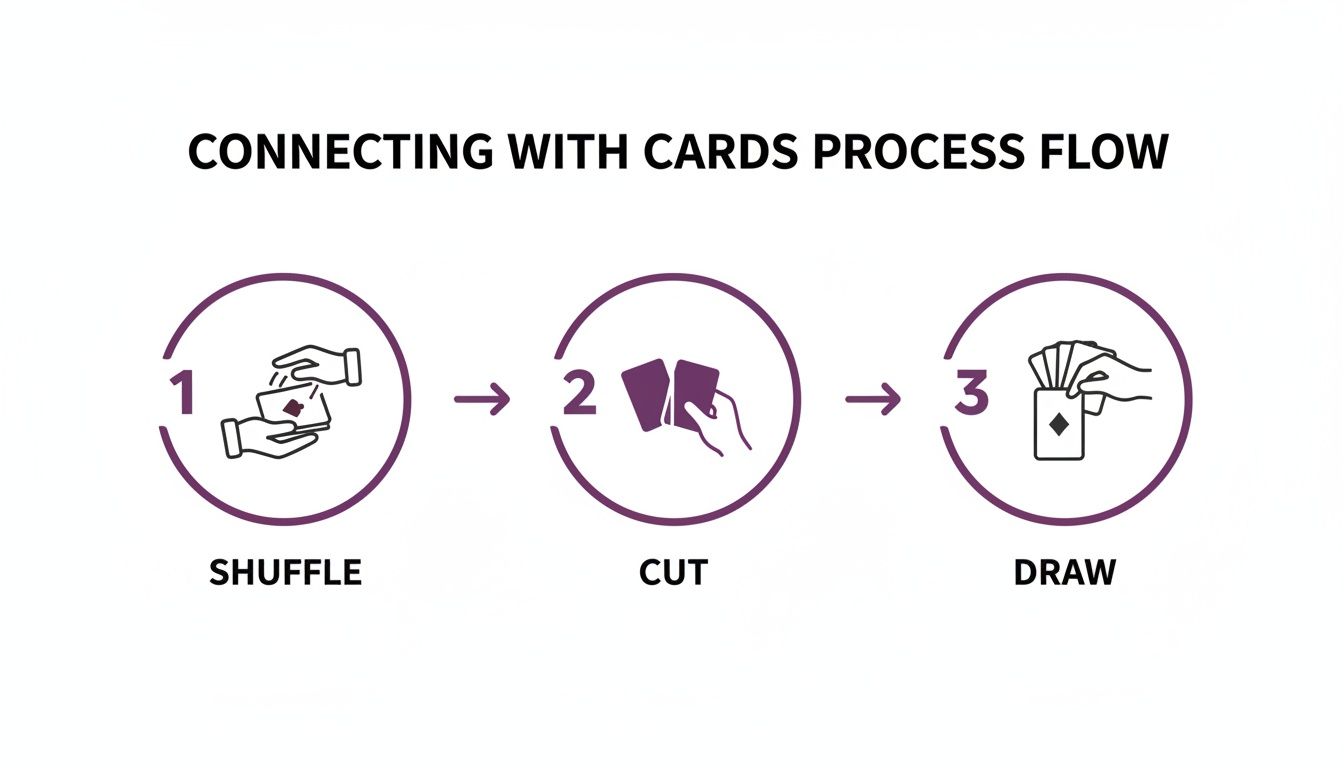
This simple flow is the heart of any reading, no matter how complex the spread gets.
A Simple Three-Card Spread: Past, Challenge, Advice
The three-card spread is the perfect next step. It’s where you start to see a story unfold—a clear beginning, middle, and end. It’s my go-to for almost any question, whether it’s about a confusing relationship or a career crossroads. This spread gives you context, zeroes in on the problem, and then offers a way forward.
Here’s a common and very effective way to use it:
- Card 1 (The Past): This represents the background energy or past events that got you here.
- Card 2 (The Challenge): This is the core issue or main obstacle you’re dealing with right now.
- Card 3 (The Advice): This card suggests a course of action or a shift in perspective that will help you move forward.
This spread is fantastic for building your narrative skills. You stop seeing three separate meanings and start weaving them together, noticing how the past flows into the present challenge and points toward a solution.
Let’s say you’re feeling creatively blocked. You do this spread and pull The Hermit (Past), the Five of Cups (Challenge), and The Star (Advice). This tells a story: a recent period of introspection and solitude (The Hermit) has led you to focus only on what you’ve lost or what isn’t working (Five of Cups). The clear advice is to reconnect with a sense of hope, inspiration, and universal connection (The Star).
The Problem-Solving Four-Card Spread
When you have a specific problem that needs unpacking, this four-card layout provides a wonderfully practical framework. It takes you beyond simple advice and helps you look at the hidden dynamics of the situation and the resources you already have.
This spread gives you a full 360-degree view of what’s going on.
- Card 1: The Situation. An objective look at the current state of affairs.
- Card 2: The Obstacle. What’s actively blocking you or making things so difficult?
- Card 3: Your Inner Strength. This reveals a quality, skill, or resource you already possess that is key to solving this.
- Card 4: The Outcome. This points to the likely result if you lean into that inner strength to face the obstacle.
By starting with these simple, structured spreads, you build a solid foundation. You’re learning the language of the cards and, more importantly, learning to trust the stories they tell. Before you know it, reading for yourself will become a reliable and insightful tool for navigating your life.
How to Interpret the Cards and Tell Your Story
So, you’ve set the mood, shuffled with intention, and laid out your cards. This is where the magic really begins—listening to what they’re trying to tell you. Forget about memorizing 78 rigid definitions. Reading tarot is more like learning to weave a story that speaks directly to your life right now.
It’s a dance between knowledge and intuition, structure and feeling. The cards are a visual language, and your first job is simply to look. Seriously, before you even think about grabbing a guidebook, just take a deep breath and absorb the imagery on the card. What jumps out at you? What story do you see? What feelings start to bubble up?
Trust Your Eyes First
Every tarot deck is a work of art, telling stories through its unique symbols, colors, and characters. All of it is designed to spark a connection with your subconscious. Think of the artwork as the first and most personal layer of meaning.
Let’s say you pull the Eight of Cups. You see a figure turning their back on eight perfectly stacked cups, walking off into a barren landscape under the moon. Without knowing a single keyword, you might feel a sense of loss, of leaving something stable behind to search for something more. It feels a bit lonely, doesn’t it?
Your initial, gut reaction to a card’s art is pure gold. It’s the most direct message you can get from your inner self. Always honor that first flash of insight before you start layering on the “official” meanings.
That first intuitive hit is your personal entry point. It’s how the card is choosing to communicate with you in this specific moment. Jot those first impressions down—they are the foundation of your reading.
Blending Intuition with Tarot’s Structure
Once you’ve honored your gut feeling, you can bring in the traditional structure of the tarot to add more depth and context. The deck is split into two main parts, and they work together beautifully to paint the full picture.
- The Major Arcana: These 22 cards are the big hitters. They represent major life lessons, archetypal energies, and the significant spiritual themes we all encounter on our journey. When a card like The Fool, The Tower, or The Empress shows up, it’s a sign to pay attention.
- The Minor Arcana: The other 56 cards are divided into four suits—Wands, Cups, Swords, and Pentacles. These cards reflect the day-to-day situations, emotions, thoughts, and practical matters of life. They add the rich detail and texture to the main story hinted at by the Major Arcana.
This very structure is what makes self-practice so powerful. The creation of the famous Rider-Waite-Smith deck back in 1909 was a huge turning point, as it was the first widely available deck to feature fully illustrated scenes on all the Minor Arcana cards. This made solo interpretation far more accessible than ever before, helping fuel a rise in personal home practice that continues to grow. You can discover more insights about tarot statistics and see just how popular it’s become.
Weaving the Narrative
The true art of reading tarot is pulling all these threads together—your intuition, the card’s imagery, and its traditional meaning—to craft a single, cohesive story. You aren’t just reading three separate cards; you’re reading a narrative told in three acts.
Start looking for connections between the cards. Are the figures looking toward or away from each other? Do any colors or symbols repeat? Does the story seem to flow from a mental challenge (Swords) toward an emotional breakthrough (Cups)?
Let’s go back to our creative block example from before, with The Hermit (Past), Five of Cups (Challenge), and The Star (Advice).
- Set the scene: “After a period of deliberate solitude and soul-searching (The Hermit)…”
- Introduce the conflict: “…you’ve found yourself stuck, focusing only on past disappointments and what you feel you’ve lost (Five of Cups).”
- Offer the resolution: “The path forward lies in reconnecting with hope, opening yourself to inspiration, and restoring your faith in your own light (The Star).”
See how that works? You become the storyteller, using the cards as prompts to explore your inner world and uncover the wisdom you already hold.
Quick-Reference Keywords for Key Major Arcana Cards
To help you get started on your journey, here’s a small cheat sheet with the core energies of a few powerful Major Arcana cards. Think of this as a jumping-off point, not a definitive dictionary. Always let your own intuition lead the way.
| Card | Upright Keywords | Reversed Keywords |
|---|---|---|
| The Fool | New beginnings, innocence, spontaneity, faith | Recklessness, fear, holding back, risk-aversion |
| The Magician | Manifestation, willpower, resourcefulness, skill | Manipulation, poor planning, untapped talents |
| The High Priestess | Intuition, subconscious, secrets, divine feminine | Secrets revealed, confusion, repressed feelings |
| The Empress | Nurturing, fertility, abundance, creativity | Creative block, dependence, smothering |
| Strength | Courage, compassion, focus, inner power | Self-doubt, weakness, insecurity, lack of control |
| The Hanged Man | Suspension, new perspective, surrender, letting go | Stalling, resistance, martyrdom, indecision |
Remember, these keywords are just signposts. The real story comes from how you connect them to the images, the question you asked, and the feelings they bring up for you.
Untangling Common Knots: Your Tarot Questions Answered
As you start reading tarot for yourself, questions are going to pop up. That’s not just normal; it’s a great sign. It means you’re really thinking about what you’re doing and engaging with the cards on a deeper level. Doubts don’t mean you’re failing—they mean you’re learning.
Think of this section as a conversation about those little uncertainties that can trip up new readers. We’ll walk through some of the most common hurdles to help you build real, lasting confidence in your practice.
“What If I Feel Nothing? My Deck and I Just Aren’t Clicking.”
This is easily the biggest worry for newcomers, so let me put your mind at ease: you’re not alone. A strong connection with your deck is like any good friendship—it rarely happens overnight. It’s built through time, attention, and shared experience.
If your cards feel like a pack of strangers, try spending some quality, low-pressure time with them. You don’t always have to be doing a “reading.” Shuffle them while you’re watching a show. Pull one card in the morning just to look at the art, with no pressure to interpret it. The goal here is simple familiarity.
And when a reading just feels like a jumble of nonsense? The best thing you can do is walk away. Seriously. Give yourself some breathing room and come back to the spread later with fresh eyes. You’d be surprised how often a message that felt impenetrable suddenly clicks into place when you stop trying to force it.
A self-reading isn’t about getting a perfect, crystal-clear answer every single time. It’s about opening a dialogue with yourself. Even a “confusing” reading is a powerful mirror, showing you where you might be feeling stuck or uncertain in your life.
“Can I Ask the Same Question Again and Again?”
It’s tempting, I know. But as a general rule, it’s best to avoid asking the exact same question over and over, especially in a short period. This usually comes from a place of anxiety—we’re not really seeking guidance, we’re fishing for the answer we want. This just muddies the water and makes everything more confusing.
Instead of hammering away at the same door, try finding a different one. Reframing your question shows you’re ready to look at the situation from a new angle.
- Instead of: “Will I get the promotion?”
- Try asking: “What skills should I focus on to advance my career right now?”
- Or explore: “What is the biggest obstacle to my professional growth that I’m not seeing?”
This shifts you out of a passive waiting game and into an empowered, proactive mindset.
“Do I Have to Read Reversed Cards?”
Nope. Absolutely not. This is a huge point of stress for beginners, but plenty of seasoned, brilliant readers use only upright cards. There’s no tarot police, and there’s no “rule” that says you must use reversals to get a deep, insightful reading.
If you are curious about reversals, you don’t have to jump into complicated interpretations. Think of them less as “opposites” and more as nudges to look inward. For beginners, a reversed card can simply point to:
- Blocked energy around the card’s theme.
- An area that needs your personal attention and quiet reflection.
- A message that is more for you, internally, than for external action.
Ultimately, this is your practice. You get to decide what works for you and what makes the messages from your intuition come through most clearly.
“How Often Should I Be Reading for Myself?”
The right cadence is whatever feels supportive, not obsessive. There is no one-size-fits-all schedule, and what you need will likely change from week to week or month to month.
Some people love the ritual of a daily one-card draw for a moment of morning focus. Others prefer a more in-depth weekly or monthly reading to check in on the bigger picture.
Here’s a good rule of thumb: reach for your cards when you have a genuine question or feel a real pull toward introspection. If you find yourself grabbing the deck every five minutes out of anxiety or for every tiny decision, that’s a signal. It might be a good time to take a little break and just trust yourself.