
So, how does a deck of 78 illustrated cards actually work?
At its heart, tarot is a tool for accessing your own deep-seated intuition. It’s not about a crystal ball showing you a fixed, unavoidable future. It’s about getting a clearer, more insightful look at where you are right now. Think of the cards as a psychological mirror. They reflect your inner world—your hidden thoughts, unconscious patterns, and the potential paths that lie before you—so you can move forward with more awareness.
How Tarot Actually Works Beyond Fortune Telling
When people ask how tarot works, they’re usually looking for a bit of magic. The truth is, it’s less about supernatural forces and more about the power of meaning-making. Many beginners assume the cards themselves hold some kind of spooky power or offer a direct line to destiny. The reality is far more personal, and frankly, much more empowering.
Tarot is a language spoken in symbols, archetypes, and universal human experiences, all captured across 78 unique cards. A deck is like a visual encyclopedia of life itself. Each card—from The Fool to the Ten of Pentacles—represents a situation, emotion, person, or energy that we all encounter on our journey. When you shuffle with a question in mind, you’re not calling on some outside entity. You’re simply creating a space for your own inner wisdom to step forward. The random draw gives you a fresh framework to see your situation from a completely new angle.
The Role of Your Subconscious Mind
One of the most compelling explanations for tarot’s effectiveness lies in its connection to the subconscious mind. Your brain is constantly processing a staggering amount of information that never reaches your conscious awareness. Tarot, with its rich and evocative imagery, acts as a key to unlock that vast inner library.
Let’s say you’re agonizing over a career choice. You pull a card—maybe the Eight of Cups—which shows a figure walking away from a stable setup toward an unknown horizon. That image might just click something into place. It could trigger a gut feeling you’ve had for weeks but couldn’t quite put into words: you’re ready for something new, even if it feels risky. The card didn’t tell you what to do; it just held up the perfect symbol to bring your own buried feelings to the surface.
Tarot doesn’t predict your future; it illuminates your present. The cards are a tool for starting a conversation with yourself, helping you access insights you already have but haven’t consciously recognized.
Different Frameworks for Understanding
Ultimately, there isn’t one single, universally agreed-upon answer for how tarot works. Your experience with the cards will be deeply personal, and how you connect with them can change over time. The real beauty of tarot is that it meets you where you are, whether you see it as a spiritual practice, a psychological tool, or a creative exercise in storytelling.
This table contrasts the two primary schools of thought on tarot’s mechanics, helping you see it’s not a one-size-fits-all explanation.
Two Core Perspectives on How Tarot Works
| Perspective | Core Principle | How Cards Get Their Meaning |
|---|---|---|
| Psychological / Intuitive | The cards are a mirror to your own subconscious and intuition. | You project your own thoughts, feelings, and unconscious knowledge onto the card’s ambiguous imagery. |
| Spiritual / Synchronistic | The cards are part of a meaningful, interconnected universe. | A “meaningful coincidence” (synchronicity) ensures you pull the exact cards you need to see at that moment. |
Some readers lean heavily into one camp, while many others, myself included, find themselves somewhere in the middle. The “how” is often less important than the result: gaining clarity and insight.
Here are a few common ways people frame the mechanism behind a reading:
- Psychological Reflection: The cards work like a Rorschach inkblot test. You project your inner state onto the images, which in turn reveals your true hopes, fears, and underlying motivations.
- Intuitive Connection: Tarot provides a structured vocabulary for your gut feelings. The symbols give that quiet inner voice a language it can use to speak to your conscious mind.
- Synchronicity: This is the idea, popularized by psychologist Carl Jung, that the cards you draw are meaningfully connected to your current life situation. It’s not just random chance; it’s a “meaningful coincidence” that creates a bridge between your inner world and the external symbols you’ve just pulled.
The Pillars of a Powerful Tarot Reading
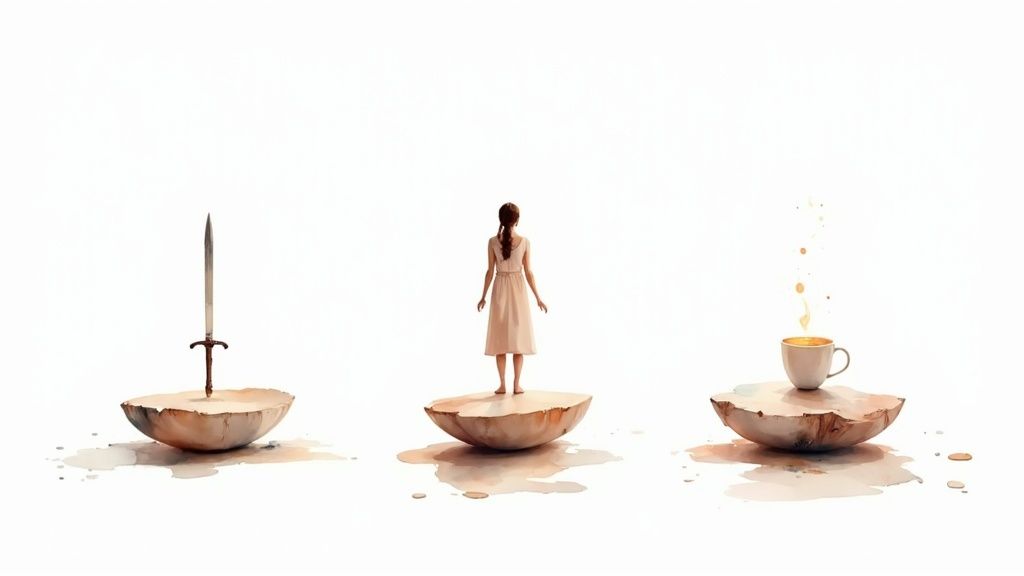
Ever wondered what gives a tarot reading that uncanny feeling of depth and relevance? It’s not some singular, mystical force. Instead, it’s the way three core pillars work together in harmony: Symbolism, Archetypes, and your own Intuition.
When you understand how these three elements intertwine, you start to see the cards for what they really are: a powerful tool for self-reflection. It’s a bit like interpreting a dream. The images aren’t literal, but they tell a story about what’s happening beneath the surface, tapping into a language that pure logic often misses.
These pillars are the engine of a meaningful reading, turning a simple shuffle and draw into a genuine “aha!” moment. Let’s look at each one to see how the magic really happens.
Symbolism: The Visual Language of the Cards
At its heart, tarot is a language spoken in pictures. Each of the 78 cards is a canvas of imagery, where every little detail—from the colors to the clothes to the objects in hand—carries its own specific meaning. This is the alphabet of tarot. Once you learn it, you can start to read the stories the cards are trying to tell.
The four suits of the Minor Arcana are a perfect example, each corresponding to a core area of life:
- Swords: Tied to the element of air, Swords are all about our thoughts, intellect, conflicts, and the way we communicate. Seeing a lot of Swords points straight to what’s on your mind.
- Cups: Representing water, Cups dive into our emotions, relationships, creativity, and inner world. A spread full of Cups is a clear sign to check in with your feelings.
- Wands: Connected to fire, Wands speak to our passion, energy, ambition, and drive. They show up when it’s time to take action or figure out what truly motivates you.
- Pentacles: Linked to the earth, Pentacles ground us in the material world—our finances, careers, health, and sense of stability.
This symbolic framework gives every reading a solid foundation. A Sword will always relate to the mind, and a Cup will always relate to the heart. This consistency prevents readings from being a random free-for-all and gives you a reliable place to start your interpretation.
Archetypes: Universal Characters and Timeless Lessons
If symbolism is the alphabet, then archetypes are the classic characters and familiar plotlines that make up the stories. An archetype is a universal pattern or personality type that we all instinctively recognize—the wise Mentor, the brave Hero, the chaotic Trickster. These figures show up in myths, fairy tales, and movies across every culture for a reason. They represent fundamental parts of the human experience.
The 22 cards of the Major Arcana are pure archetypes. Each one represents a major life lesson, a spiritual milestone on the journey of being human.
When you pull The Emperor, you’re not just looking at a king on a throne. You’re meeting the archetype of authority, structure, rules, and fatherly energy. The card immediately prompts you to ask: Where in my life do I need more discipline? Or where has control become too rigid and stifling?
These characters feel so potent because we all carry pieces of them inside us. We’ve all been The Fool, leaping into a new adventure with blind faith. We’ve all lived through a Tower moment, when our world was turned upside down. The cards give these universal feelings a face and a name, helping us see them more clearly in our own lives.
Intuition: The Personal Interpreter
Symbolism and archetypes provide the universal meaning, but intuition is the spark that makes a reading personal. It’s the bridge connecting the card’s traditional meaning to your unique situation, right here, right now. Your intuition is the interpreter that weaves everything together into a story that actually makes sense for you.
This is easily the most subjective part of reading tarot, and often the most powerful. It’s that gut feeling you get looking at a card, the unexpected memory an image brings to mind, or the way two cards that seem to have nothing in common suddenly click into place to deliver a crystal-clear message.
Take the Ten of Swords. Traditionally, it’s a rough card, signaling a painful ending, betrayal, or hitting rock bottom. But your intuition might whisper a different story. For you, maybe that image of a figure with ten swords in their back doesn’t feel like defeat. Maybe it feels like a dramatic, final surrender—the relief of finally letting go of a struggle you’ve been fighting for way too long.
This personal, intuitive layer is what transforms tarot from a simple divination tool into a profound dialogue with yourself. The cards don’t give you a single, fixed answer; they lay out a symbolic landscape and invite your own inner wisdom to come out and explore.
The Psychology Behind Why Tarot Feels So Real
So, we’ve talked about symbols and intuition, but there’s a big question that hangs in the air for a lot of people: How can a random shuffle of cards feel so spot-on? So deeply, uncannily personal?
The answer, it turns out, has less to do with magic and more to do with the incredible way our own minds work. There are some well-grounded psychological principles that explain why tarot is such a powerful tool for self-discovery, whether you consider yourself a spiritual person or a hardened skeptic.
That strange feeling of relevance you get from a reading actually has a name: synchronicity. The famous psychiatrist Carl Jung coined the term to describe events that aren’t linked by cause and effect but still feel profoundly connected. When you pull the exact card that speaks to the very heart of what you’re going through, Jung would call that a “meaningful coincidence.”
This is really the cornerstone of the psychological view of tarot. It’s the idea that there’s a meaningful link between your inner world—your questions, your worries, your hopes—and the outer event of the cards you draw.
Projecting Your Inner World onto the Cards
Another huge piece of the puzzle is a psychological mechanism called projection. We all do it. Projection is when we unconsciously take our own feelings, fears, or hopes and see them in someone or something else. The rich, ambiguous imagery of the tarot deck makes it a perfect screen for this to happen.
Think of the cards as something like a Rorschach inkblot test. When you look at The Hermit, cloaked and holding his lantern, you’re not just seeing an old man on a hill. You’re projecting your own relationship with solitude, wisdom, or the search for answers onto that image.
If you’re feeling isolated, you might see his loneliness. If you’re craving a quiet weekend, you might see his peace. The card is the same, but what you bring to it—your own inner landscape—colors its meaning completely. This is how tarot facilitates a conversation with the parts of yourself that don’t always get to speak.
By projecting your subconscious onto the cards, you’re essentially giving a voice to hidden feelings. The deck becomes a mirror, reflecting the truths you already carry inside but haven’t been able to put into words.
This is precisely why a reading can feel so incredibly personal and tailored to you. The insights aren’t coming from some mysterious external force; they’re being coaxed out from your own mind, sparked by the universal archetypes in the cards.
A Tool for Therapeutic Self-Discovery
When you look at it this way, tarot shifts from being a fortune-telling device to a powerful tool for mental and emotional wellness. It gives you a safe, structured framework to explore complicated situations and feelings without judgment.
Here are just a few ways it can work therapeutically:
- Externalizing Problems: Laying out your challenges in a spread makes abstract worries feel tangible. Seeing your inner conflict physically represented by the Two of Swords helps you look at it from a distance.
- Encouraging New Perspectives: Are you stuck in a rut? The cards are fantastic for shaking things up. Pulling a card like The Hanged Man is a direct invitation to flip your entire situation upside down and see it from a new angle.
- Validating Feelings: The cards cover the whole spectrum of human experience. Drawing the Three of Swords after a painful breakup can feel incredibly validating. It’s the universe—or at least, the deck—acknowledging that your pain is real and universal.
- Empowering Choice: At the end of the day, tarot doesn’t lock you into a certain fate. It shines a light on where you are now and shows you the potential roads ahead. The power to choose which path to take is always, always yours.
This grounded, psychological take on tarot makes it accessible to just about anyone. You don’t have to believe in anything mystical to get real value from the cards. All you really need is an open mind and the courage to explore the world within yourself.
From a Parlor Game to a Personal Guidebook
If you really want to get a feel for how tarot works, you have to look at where it came from. The story isn’t what most people think, and it’s a fascinating tale of evolution, adaptation, and reinvention. Frankly, understanding this history is one of the most empowering things a new reader can do.
It shows you that tarot isn’t some rigid, ancient system of secrets you have to decode perfectly. Instead, it’s a living language that has grown and shifted over centuries, shaped by culture, philosophy, and the people who used it. Once you realize that, the cards suddenly feel a lot less intimidating and much more like a tool you can actually hold and use.
The Surprising Origins of the Cards
Most of us picture tarot cards in the hands of a mysterious fortune-teller in a medieval tent, but their beginning was far more ordinary. The first tarot decks popped up in mid-15th century Italy, and they weren’t used for divination at all—they were for playing a popular trick-taking game among the nobility.
These early decks, known as carte da trionfi (“cards of triumph”), were stunning, hand-painted works of art used purely for entertainment. You can dive deeper into tarot’s rich history as a European card game to see how it all started.
The deck’s structure, with its four suits and a separate group of trump cards (the Triumphs), was perfect for gameplay. Once the printing press came along, these decks spread across Europe and became a common household item. For hundreds of years, that’s all they were: a clever and engaging parlor game.
The idea of tarot as an ancient, secret key to the universe is a surprisingly modern invention. For the first 300 years of their existence, the cards were used almost exclusively for playing games, not for telling fortunes.
The Great Occult Revival
So when did things change? The big shift from game to divination tool didn’t happen until the late 18th century. This was a time when a lot of people were getting interested in esoteric knowledge, ancient Egypt, and mystical traditions. During this “occult revival,” thinkers and mystics started looking at tarot in a new light, seeing its rich symbolism as a potential map to deeper wisdom.
A French cartomancer named Jean-Baptiste Alliette, who wrote under the pseudonym Etteilla, was a major player in this transformation. He was one of the very first to systematically assign divinatory meanings to each card and, around the 1770s, he created the first known deck designed specifically for fortune-telling. Etteilla and others like him connected the cards to everything from Egyptian mythology to astrology and the Kabbalah, layering them with the complex symbolic meanings we recognize today.
This was the birth of modern tarot. The cards were fundamentally reinterpreted, and their purpose was changed forever.
From Fortune-Telling to Self-Reflection
But the evolution didn’t stop there. The 20th century brought another huge shift, especially with the creation of the Rider-Waite-Smith deck in 1909. This deck was a game-changer for one key reason: it was the first to feature fully illustrated scenes on every single card, not just the Major Arcana.
This innovation made the cards incredibly accessible. Suddenly, you didn’t have to just memorize that the Four of Swords meant “rest.” You could see it in the image of a figure lying in peaceful repose. This simple but powerful change moved tarot away from rote memorization and towards a more psychological, reflective practice.
Today, that legacy is what most modern readers build upon. We see the cards less as a tool to predict an unchangeable future and more as a guidebook for navigating the present with more awareness, clarity, and intention.
Your First Reading: A Step-by-Step Guide
Alright, let’s move from theory to the real thing. This is where you actually start building a relationship with your tarot deck. I’ll walk you through your very first reading, breaking it down into simple, manageable steps. Don’t worry about getting it “perfect”—the goal here is to open up a conversation with your cards and see what they have to say.
Before you even lay a card down, the most important part is figuring out what you want to ask. The way you frame your question has a huge impact on the clarity of the answer you’ll get.
Step 1: Frame a Powerful Question
The best tarot questions are always open-ended. Think “how,” “what,” or “why.” These kinds of questions invite guidance and a deeper look at the situation, rather than a simple yes or no. A closed question like, “Will I get the job?” really just boxes you in and takes away your power to influence the outcome.
Instead, try reframing it to put yourself back in the driver’s seat. For instance:
- “What should I focus on to succeed in my job search?” This asks for actionable advice you can actually use.
- “How can I best present my skills in the upcoming interview?” This helps you figure out the best approach.
- “What inner resource can I draw upon for confidence right now?” This turns the focus inward to your own growth.
A well-phrased question is the bedrock of a good reading. It shifts your perspective from being a passive bystander waiting for the future to happen to you, to an active participant creating your own path.
Step 2: Shuffle with Intention
Shuffling isn’t just about mixing up the cards. It’s a moment to center yourself and pour your energy—and your question—into the deck. Honestly, there’s no single “right” way to do this. You can do a classic casino-style riffle shuffle, a simple overhand shuffle, or even just spread the cards out on a table and mix them around.
As you shuffle, keep your question in the front of your mind. Really focus on the feelings surrounding it and your genuine desire for clarity. Keep shuffling until it just feels right to stop. That little gut feeling is your first lesson in listening to your intuition, which is a key skill in understanding how tarot works.
Step 3: Lay Out a Simple Spread
For your first reading, you can’t go wrong with a simple three-card spread. It’s incredibly straightforward but can offer a surprising amount of insight. Once you’re done shuffling and feel the deck is ready, cut the cards into a pile, draw the top three, and lay them out in a row from left to right.
This is a classic spread that works for just about any question you can think of.
The Three-Card Spread: A Beginner’s Best Friend
- Card 1 (Left): The Past. This card gives you the backstory of the situation—the events or energies that got you here.
- Card 2 (Center): The Present. This card is a snapshot of right now. It points to the main challenge or opportunity you’re currently facing.
- Card 3 (Right): The Future/Potential Outcome. This card shows where things are likely headed if you stay on your current path. Think of it as advice for moving forward.
This structure gives you a clear narrative—a beginning, a middle, and an end—turning a few static images into a dynamic story.
This diagram illustrates how tarot has evolved from a simple card game into a powerful tool for personal insight.
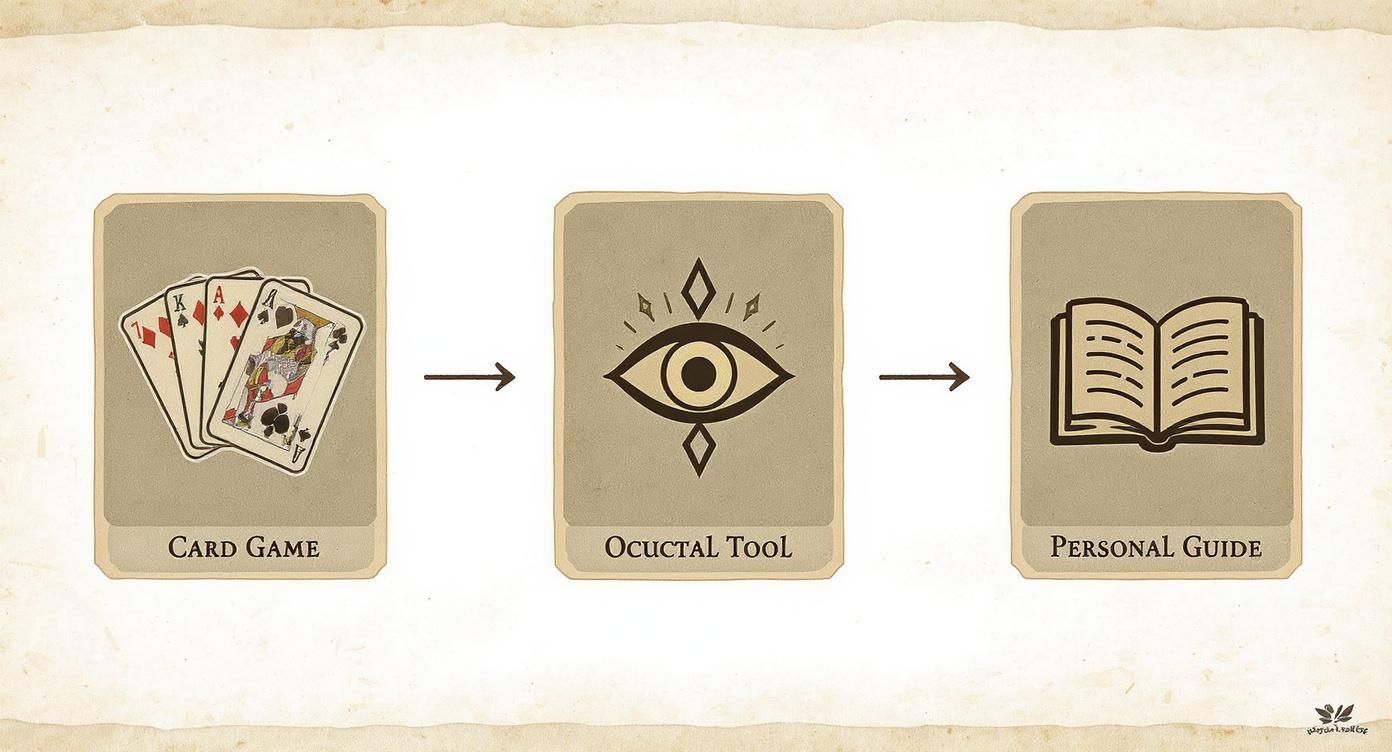
This journey reminds us that tarot’s meaning isn’t set in stone; it has adapted over time. Your personal interpretation is a valid and vital part of how it’s used today.
Step 4: Interpret the Story
Now for the fun part: figuring out what it all means. Before you grab your guidebook, just take a minute and really look at the cards in front of you. What’s the very first thing that jumps out at you? What feelings do the images bring up?
- Look at the pictures: What’s literally happening in each card? Who are the characters? What are they doing?
- Trust your gut: What’s your immediate, intuitive reaction? For example, does the person in the card look hopeful or totally defeated to you?
- Connect the dots: How do the three cards flow together as a story? Read them from left to right. Does the energy seem to be getting better or more difficult?
Only after you’ve taken a moment for your own impressions should you crack open a guidebook. Use the book’s definitions to add layers and new perspectives to what you already feel, not to overwrite your own intuition. The real magic happens when you weave together the traditional symbolism with your personal insights to create a narrative that resonates deeply with your situation. That synthesis is the heart of a truly powerful reading.
Got Questions? Let’s Talk Tarot
As you start working with tarot, you’re bound to have questions. Everyone does. Learning how the cards speak is a process, and it’s easy to feel a little overwhelmed at first. Let’s tackle some of the most common questions that come up for new readers, so you can feel more confident and connected to your deck.
The whole point here is to pull back the curtain on the practice. Tarot isn’t some unknowable mystery; it’s a tool for you to use. Let’s clear up the confusion and get you reading with clarity.
Can the Cards Be Wrong?
This is probably the number one question I hear. The short answer? No, the cards themselves are never “wrong.” But that’s because tarot isn’t a rigid system that spits out one single, unchangeable truth. A reading is more like a snapshot of the energy surrounding you right now—it shows you the potential paths, not a fixed destination.
If a reading feels “off” or doesn’t immediately click, it usually means one of a few things:
- You’re seeing a new angle: The cards might be showing you a perspective on the situation you hadn’t even considered.
- The timing isn’t right yet: Sometimes the message only makes perfect sense a few days or weeks down the line, after things have shifted a bit.
- Your interpretation needs a tweak: Maybe the standard guidebook meaning isn’t the one that applies here. Your intuition could be nudging you toward a less common interpretation that fits your situation perfectly.
So, instead of asking if the cards are wrong, try asking, “What is this reading trying to show me that I haven’t seen yet?” This simple shift moves you from a place of judgment to one of curiosity, and that’s where the real magic happens.
What If I Pull a Scary Card?
Seeing cards like The Tower, Death, or the Ten of Swords can definitely be jarring. But take a deep breath—they almost never point to a literal disaster. These cards are actually powerful archetypes of profound transformation and necessary endings. They aren’t signs of doom; they’re signs of growth.
The “scary” cards in the tarot deck are not predictors of inevitable doom. They are archetypes of major change, signaling that an old way of being is ending so that a new, more authentic chapter can begin.
When one of these cards appears, it’s an invitation to honestly look at what needs to be released from your life. The Death card, for example, rarely signifies a physical death. It’s far more likely to be talking about the end of a job, a relationship, or a self-limiting belief. It’s about clearing out the old to make room for something new. Understanding these cards as opportunities, not just challenges, is a huge part of learning how tarot really works.
Do I Have to Be Psychic to Read Tarot?
Absolutely not. While some tarot readers might also be psychic, it is by no means a prerequisite. Tarot is a system that works through symbols, archetypes, and intuition—and these are all things anyone can develop with practice.
Think of it like learning a language. At first, you’re constantly looking up words in a dictionary (the guidebook). With a little practice, you start to understand grammar and sentence structure (card combinations and spreads). Before you know it, you’re speaking fluently, forming your own sentences from the heart (reading intuitively).
Anyone with an open mind and a willingness to practice can become a skilled reader. The practice is more accessible than ever, too. In the United States, about 10% of adults consult tarot cards annually. It’s especially popular with younger generations—nearly 25% of those aged 18-29 use tarot, compared to just 3% of people 65 and older. If you’re curious, you can explore more of these trends in spiritual practices from Pew Research.
Can I Read for Myself?
Of course! In fact, reading for yourself is one of the best ways to learn the cards and build a real connection with your deck. Self-readings are an incredible tool for daily reflection, working through problems, or just checking in with how you’re feeling.
The only catch is that it can be tough to stay objective when you’re reading about your own life. Our hopes, fears, and biases can easily color how we interpret the cards.
Here are a few tips to get the most out of your self-readings:
- Ask specific questions. “What should I know about my career?” is okay, but “What energy should I focus on to move forward in my career this month?” is much better.
- Get grounded first. Before you even touch the deck, take a few deep breaths to clear your mind and release any attachment to a specific outcome.
- Journal everything. Write down the date, your question, the cards you pulled, and your immediate thoughts. Looking back on these notes later can offer incredible new insights.
Reading for yourself is a fantastic way to build your intuitive muscles. It’s a journey of self-discovery, one card at a time.
Ready to move beyond questions and start building a confident, intuitive practice? At Tarot Studies, we provide clear guides and practical instruction to help you connect with your cards and unlock your inner wisdom. Discover how to read for yourself with clarity and purpose. Start your journey at tarotstudies.org.